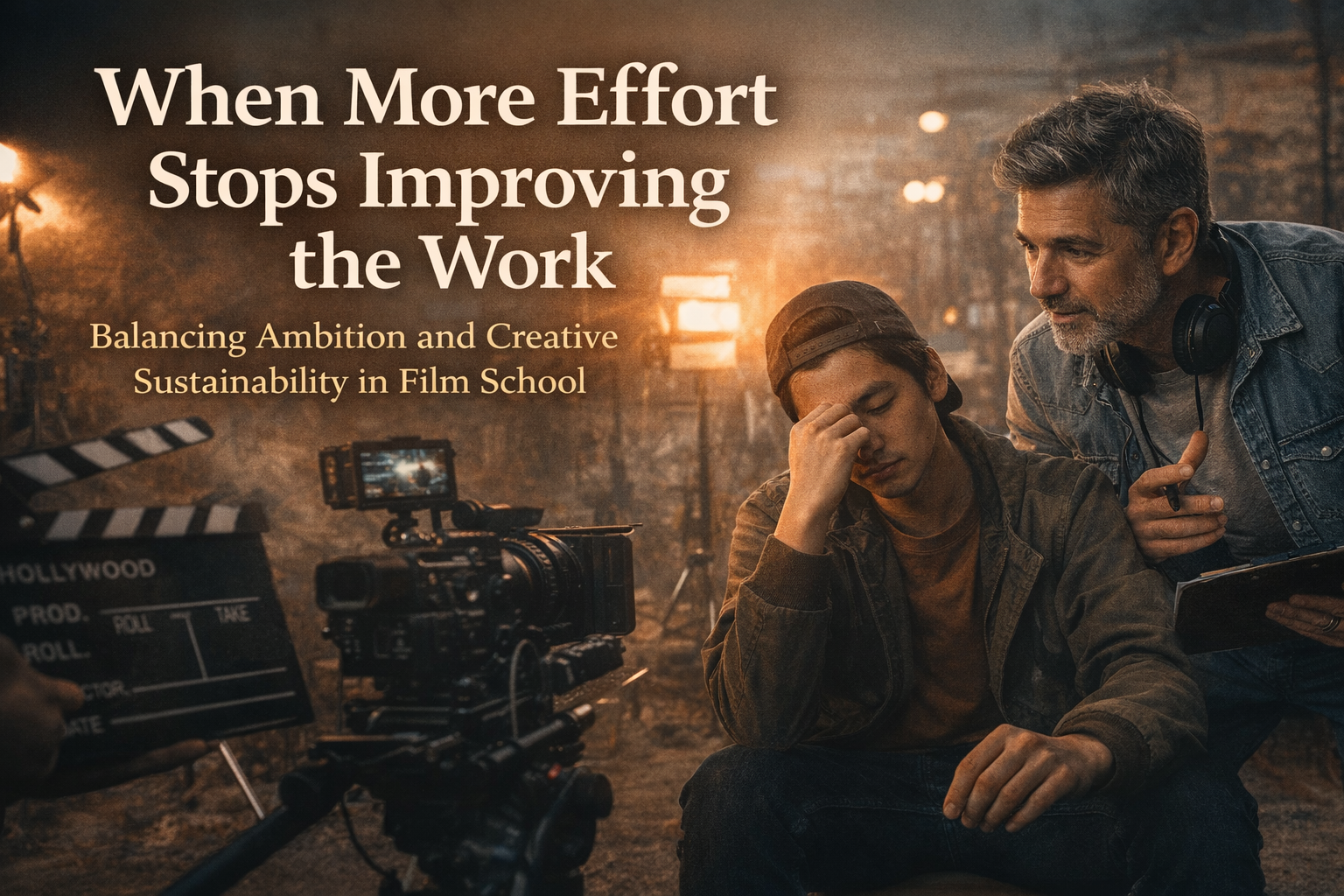
When More Effort Stops Improving the Work
Balancing ambition and creative sustainability for student filmmakers and film educators
One of the hardest lessons in creative education is learning that effort and quality are not always proportional.
Many student filmmakers enter film school believing that better work simply requires more time: more revisions, more hours, more sacrifice. And many film educators—often unintentionally—reinforce this belief by praising endurance, constant availability, and visible struggle as signs of commitment.
At some point, both students and teachers notice something unsettling: the work isn’t getting better. It’s getting heavier.
What Diminishing Returns Looks Like in Creative Work
There is a point—different for every person—where additional effort no longer improves the work. Not because the creator lacks talent or discipline, but because attention and perspective have limits.
When you push beyond those limits, the symptoms often look like “trying harder,” even though the results look like:
- Revisions that add complexity without adding clarity
- Edits that feel busier but not stronger
- Scenes that lose emotional truth as they get “tightened”
- More time spent fixing minor issues than solving major ones
- Decision fatigue that turns choices into second-guessing
In other words: more effort can begin to produce less impact.
The Student Experience: When Pushing Becomes a Habit
For students, overworking usually starts as responsibility. You want to be prepared. You don’t want to let collaborators down. You want to meet expectations—especially the unspoken ones.
But when pushing past fatigue becomes routine, creative judgment suffers. Scenes get over-edited. Concepts lose coherence. Self-doubt replaces curiosity. The work becomes harder to see clearly because the creator is exhausted.
Many students don’t recognize this moment because film school environments often normalize intensity. Exhaustion can get mislabeled as dedication. Struggle can get mistaken for proof.
The Educator Experience: When Support Turns Into Absorption
Educators witness the pattern from the other side. Students show up drained, anxious, or stuck. Projects expand beyond their original scope. Requests for feedback multiply as confidence erodes.
In response, many teachers give more—more notes, more time, more reassurance. The intention is generous. But without clear stopping points, this can unintentionally reinforce the idea that unlimited effort is normal and expected.
The result becomes a feedback loop: exhaustion becomes invisible because it is everywhere.
Shared Ground: Naming the Moment Without Shame
Work–life balance improves when both students and educators can name diminishing returns without turning it into a character flaw.
For students, that might sound like:
“I’ve reached the point where more time isn’t helping. I need to step back so I can make better decisions.”
For educators, it might sound like:
“This project is asking for refinement, not expansion. Let’s define what ‘enough’ looks like.”
When limits are articulated, they stop feeling like personal failures and start functioning as creative tools.
Redefining Rigor Without Exhaustion
Rigor does not require suffering. It requires intention.
Clear goals, defined revision rounds, and realistic scope allow students to focus deeply without spiraling into endless adjustment. Educators who model this clarity help students internalize healthier creative standards.
The most sustainable work often comes from knowing when to stop—not because the work is perfect, but because it is complete.
Staying With the Work
Learning when effort stops serving the work is not about quitting early. It is about preserving the capacity to keep creating.
For students, this means finishing projects with enough energy to learn from them. For educators, it means supporting growth without absorbing exhaustion.
Balance lives in that shared understanding.
Discussion Guide: Work–Life Balance in Film School and Creative Programs
Discussion goals: Normalize conversations about creative fatigue, build empathy between students and educators, and identify practical stopping points that protect quality and well-being.
Discussion Questions
- How do you personally recognize when effort stops improving your work?
- Where do you think the pressure to “keep pushing” comes from in creative education?
- How can clarity reduce overwork without lowering standards?
- What signals could help teams identify diminishing returns earlier?
- How might this awareness change the way projects are planned and revised?
Course / Lesson Exercise: The “Enough” Framework
Objective: Help student filmmakers and film educators practice defining completion before burnout, using clear goals and bounded revision.
Instructions
- Choose a current or upcoming project (individual or group).
- Define one primary goal (what success actually means for this project).
- Define two acceptable outcomes (what “good enough” looks like if time or energy is limited).
- Set a maximum number of revision passes (example: two structure passes, one polish pass).
- Identify one stopping signal:
- a time limit (e.g., stop editing at 9:00 p.m.), or
- a quality limit (e.g., when the story is clear and the pacing holds).
- After completion, write a short reflection (150–250 words):
- Did clarity reduce stress?
- Did it improve decision-making?
- What would you change next time?
Outcome: Students learn to work intentionally. Educators reinforce sustainability as a creative value.