Reference: StudentFilmmakers Magazine, November 2007. James Mangold’s New Film 3:10 to Yuma – An Homage and Contemporary Classic: A look into the genre and filmography of some other Westerns to see. by Dana Dorrity. Pages 36 – 38.
James Mangold’s new film 3:10 to Yuma, based on an Elmore Leonard story and a 1957 western of the same name, is both an homage to many of the masterpieces of this genre and a contemporary classic in its own right. Leonard, who is usually associated with hip, urban dramas like Jackie Brown, Out of Sight, and Get Shorty, is getting much of the credit for the memorable, poetic dialogue and the well-drawn characters. The conflict and the rapport between the lawman and the prisoner are set up in his original short story. But in Leonard’s terse 14-pages, originally published in 1953 in Dime Western Magazine and currently available in the book, “The Complete Western Stories of Elmore Leonard,” the story begins in Contention, Arizona, where the two men, a deputy named Paul Scallen and an outlaw named Jim Kidd, wait in the Republic Hotel, room 207, to catch the 3:10 train to the Yuma prison, and ends two hours later with the face-off between the deputy and the killer’s gang of outlaws.
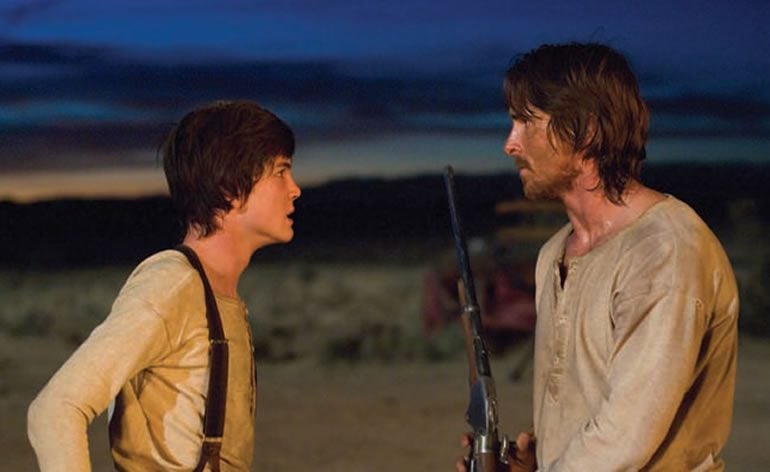
The new film has expanded significantly on both the Leonard story and the 1953 black and white film. The 1953 screenplay, by television writer Halstead Welles, opens when a poor rancher, Dan Evans (Van Heflin), out with his two sons trying to graze his cattle, accidentally stumbles upon Ben Wade (Glenn Ford) and his band of outlaws robbing the Butterfield Stagecoach. The newest version of the film starring Christian Bale as Evans and Russell Crowe as Wade, takes the story back another step to the night. The opening shot pays tribute to Leonard’s early western stories. In the scene, Dan’s son, Will Evans (Logan Lerman), is laying in bed reading Dime Western Magazine, when he hears men approaching outside. Although his father is ready and waiting with a rifle, when the men who work for the local moneylender set the barn on fire, Evans, a law-abiding citizen, refuses to fight back. This sets up a powerful secondary conflict between the father and son in the 2007 screenplay written by Michael Brandt and Derek Haas.
Westerns are about cowboys, Indians, loose women and gunfighters; and the great, classic Western films have all of these characters, but at the core, the Western genre is about the taming of the Wild West which is usually personified by a single criminal who refuses to live within the bounds of the law. The Western, as a genre in film or literature, is set in the decades after the American Civil War, when Union and Confederate Veterans were going west to seek cheap farmland and new opportunities. Until this moment, the Western towns were places that were barely governed.
Ranchers laid claim to whatever land they could see to graze and water their cattle. And stagecoach robbers would lay claim to any gold that came through their territory. As the railroad laid tracks across the country and little towns sprang up on either side, East Coast families moved out to run stores and start farms, and their property needed to be defined and protected. This is the saga of the Western. Surprisingly, it’s not the gunfighters and outlaws that are lauded in these stories. In many of the best Westerns, the hero is the lawman who brings the gunslinger down.
Probably the best example of this precise storyline is The Man Who Shot Liberty Valance. Lee Marvin plays the title character, a recalcitrant bully, as though he was some kind of unstoppable id.
James Stewart is Ransom Stoddard, an tenderfoot, law school graduate who represents the impotent arm of the law. What makes this story is a third character, Tom Doniphon, played by John Wayne. Tom is a man of the west, illiterate and ill-suited to polite society, and he ends up losing his girl, Hallie, played by Vera Miles, to Stoddard. But unlike Liberty Valance, Doniphon sees the power of the law and aids Stoddard in his gunfight with Valance. Ironically, it is this gunfight that establishes Ranse Stoddard’s reputation as a tough lawman and eventually leads to his rise in politics to become senator of the state. It’s a great film about how the mythology of the west created its own heroes. In 3:10, Dan Evans, who has lost his foot, fighting for the North in the Civil War, represents the struggling ranchers and farmers trying to make a life in the West. Ben Wade, the outlaw, represents the old ways. What makes this movie great is the relationship, respect and friendship between these two characters.
Another great western that 3:10 mirrors is the 1952 Academy Award Winner, High Noon. The screenplay, adapted by Carl Foreman, was based on a magazine story called “The Tin Star” by John W. Cunningham. The conflict arises in this film when Marshal Will Kane (Gary Cooper) gets word on his wedding day that Frank Miller, a killer that he sent to prison, is going to be arriving back in town on the noon train. To make matters worse, Kane’s new wife, played by Grace Kelly, is a quaker and a pacifist, so Kane has hung up his star and gun to become a storekeeper. Before he can leave town for good, he must face Frank Miller and his gang for a shoot-out on the streets of the town that he defended as Marshal, and like Dan Evans, the hero of 3:10 to Yuma, no one in town is willing to back him up.
The main plot device used in all the great westerns is “The Law of the West.” This is the rule that dictates that you can only shoot a man after he has drawn his gun to shoot you. There were no pre-emptive strikes in the West. If a man draws and the Marshal can outshoot him, it’s self-defense, if the Marshal shoots, even if he’s killing a known, wanted outlaw, it’s considered cold-blooded murder. This is the foundation of all the great gunfight scenes in Western film, the greatest of all is probably the three-way stand-off in the final act of Sergio Leone’s The Good, the Bad, and the Ugly, and it’s still the foundation of American homicide and self-defense laws. It’s also worth noting that Marco Beltrami’s subtly beautiful 3:10 soundtrack is evocative of Ennio Morricone’s brilliant compositions in The Good, the Bad and the Ugly.
Christian Bale came to 3:10, after spending months in the jungles of Thailand with Werner Herzog shooting Rescue Dawn, so he’s gaunt and believable as a desperate rancher. Russell Crowe who has had some run-ins with the press and even the police embodies the swaggering outlaw. But along with these two powerful main characters, there is a tremendous cast of brilliant actors in supporting roles. Peter Fonda plays Byron McElroy, a Pinkerton agent sent by Butterfield to guard the Stagecoach. McElroy initially leads the posse that leaves Bisbee to escort Ben Wade to the prison train, and Fonda plays the part with a cold cruelty. Alan Tudyk plays the tippling veterinarian who needs to accompany McElroy on the trip to Contention because he’s the only physician that can attend to his bullet wound. Tudyk has some great lines in the film, and he plays this character with such heart that the character of Doc Potter is one of the great additions to the 2007 script. Logan Lerman as Will Evans displays such contempt for his lame father in the beginning of the film, and he’s clearly both attracted and repulsed by the brazenness of Ben Wade.
Gretchen Mol, who plays Alice, Dan’s loyal wife, bares a striking resemblance to Leora Dana who played Alice in the 1957 movie, but she brings much more compassion to the part. And Ben Foster is Charlie Prince, Wade’s determined, deadeye, second-in-command.
Great character actors are part of what makes Westerns fun. In Stagecoach, John Ford’s 1939 film that introduced John Wayne to the screen, Andy Devine played the drunken Stagecoach driver.
Devine, who had a cracking whiskey soaked voice was one of the actors who defined the cowardly town drunk of the west. Also on that stagecoach were Donald Meek as a whiskey salesman with a case of samples and Thomas Mitchell as the town doctor who keeps sampling his wares. In The Man Who Shot Liberty Valance, Andy Devine played the cowardly Marshal of Shinbone who allowed Liberty Valance to run the town. Woody Strode played Pompey, Tom Doniphon’s African-American sidekick and shotgun man.
Many of outlaws of the west were lovable characters, Butch Cassidy and the Sundance Kid, Frank and Jesse James, to name only a few. Crowe’s Ben Wade, who sketches in his free time and quotes from the Bible to make points with his gunmen, is perhaps one of the most charming bad guys, but he’s definitely bad. When young Will Evans tries to appeal to his compassion, saying “You’re not all bad.” He responds, “Yes, I am.” Evil is seductive and Dan Evans’ son is sometimes seduced by the freedom that comes from the choice to live outside the law, but the Western is essentially a morality tale and even nice guys like Butch and Sundance can’t survive unless they hang up their guns.
Dana Dorrity is an assistant professor of Communications and Media Arts at Dutchess Community College. She has an MFA in screenwriting from the American Film Institute and teaches media writing, screenwriting and video production classes.