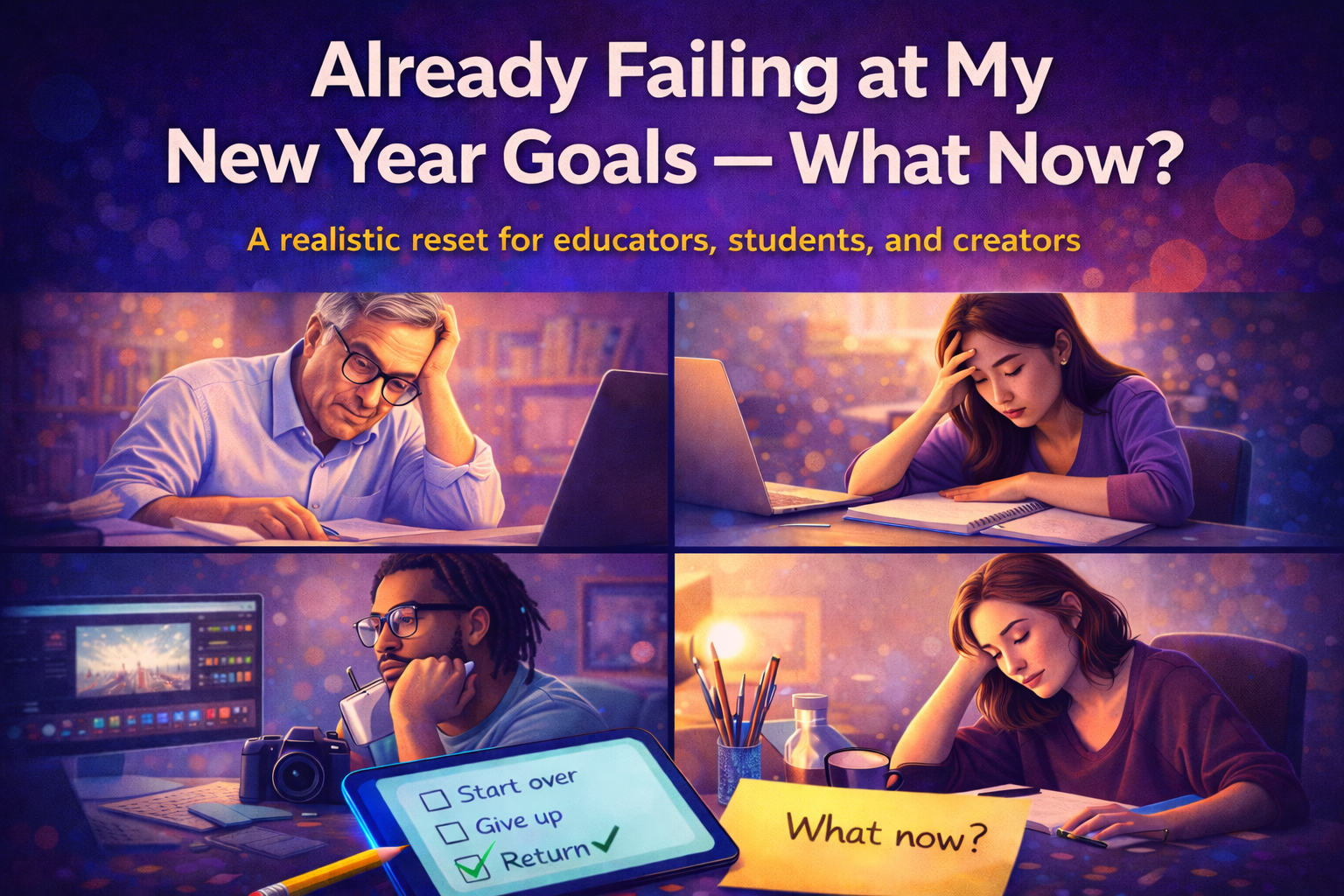
I’m Already Failing at My New Year Goals — Now What?
A realistic reset for educators, students, and creators who feel behind before the year has really started
It’s mid-January. Or maybe earlier. Or maybe you didn’t even make it past the first week.
The goals you wrote down with good intentions already feel distant. Schedules filled faster than expected. Energy didn’t arrive on cue. Motivation showed up briefly and then disappeared.
If you’re already thinking, “I’m failing my New Year goals,” you’re not alone—and you’re not broken.
This article isn’t about pushing harder, reframing everything as positive, or pretending discipline solves structural realities. It’s about what to do when goals collapse early—and how to turn that moment into something useful instead of discouraging.
Why Early Failure Feels So Personal
New Year goals fail loudly because of timing, not because of character.
January often arrives with:
- unfinished work from the previous year
- returning academic or professional responsibilities
- compressed schedules
- low energy after sustained effort
Yet goals are usually written as if none of that exists.
When the plan meets reality and reality wins, the conclusion often becomes: I didn’t want this badly enough.
More often, the truth is simpler: the goals were written for an imaginary version of your life.
Failure This Early Is Information, Not Evidence
If a goal collapses in the first few weeks, it’s not proof that you can’t follow through.
It’s information about:
- how your time actually behaves
- how your energy really fluctuates
- what pressures you underestimated
- what assumptions didn’t hold up
That information is far more valuable now than it would be in December.
The mistake is treating early failure as a verdict instead of feedback.
Step One: Stop Rewriting the Goal. Rewrite the Context.
When goals fail, people often try to “fix” the goal itself—make it smaller, more modest, or more reasonable.
Sometimes that helps. Often it doesn’t.
A better first move is to ask:
- What did I assume about my schedule?
- What did I assume about my energy?
- What did I assume about how quickly progress would show up?
Most goals fail not because the intention was wrong, but because the context was misread.
Correct the context first. Then revisit the goal.
Step Two: Replace “Starting Over” With “Returning”
The language of New Year goals is obsessed with restarting.
Restarting implies you’re back at zero. You’re not.
You didn’t lose what you learned last year. You didn’t unlearn skills. You didn’t erase progress just because momentum paused.
Instead of asking, How do I start over? ask:
How do I return?
Returning is gentler, more realistic, and far more sustainable.
Step Three: Shift From Outcome Goals to Operating Goals
Outcome goals focus on results:
- finish the project
- publish the work
- hit a milestone
Operating goals focus on how you move through the work:
- work in shorter, repeatable sessions
- touch projects more often, even briefly
- revise instead of abandoning
When outcomes stall, operating goals keep momentum alive.
Momentum, not motivation, is what carries you through uneven months.
Step Four: Identify the “Minimum Viable Version” of the Goal
Ask yourself:
If I could only do the smallest meaningful version of this goal, what would that look like?
Examples:
- not “write every day,” but “write twice a week”
- not “finish the film,” but “stay in contact with the edit”
- not “redesign the course,” but “adjust one assignment”
This is not lowering standards. It’s designing for reality.
Why This Matters in Educational and Creative Environments
Students learn how to fail by watching how adults respond to it.
Educators model what persistence actually looks like—not in speeches, but in behavior.
Creators internalize whether pauses mean collapse or recalibration.
When early failure is treated as part of the process instead of a moral problem, people stay engaged longer.
Optional Classroom or Personal Exercise: The Goal Salvage
Purpose: Turn early goal failure into usable insight.
Step 1: Name What Isn’t Working (5 minutes)
Write one sentence:
“This goal stopped working because…”
No judgment. Just description.
Step 2: Extract One Truth (5 minutes)
Write one sentence:
“What this taught me about how I actually work is…”
Step 3: Rewrite as a Return Goal (10 minutes)
Complete this sentence:
“For the next 30 days, I will return to this work by…”
Examples:
- checking in once a week
- revising instead of expanding
- working shorter sessions
Step 4: Time-Limit the Experiment
Set a short horizon: 30 days or one academic unit.
Goals that survive small windows tend to survive long ones.
What Success Actually Looks Like This Year
Success may not look like dramatic progress.
It may look like:
- returning after pauses
- adjusting without quitting
- learning how your energy actually behaves
- staying in motion through imperfect conditions
If by the end of the year you can say, “I didn’t disappear from my own goals,” then the year did its work.
A Final Thought
Failing early at a New Year goal doesn’t mean the year is lost.
It means the fantasy version of the year met the real one.
The work now is not to punish yourself—but to listen, recalibrate, and return.
Returning is how long-term creative lives are built.
Related Articles: