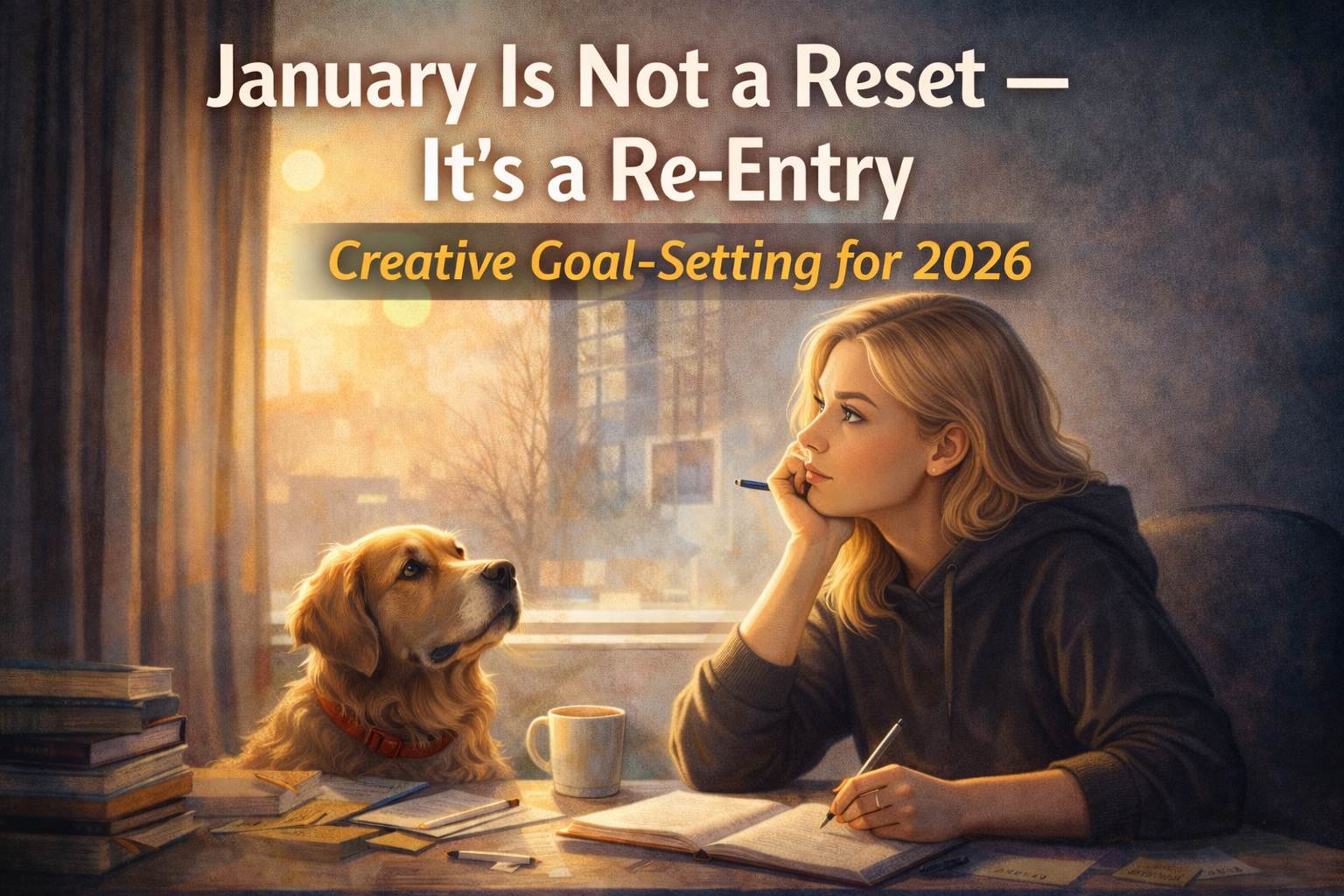
January Is Not a Reset — It’s a Re-Entry
Creative goal-setting for educators, students, and do-ers looking toward 2026
January arrives with expectations it didn’t ask for.
We’re told it’s a clean slate. A restart. A chance to erase last year’s unfinished work, stalled momentum, and quiet doubts. But for most people—especially those who teach, study, or create—January doesn’t feel like a reset at all. It feels like coming back mid-sentence.
Emails resume. Classes restart. Projects pick up where they paused, not where we wish they were. And that’s exactly why January is a powerful time to set goals—if we stop pretending nothing came before it.
January is not about reinvention. It’s about re-entry. And goals written from a place of re-entry tend to last longer than goals written from fantasy.
Why Most Goal Advice Doesn’t Fit Classrooms or Creative Lives
Much of the goal-setting advice circulating online assumes:
- You control your time
- Progress is neat and visible
- Motivation is stable
- Results appear quickly
Educators know this isn’t how learning works. Students know this isn’t how growth feels. Creators know this isn’t how ideas behave.
In real educational and creative environments:
- Energy fluctuates by term, not by week
- Learning often looks messy before it looks successful
- Creative output is cyclical
- External pressures interrupt even the best plans
When goals fail here, it’s rarely due to lack of effort. It’s usually because the goals were written for a different kind of life.
A more useful January question is not: “What do I want to accomplish?”
But:
“What kind of momentum do I want to be in by this time next year?”
Momentum survives interruptions. Motivation often doesn’t.
Step 1: Write Goals as Directions, Not Destinations
Destination goals sound familiar:
- Finish the project
- Publish the paper
- Master the skill
They’re not wrong—but they’re incomplete.
Direction goals sound different:
- Become someone who finishes, even imperfectly
- Build a body of work others can respond to
- Teach in a way that leaves students more confident than when they arrived
Destinations create pressure. Directions create orientation.
Over a long year, orientation matters more. When progress stalls, a direction goal still tells you which way to face.
Step 2: Separate Output Goals From Identity Goals
This distinction is essential—and rarely taught.
Output Goals
These are measurable:
- Complete 12 essays
- Design 3 new units
- Produce 24 short videos
- Submit to 5 opportunities
Output goals give structure. They make progress visible.
Identity Goals
These define how you operate:
- “I follow through.”
- “I revise instead of abandoning.”
- “I show unfinished work.”
- “I ask better questions.”
Identity goals determine what happens when output goals wobble—and they always do.
January is an ideal time to clarify identity goals, because they shape how the rest of the year unfolds.
A Classroom or At-Home Exercise: The Momentum Map
This exercise works:
- In classrooms
- In workshops
- Remotely
- Individually at home
- With students, educators, or creators
It emphasizes reflection, direction, and adaptability—not performance.
Step 1: Name the carry-over (10 minutes)
Ask participants to write:
- Three things they’re carrying from last year (skills, habits, frustrations, questions)
- One thing they’re not finished with yet
No fixing. No reframing. Just naming.
This anchors goal-setting in reality instead of wishful thinking.
Step 2: Define a direction (10–15 minutes)
Prompt: “By January 2026, I want to be someone who…”
Examples:
- “…finishes more than I perfect.”
- “…designs learning experiences that value process.”
- “…shares work before it feels ready.”
- “…stays in motion during slow periods.”
Encourage participants to choose one direction, not many.
Step 3: Pair identity with output (15 minutes)
Have participants write:
- One identity goal (how they want to operate)
- Two or three output goals that support that identity
Example:
Identity: “I revise instead of quitting.”
Outputs:
- Rework one assignment after feedback each term
- Revisit one unfinished project every 90 days
This teaches alignment—something students and educators both benefit from learning explicitly.
Step 4: Stress-test the goals (5 minutes)
Ask:
“If February is a bad month, does this goal still make sense?”
If not, rewrite. Strong goals survive imperfect conditions.
Step 5: Reflection anchor (ongoing)
Set a recurring reflection moment:
- End of term
- Every 90 days
- Once a month
Prompt: “What’s working, what’s resisting, and what needs adjustment?”
This turns goals into a living system rather than a forgotten list.
Example Goals as Adaptable Models
For Educators
- Design one assignment that rewards thinking, not just correctness
- Document what works while it’s working
- Build one teaching habit that survives the busiest weeks
- Leave intentional space for student process, not just outcomes
For Students
- Finish more things than I perfect
- Ask for feedback earlier
- Track progress monthly, not emotionally
- Become comfortable showing work in progress
For Creators and Do-ers
- Build a repeatable workflow instead of relying on inspiration
- Share work publicly before it feels complete
- Measure consistency, not attention
- Treat learning as part of output, not a delay
These are not prescriptions. They’re starting points.
Writing Goals That Last Beyond January
Effective goals don’t shame you. They don’t require constant motivation. They don’t collapse under stress.
They:
- Acknowledge reality
- Define direction
- Allow adjustment
- Encourage return, not perfection
If by January 2026 someone can say:
- “I stayed in motion.”
- “I returned even after pauses.”
- “I learned how I actually work.”
Then the goals did their job.
So instead of asking what you should achieve, ask:
“Who do I want to recognize myself as a year from now?”
Write goals that help you stay oriented toward that answer—through semesters, slow weeks, interruptions, and all the ordinary days in between.