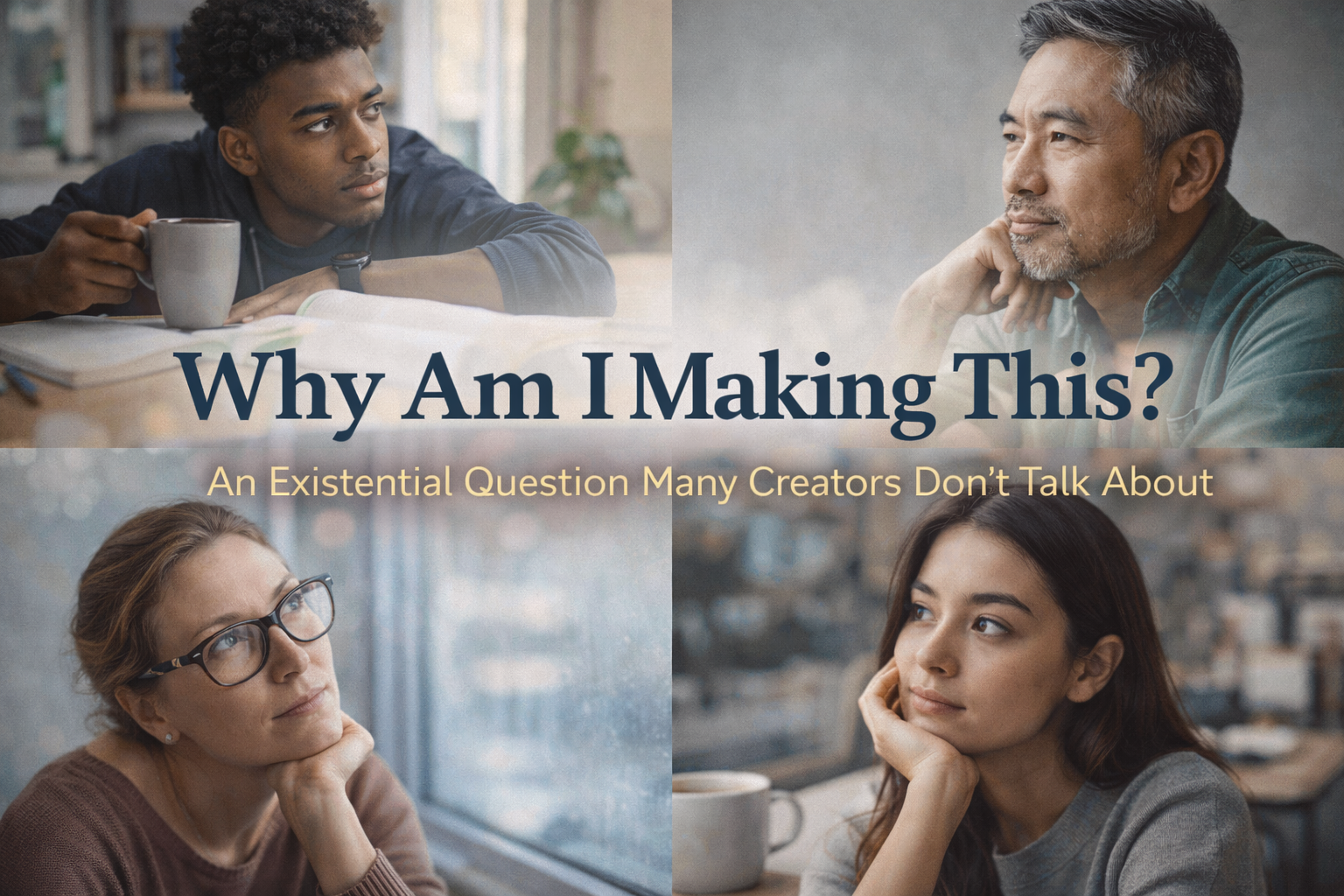
“Why Am I Doing This Again?”: An Existential Question Many Creators Don’t Talk About
On motivation, meaning, and continuing creative work without easy answers
At some point, many filmmakers and creators quietly ask themselves why they keep making work. It doesn’t usually arrive as a dramatic crisis. It shows up mid-project—when you’re capable, still working, and yet something feels less clear than it used to.
This article explores that question with honesty and care: not to force a neat answer, but to normalize creative doubt and offer a practical way to keep going without pressure, hype, or judgment.
Understanding this question, why am i making this, can lead to deeper insights into your creative journey.
Why This Question Appears in Creative Work
Creative paths often begin with momentum. Early on, enthusiasm does a lot of the work for you. You’re learning, discovering, responding to new challenges. Over time, skill replaces novelty, and momentum turns into routine.
That transition isn’t a problem—but it can create distance between what you’re doing and why you started. When that distance grows, the question surfaces.
It’s not necessarily asking whether you should quit. More often, it’s asking whether your current habits still reflect your evolving interests.
Momentum vs. Intention
Momentum is powerful. It keeps you moving even when you’re unsure. But momentum alone can carry you further than intention.
Many creators continue making work because:
- they know how to do it
- others expect it
- it once felt meaningful
- stopping feels riskier than continuing
None of these reasons are wrong. But none of them guarantee alignment.
Alignment is the quieter sense that your effort still feels coherent—internally—even if the outcome is uncertain.
Enjoyment Is Not the Same as Alignment
One reason this question feels confusing is that enjoyment often remains.
You can enjoy a process and still feel unsure about its place in your life. You can be good at something and still question whether it’s what you want to give your energy to right now.
Enjoyment answers: Do I like doing this?
Alignment answers: Does this feel like a meaningful use of my attention at this moment?
Creative culture often collapses these into one. Separating them allows for honest reflection without guilt.
Why the Question Keeps Coming Back
Most people don’t ask this question once. They ask it repeatedly, at different stages, for different reasons.
It tends to resurface when:
- external validation stops explaining your motivation
- your taste evolves faster than your habits
- success removes urgency but not uncertainty
- you become aware of alternatives you didn’t see before
This repetition doesn’t mean you failed to decide. It means creative identity isn’t fixed.
You Don’t Need a Final Answer—You Need a Relationship to the Question
Creative advice often suggests that once you “find your why,” everything becomes easier. In practice, purpose behaves less like a conclusion and more like an ongoing conversation.
Trying to lock in a final answer too early can create rigidity. You end up defending a version of yourself that no longer fits simply because you already named it.
A more sustainable approach is to let the question inform your attention rather than demand immediate resolution:
- What am I still curious about?
- What feels repetitive rather than deep?
- What questions do I keep circling?
- What work feels alive, even if it’s unclear?
These questions don’t require instant action. They guide choice.
Continuing Without Certainty Is a Creative Skill
One of the least discussed skills in creative education is learning how to continue working while unsure—without either forcing confidence or waiting for clarity to arrive.
This can look like:
- choosing lower-stakes projects for a season of exploration
- experimenting without announcing a new identity
- letting work be provisional instead of declarative
- resisting the urge to explain your choices to everyone
Uncertainty doesn’t always mean you’re lost. Often, it means you’re listening.
Discussion Section: For Students, Educators, and Creators
Purpose: Normalize existential questions in creative work and build a shared language for discussing motivation without shame.
Discussion Questions
- When have you found yourself asking, “Why am I making this?”
- What tends to trigger that question for you—fatigue, repetition, success, comparison, or something else?
- How do enjoyment and alignment differ in your own work?
- What makes it hard to talk openly about uncertainty in creative environments?
- How might acknowledging this question change the way you approach projects?
Coursework Companion: Reflection & Practice Exercise
Exercise Title: Working Without Immediate Answers
Objective: Help students and educators practice continuing creative work thoughtfully during periods of uncertainty.
Instructions
- Choose a current or recent creative project.
- Write a reflection (300–500 words) responding to:
- What originally motivated this project?
- What motivates you to continue now?
- Where do enjoyment and alignment overlap—or diverge?
- What question does this project raise that you haven’t fully answered?
- Identify one small adjustment you could make that reflects curiosity rather than certainty (scope, format, subject, process, collaboration).
- Optional group share: Share insights without offering solutions or advice—just listening for patterns.
Outcome: Participants learn that uncertainty can coexist with productive, meaningful creative work—and that doubt can be informative rather than disqualifying.
Optional Related Reading
A Final Thought
The question “Why am I making this?” is not a signal to stop. It’s an invitation to pay attention.
You don’t need to answer it perfectly. You only need to let it shape your choices with honesty.
Sometimes, continuing because you are still curious is enough.