By Erica McKenzie
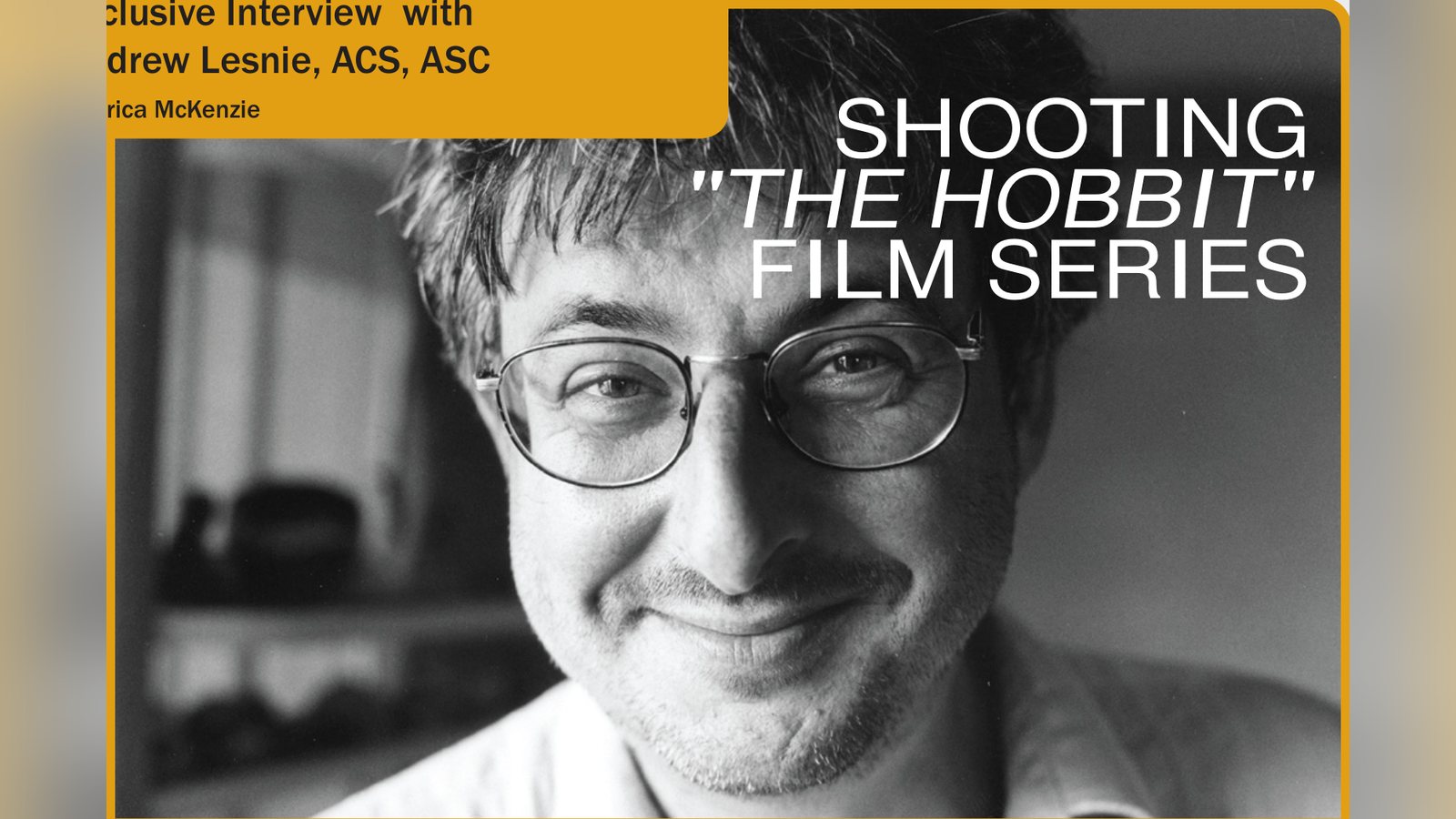
Cinematographer Andrew Lesnie, ACS, ASC talks about starting at AFTRS, news and documentary training, and shooting Peter Jackson’s Hobbit films.
How did you get started in cinematography? Did you go to film school?
Andrew Lesnie, ACS, ASC: I was a student at the AFTRS (Australian Film, Television & Radio School). I worked as a camera assistant and also shot student films, shorts and music videos. I moved into current affairs, news and documentaries, training that I still regard as invaluable to this day. Finally, I did second unit on some projects, eventually becoming a DP on feature films.
How do you make your technical decisions for a project, for example, what cameras and lenses to shoot with for story, and for creating different looks and moods?
Andrew Lesnie, ACS, ASC: Script and performance. The two words that echo through my head. In my opinion they are the two most important elements in any drama. Script and performance inform every technical decision you will make on a project. The choice of lenses and cameras, the choices of look, mood and approach, are all dependent on my interpretation of the script and the subtext of the story. Great photography is how you film the subtext.
Could you share with us a little bit about your work and production workflow on “The Hobbit” film series?
Andrew Lesnie, ACS, ASC: Issues unique to “The Hobbit” were shooting at 48fps (in 3D), using slave motion control rigs and motion capture live on set. All these elements were developed and tested in pre-production. I staged a series of comprehensive tests during 2010 pre-production. Full events were conducted in the two sets that were built; Bag End and Gollum’s Cave. We were testing the cameras, rigs, remote heads as well as the slave mocon rigs and onset motion capture. We made the systems as efficient as possible so we could tell the story without feeling like we were being hindeRed by the technology. There was a lot of room for improvisation on the set of to “The Hobbit”, in both performance and coverage. Even with the huge amount of preparation we’d done, it was important to remain open to a good idea or a ‘happy accident’. That’s one reason why we wanted the camera systems to be as flexible as possible, so we could exploit an opportunity if one presented itself.
My stylistic decisions were not only based on the physical quest, but the metaphysical journey that Bilbo undertakes by agreeing to go along. He overcomes a parochial lifestyle and launches headlong into a sensory overload that is experiencing the world firsthand. We have a certain mandate to remain faithful to the look of Middle Earth, while acknowledging that LOTR was shot on film and now we are in a fully digital environment. We’ve been successful designing an ‘old schneider lens look’ to soften the curve and give the material a gentle, textural finish. Sometimes digital capture feels a bit thin or sharp, so we took great pains to give the material some softness and ‘body’.
Tell us about your camera to post workflow.
Andrew Lesnie, ACS, ASC: In 2010, we’d already decided to shoot 3D at a higher frame rate. So when we started prep, the digital camera that accommodated these requirements was the Red. Other shoots around the world were about to use the same technology, and all the DPs stayed in close contact throughout. The Red cameras and 3Ality 3D rigs were still a work in progress, with software and design upgrades coming in on a regular basis, covering everything from the cameras to rigs to wireless systems. Both Red and 3Ality put a great deal of effort into helping get the issues sorted. Our head of technology, Dion Hartley, and 3D camera supervisor, Gareth Daley, tailor-made a lot of additional hardware. Our infrastructure had the personnel, equipment, engineering and post facility to investigate every new challenge. We needed cameras to not only be synchronized at 48fps, but 72fps and 96fps and 120fps. I wanted space for filtration in the 3D rigs. We wanted to reduce the weight and size of the 3Ality TS5 rigs for the steadicams. We were constantly making demands on the new technology.
Park Road Post was also going through its own voyage of discovery. Initially the SGO Mistika was put in to handle the stereoscopic work, but potential was also being seen as a general conforming and DI tool. Another spanner we threw at them was a high frame rate shoot. And the desire to view 3D dailies in a cinema three times a week. We were looking for the most comfortable 3D viewing experience, so we tested every speed at every shutter angle, while Park Road Post struggled to accommodate the massive influx of data. Everything from drama scenes to still lifes to raiding the stunt department and staging swordfights in water to watch motion blur and strobing as well as getting a handle on the Red Epic’s dynamic range. We eventually settled on 48fps at 270 degree shutter as our standard shooting speed. The color science was also in its infancy. The images we screened on set were just an interpretation of the final output, the camera shot redcode raw and it’s with the post production process we extracted the grade. The LUT had to accommodate Weta Digital’s needs as well as mine. When I examined our test footage, I was pleasantly surprised at how much information and dynamic range was contained in the Red raw files. With the workflow, a monumental amount of data had to be collected in camera, checked, processed, backed up and made ready for post. For the demands we had to devise new peripherals to achieve the shoot and to make the rigs work with the cameras – sync, timecode, video reference, control, making the systems wireless and managing the wireless spectrum to allow multiple units to run multiple rigs at the same time. Because we were planning on running so much wireless technology, transmitted picture delay became a real issue. Making rigs waterproof, sharing metadata to other departments, getting our physical lens changes down to about two to three minutes, getting stereo down to another couple of minutes, all of these issues we resolved. I was keen to get things sorted before we started principal photography. I wanted to shoot 3D on a 2D schedule.
The reality was we never completely locked off the tech development in these cameras and rigs. Day to day use educates you in ways that are irreplaceable. I think we live in a world of perpetual upgrades.
What was one of the most interesting challenges shooting “The Hobbit” film series?
Andrew Lesnie, ACS, ASC: All the sets and locations present their own challenges. In film 1, Bag End was a very challenging set because of its intimate space, low ceilings and crowded environment (once you put that cast in, any room fills up!). The sets in films 2 & 3 that presented the same challenges as Bag End were Beorn’s house and Bard’s house in Laketown. We were getting increasingly more complex in our staging and choreography, while still dealing with the reality of having different people needing to be different sizes. And usually it’s crowded. Apart from having two sets of the same house but different sizes, we also needed to employ our slave motion control rigs to capture as much of the performance live as possible. Those rigs are also space consuming. There was a lot of matching going on.
If you could share three quick tips for filmmakers around the world what would they be?
Andrew Lesnie, ACS, ASC: Stay healthy, keep an open mind, and listen.
Keep learning filmmaking
Want more lessons like this? Join StudentFilmmakers free for live webinars with working pros, and stream on-demand filmmaking classes in cinematography, directing, screenwriting, sound and post.