Reference: StudentFilmmakers Magazine, October 2007. Graphic Filmmaking Techniques: ‘Light and Rhythm: One Kind of Filmmaking that Can’t Be Replaced with Video by Dana Dorrity. Pages 32 – 34.
Although Kodak has stated definitively that they are committed to continuing to make motion picture film – word on the street, on studio lots, and in the corridors of film schools, is that digital video, particularly high-definition video, is gradually but inevitably replacing film for most commercial and independent film applications. But there is one group of filmmakers that feel fairly confident when they say that they will not be switching to HD, and these are film artists that create graphic film.
Graphic filmmakers paint and scratch directly onto the celluloid and use a variety of chemicals to alter and distort the film images. “Graphic film is abstract and non-representational like music. It’s a different way of telling a story; a different way of creating a narrative. I’m bored with normal plot devices, and some of the things I want to draw on are techniques that the graphic filmmakers used. But it’s all about telling a story,” says graphic filmmaker, Jordan Stone.
One of the more well-known experimental filmmakers, Stan Brakhage, actually glued and taped moth wings onto film stock then rephotographed it to create his film, Mothlight, which came out in 1963. Brakhage’s silent films tended to be deeply personal and lyrical. His film Window Water Baby Moving recorded the birth of his first child. In the middle of the delivery, Brakhage passed his camera to his wife so that she could film his reaction to becoming a father. In other films, he intercut images of arguments between himself and his wife and images of their lovemaking. In Sirius Remembered, Brakhage recorded images of the corpse of their family dog as it decayed and decomposed in the woods behind their house.
Stone was inspired when he saw The Dante Quartet by Stan Brakhage. “It’s almost entirely non-representational, splashes of glass paint, really deep color, then out of all that, came a face, and it made me start thinking about film in this three dimensional way. The surface of the film is a thing, a place to draw or to paint or to color.” By altering the images or creating new images on the surface of the film, graphic filmmakers break the relationship between film and photography and representation, enabling them to create narratives about mental illness, drugs, memory, and spirituality.
Stone studied with contemporary filmmakers Peter Hutton, Jennifer Todd Reeves and Peggy Ahwesh at Bard College in Annandale-on-Hudson, New York. “When I saw work by Jennifer Todd Reeves, even though it started from the same school, there was a story there, about sexuality and gender and mental illness, and a really interesting use of music. I’m a musician, so her work talked to me. And that’s what got me interested in Harry Smith and Len Lye.”
In the early 20th Century, New Zealand artist, Len Lye was reading interviews with painters who talked about using different techniques to depict motion. One morning when he was out delivering newspapers on his paper route, he watched the sunrise and realized that the way to paint with motion was to paint on something that moved. He began studying animation in Australia, but eventually rejected the techniques of animation, where pictures are drawn and photographed one cel at a time. Instead, he decided to paint directly onto the film. His first films, Tusalava, inspired by Samoan art and imagery, and Colour Box, were completed in the late 1920s and early 30s.
People have painted on film and experimented with altering film images since the beginning of still photography. The first innovators in graphic cinema were inspired by jazz. Harry Smith, the founder of The Anthology of American Folk Music on Folkways Records, was one of the earliest American innovators in abstract, hand-painted, cameraless motion pictures. He saw Charlie Parker and Dizzy Gillespie perform and this was his inspiration to begin painting on film to create the kinds of abstract images that the music of Parker and Gillespie evoked in his mind. Smith eventually began projecting his films at concerts. Using a projector with variable speeds, he could alter the pace of the film so that it was always in rhythm with the music. He felt that his film, the projected images, and the projector itself became like another instrument, a visual member of the band.
Harry Smith gained recognition for his avant-garde films when they were presented as part of the “Art in Cinema” series at the San Francisco Museum of Art in the 1940s. This series, curated by Frank Stauffacher, presented new work by Bay Area artists, like Sidney Peterson and Christopher MacLaine, as well as surrealist films by European filmmakers like Luis Buñuel and Salvador Dali. Around the same time, Jackson Pollack was developing his action painting technique of dripping and splattering paint onto the canvas. These techniques which revolutionized painting also influenced and inspired graphic filmmakers who considered the gesture and process of creating and distorting film images as being equally important to the results of their work.
Some filmmakers work directly on film stock, but other graphic filmmakers, like Bruce Connor and Bill Morrison, used found footage, which was edited, altered and distorted to create new stories. Connor’s 1965 film, Report, used footage of the Kennedy assassination that he filmed off of his television set. Through repetition of the coverage of the assassination and the addition of footage from other sources, Conner’s film comments on both the media coverage of the assassination and the collective memory of this event. Bill Morrison’s Decasia is an assemblage of found decayed film footage shot on highly flammable cellulose nitrate film stock.
“Different people use different media, but I use a lot of glass paint and ink,” says Stone. “I use dark room tricks like solarization, toning and reticulation. And I’m interested in decay, anything from burying the film to dumping chemicals on it. Plus I use a lot of different film stocks. And after I do all that I optically print it and I transfer that and edit with Final Cut Pro on the computer.”
Until recently most of these films were nearly impossible to see outside of film schools and occasional screenings at Anthology Film Archives on the Lower East Side. But today, films by early graphic cinema innovators and contemporary film artists like Peggy Ahwesh can be accessed on Youtube.com. Graphic film techniques have all been also used for credit sequences, as in the film, Seven, and in music videos like Stupid Girl by Garbage.
When photography emerged in the second half of the nineteenth century, it freed painters from traditional portraiture and landscape and abstract expressionism emerged. Now that HD is replacing film for television and Hollywood movie production, it would be interesting to see if film becomes the medium for more abstract modes of expression. When discussing his interest in using graphic film techniques for his film projects, Jordan Stone explains, “It has to do with the idea of resolved and unresolved. I like the film to go out there, like jazz does. It’s totally related to be-bop and Charlie Parker. You can play any note, so long as you resolve it with a note from the original key. And that’s what I would like to do with film.”
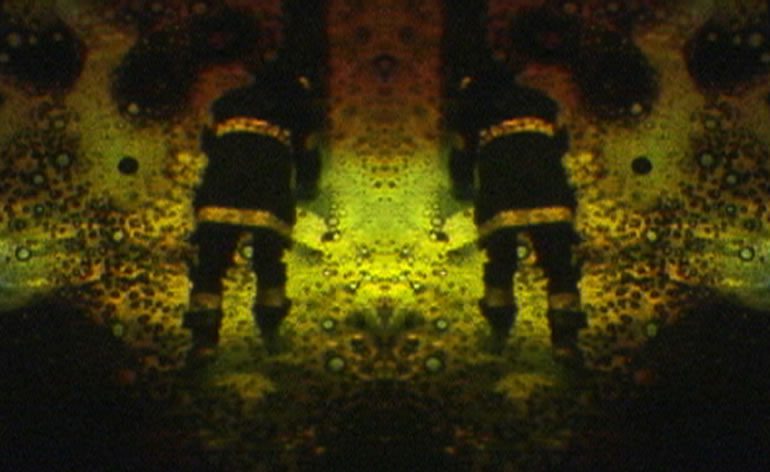
Images by Jordan Stone.
Dana Dorrity is an assistant professor of Communications and Media Arts at Dutchess Community College. She has an MFA in screenwriting from the American Film Institute and teaches media writing, screenwriting and video production classes.