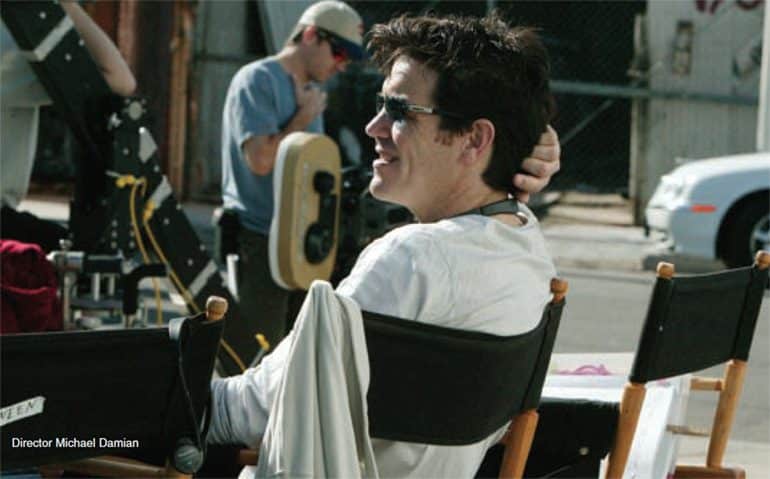
#FlashbackFriday #FBF Do you remember our Exclusive Interview with Michael Damian?
Director Michael Damian’s “Hot Tamale” wins the Indie Spirit Best Picture Award at the 2006 Fourth Annual Boston International Film Festival, and is an official selection for the San Diego Film Festival in September.
The film world-premiered at The Newport Beach Film Festival, receiving a special mention, and also screened at the Winnipeg International Film Festival. The action-comedy is written and produced by Damian, and his wife, Janeen Damian, and features an ensemble cast including Randy Spelling, Diora Baird, Jason Priestley, Carmen Electra, Matt Cedeño and Mike Starr.
Is this a transition into a new career?
Michael Damian: It’s an extension, and it’s sort of something that evolved organically. I love acting, I love working with actors, and what better than directing and writing and being able to work with actors and creative people, production designers and cinematographers. It broadened the scope of the things that I have a great passion for, and it’s really an extension. And working with the composer too. I get to work with the composer and music and the songs that we pick for the movie. Everything that I’ve done in the past has really come into play now.
How do your skills translate to directing?
Michael Damian: Having worked with some really wonderful directors and writers and producers and actors, I’ve picked up a lot through the years working with Andrew Lloyd Webber, I learned a lot working with the director of the musical, Steven Pimlott, working with Garry Marshall in “Young Doctors in Love.” And different people I’ve worked with through the years, I’ve had a chance to see how they work and how they treat people. And I’ve also learned some things that I didn’t like [laughs] working with some directors and producers – and I vowed not do those things… I’ve tried to take positives that I’ve learn through the years.
I don’t know if you know but the film [“Hot Tamale”] won at the Boston International Film Festival Thursday night. We’re really excited about that. My wife and I have worked really hard writing and producing together, and we put this company together so we could work together and give me a chance, a platform to direct from.
How did you get started in filmmaking? Did you want to provide a vehicle for yourself as an actor?
Michael Damian: Yes, it started out when I wrote and directed the pilot, “Red Eye,” an action spy pilot that I developed and wrote, produced and shot in Paris in 2000. But even before that, I wrote and directed a short film called, “Finders Keepers,” and it played into foreign festivals in Europe, and that was the beginning for me. But I love movies. [Laughs] That’s really why I’m doing what I’m doing now, I’m a huge movie fan. And I go to movies, I watch movies, I rent DVDs – I got Netflix coming 6 and 8 a day to my house, and I’m a movie fanatic.
Looking back at “Red Eye,” would you make any adjustments when directing yourself?
Michael Damian: That was really hard, starring and directing myself, it was very difficult. Because first of all, you don’t want to be spending a half hour or forty-five minutes to an hour in make-up and hair because that’s an hour that you really need to be working, [laughs] laying out the shot with the DP, or talking to the actors, … That’s the downfall is that it doesn’t give you enough time, and that’s why I did a small cameo in “Hot Tamale.” It was a one day cameo. I probably wouldn’t direct myself in a major acting role again. It’s better not to. It’s better to work just as the director, and that way you could spend more time with your actors and your creative team.
Can you talk about any changes that you’ve noticed, or any trends in terms of indie films, actors, and music. Starting with indie films, are they technically still an independent alternative, or is it studio system politics all over again?
MD: I think that you’ve got a combination of both… The only thing is I haven’t really worked in a studio system. “Red Eye,” was actually a television pilot; “Hot Tamale” is my first feature film. And that was totally me, and independent financing. “Moondance Alexander,” which is what I’m shooting starting Monday, that again is privately funded. So I really haven’t worked in the studio systems, so I don’t know really what it’s like to be honest with you. It’s not something I’ve experienced.
In terms of actors, how they promote themselves, their image to enhance their careers… Self-promotion seems to be part of being an actor today?
Michael Damian: You do need to get out there, and you really do need to promote. And I really encourage young actors to get out there and promote themselves because the competition is pretty tough. The reason we need to promote, or get an agent who really is behind you, or a manager or someone to really get your name out there, I’ll give you an example with “Hot Tamale,” we weren’t really thinking of Randy Spelling. I didn’t know anything about Randy. His agent kept calling. Dave Weintraub from UTA, United Talent Agency, said, this kid is a hard worker, he’s so talented, this Harlan from “Hot Tamale” is Randy Spelling, please, see him, meet him, let him read for you…
So, if you don’t have a good agent, or an agent like that who’s as aggressive and passionate, then you gotta do whatever you can do to let people, let directors and producers know that you’re out there. They’ve gotta know. Either they see it in your work, but I never watched Randy in anything so I wasn’t familiar with his work. So whatever you could do to promote yourself – I’m talking about, properly promote yourself, I’m not talking about, do something silly for shock value. Really you need to promote the film you’re working on. That’s the best thing you can do.
Out of curiosity, who are you listening to?
Michael Damian: I’m listening to a lot of pop rock [laughs]. I listen to opera and jazz and Latin music. I like all kinds of music. I listen to a lot of bizarre CDs I get from Europe that have compilations… There’s a thing called Buddha Bar, which is a restaurant and bar in Paris that has an album that they put out, like three or four albums a year, and it has a collection of different songs from performers all over the world, from Turkey, from Italy, from France. I don’t have one specific style or an artist that I’m crazy about. I like all sorts of music. I like jazz, classical, I like some rap. I’m pretty open.
How important has it been that you get support from your family and friends?
Michael Damian: Oh, I think it’s crucial. You need support. It’s very important – from your family, from your friends. Family’s everything. So you want to share the success with them. You want to share the highs, and you have to have someone you can share the lows with as well and help you through tough times. Family and good friends are crucial. You don’t want to be alone. That’s terrible.
Who has inspired you?
Michael Damian: I love great filmmakers like Coppola, Scorsese, Spielberg, Hitchcock. Those are some of my favorites. Peter Weir is a wonderful director as well… Billy Wilder … Those are some of my inspirations.
Is there anything that you would have done differently with your career?
Michael Damian: No, because if you pull something out, it could change everything, and I wouldn’t be where I’m at right now. Sometimes there were real tough times, but if you didn’t go through those, then you wouldn’t be where you are today, you’d be somewhere else, and I’m really happy where I am.
Your film, “Hot Tamale,” is screening in festivals. For those who haven’t seen it yet, what can people expect?
Michael Damian: It’s a ride. [Laughs] It’s basically a kid from Wyoming who has this dream of playing in an all-Latin salsa band. He leaves Wyoming and goes to LA, and is basically thrown in a blender and encounters some very interesting and unusual [laughs] and spectacular and dangerous characters. And it’s his journey on how he survives these three or four days in LA, and learns a lot [laughs] from his adventure and grows up very quick. It’s edgy. It’s not like “Moondance,” which is more of a family drama. “Hot Tamale” is an edgy, crime caper basically.
How did you create the look and feel for “Hot Tamale,” is there a director that you wanted to emulate?
Michael Damian: I needed to really develop my own style, and to do that, I didn’t watch anything. I didn’t watch any other films of this genre. I basically had to read the script and visualize and do the film the way that I was inspired to do it. This film is a little bit different, it’s a little bit out of the box. It’s not like “Snatch,” it’s not like “Go,” it’s not like “Pulp Fiction,” but it has some of those nuances. Those films are great films. And if you like those films, I think you’re gonna like “Hot Tamale,” by the way. There’s a vibe, and if you like the vibe of those films, I think you’re gonna like the vibe of “Hot Tamale.”
We talked about how you got started in filmmaking. Did you ever go to film school, or have you had any formal training as an actor?
Michael Damian: No, I bought a couple 16mm cameras, I studied, and I’m basically self-taught. And going down to camera stores and different camera houses and talking to the people there and the techs, and talking to people at Panavision and then getting out there and shooting my own stuff. That was really the best thing. For me, the good thing is to get a camera and get out there and start shooting. So I started shooting music videos. I started shooting anything I could shoot and then cut it together. I think that’s a really good way to start for a director is to get a camera, get a film camera, and start shooting. And that’s what I did. Touch the film, handle it, load the camera yourself, all those things. Switch the lenses out, go through all the lenses, learn all the lens sizes, transfer the film to video, cut the thing together on your laptop or whatever you’ve got. That’s really the best way to learn it. There’s also a good book called “Shot by Shot.” It’s an excellent book to read. He’s got everything in there, he’s got storyboards in there. I’ve been kind of a big, big storyboard fan because even though I block the scene out, put the whole shot list together, when I went and storyboarded it, it actually inspired me to do a few little things that I hadn’t thought of. When you start to see the pictures and sketches of the characters, it really comes alive for you. So I recommend if you can storyboard or get someone – get a student, get somebody from the art class that wants to do something and bring them in and have a storyboard.
Did you ever have formal training as an actor?
Michael Damian: I did take a couple classes from Guy Stockwell. But I had landed on a show… They wrote me into “The Young and the Restless,” as a singer/musician, and I basically went on playing myself. I didn’t have a chance to really study.
Do you have any advice for aspiring filmmakers?
Michael Damian: Stay focused. You’ve got to keep your vision. Because when you get there with everybody you want people to feel involved, you want their energy, but at the same time, you’ve got to limit the amount of information you’re going to allow them to inundate you with. You’ve got to [say] – okay, no, no, that’s not gonna work, thank you, though. Then you’ve got to really stay focused because you could have people twisting you and spinning you into different directions. Especially working with your cinematographer, he’s gotta be behind you, not in front of you. He’s got to support you and your vision, not run ahead of you and go off and do his or her thing. You’ve got to stay focused and hold on to your vision and demand the respect and what you want to shoot.
With actors, less information is always better. Don’t inundate them with tons of notes. Let ‘em do their thing. Let them surprise you. Let ‘em act. The key is casting, find the right person in casting, and then you don’t have to be going on and on and pontificating about notes and things and this and that. Let them act, let them do their thing. If you don’t see it, then go over and make a few adjustments, but let ‘em do their thing. And say as little as possible, and don’t touch the actors. Actors don’t like being moved around like Disney characters… Actors are not puppets. It may feel like a strange note, but that’ll really get your first day off on a bad start with an actor. And the bigger the star, you’re gonna have a real tough time if you start to upset them. And don’t invite people on to the set and have a lot of visitors and strange people on the set because actors could get really wigged out with a lot of unfamiliar faces. You’ve got to create a safe environment for them and to feel comfortable to be at their best on camera. Not to say that you need to create a Gestapo mentality on the set. You want to create the feeling that it is this great place to be and great wonderful harmonic environment, but you don’t want a lot of chaos. Actors don’t like chaos on the set.
Do you have any advice for aspiring actors?
Michael Damian: Work, train, do whatever you can, but keep acting. Don’t sit around and talk about acting. You gotta act. Whether it be a play, go to auditions, audition as much as you can. Find a great agent, and if they’re not doing anything for you, you’ve gotta move fast and find someone else. Do not let like a year go by where they’re not getting you out there. The rule is if you don’t get your job in 90 days, you could leave them. I think you could even leave them sooner…
You can get discouraged really easily. It hurts when they don’t want you. But it may not be personal, it may be not right for the character, the way it looked, you didn’t interpret the character the way that they want you to interpret it, so you can’t take it so personally, you gotta [say] – okay, you know what, I’ll get the next one. Stay positive, and I know it’s difficult. But stay in class, keep studying, do cold audition classes for cold readings.
…You definitely need an agent. An agent is everything. You have to have an agent. And a good agent. … Send your photo and your tape. Send them out, keep calling. Get in their face. …You know the story, the guy that did “Goodfellas,” the star, Ray Liotta, he tried to get an audition, they wouldn’t see him, so he went to see Martin Scorsese at Cannes. And Martin had bodyguards because he did “The Last Temptation of Christ,” and people were threatening him with death threats. And Ray Liotta ran over there to try to get the director to see him, and the bodyguards jumped him and tackled him to the ground. And Martin Scorsese went over there and said, what’s going on here, and Ray Liotta looked up and said, I really wanna audition for “Goodfellas.” And they picked him up, and Scorsese said, yeah, well come in and audition…

 Interview conducted by Jody Michelle Solis. Associate Publisher for StudentFilmmakers Magazine (studentfilmmakers.com), HD Pro Guide Magazine (www.hdproguide.com), and Sports Video Tech (www.sportsvideotech.com) Magazine. “Lifelines, not deadlines. Motion Arts. Fusion Everything.” If you’re in Dallas, sign up for Jody’s Yoga Class.