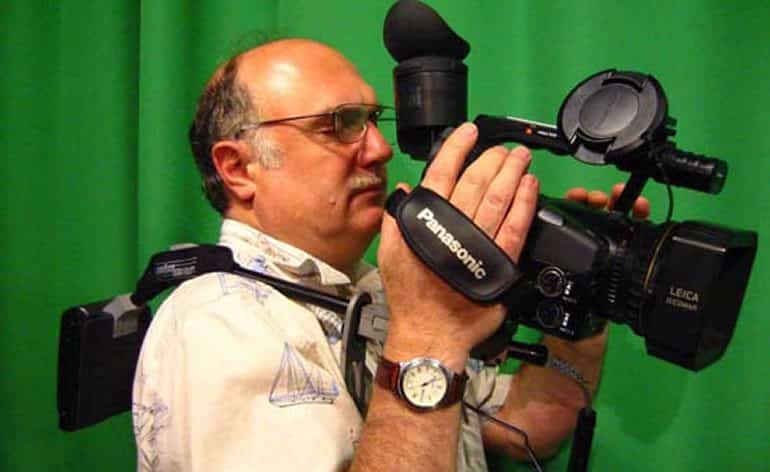
Reference: StudentFilmmakers Magazine, July 2007. Keeping Handheld Camera Shots Steady: A Shaky Horizon by Chris Cavallari. Pages 46 – 47.
Being a camera operator is not an easy job. Back in the day (and yes, even today), keeping a handheld 35mm film camera steady enough for a good shot, even while shooting in one of the widescreen aspect ratios, was relatively easy. This was because some of those rigs were shoulder mounted beasts that weighed more than a mid-sized dog. The camera operator merely had to keep the thing properly balanced on his shoulder and hope he didn’t drop the rig. By comparison, today’s diminutive, lightweight, handheld video camcorders are great, low-cost solutions for the indie filmmaker, but they make life miserable for the handheld camera operator, especially when shooting in a widescreen aspect ratio.
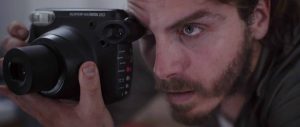
One of the main problems with a handheld camera is the majority of the weight rests solely on the operator’s right hand. Without any kind of weight distribution, steady shots become nearly impossible, and hand and wrist strain become real problems. Camera manufacturers, recognizing the problem, began engineering optical image stabilizers into their lenses to help reduce the shake and sway. Unfortunately, these were not the ultimate solutions to the problem. Without a proper physical stabilizer, one-handed operation simply creates too much unwanted motion. As a result, camera operators have come to use other means of stabilization. Most of today’s digital video cameras have swing out LCD viewfinders that operators use as a sort of makeshift grip. While this method, along with bracing one’s arms against the body, does seem to help with stabilization, the flimsy LCDs are paying the price.
In the days of 16mm and Super 8mm film, cameras had a similar problem. The cameras were small, and when handheld, they created enormous amounts of movement. Manufacturers came up with an ingenious tool to help curb this problem: The pistol grip. Mounted to the bottom of the camera, the pistol grip allowed the operator to use his entire hand in a more natural way to hold the camera steady. His left hand was free to operate controls on the camera. Many cameras had a trigger built into the grip to start the camera’s movements. It was a tidy solution to the problem.
But today’s camera designs don’t allow for a pistol grip. Third party manufacturers came up with many different stabilizers, but the most popular were the ones that essentially converted the handheld camera into a shoulder mounted unit. Some of these designs allow the LCD to be used for its intended purpose, and the camera’s built in grip can also be used, making the camera feel more like a traditional shoulder mount. This design is essentially a tripod. Other shoulder mount designs are built for adding accessories and batteries, creating a large rig out of a small package. All these designs take the principles of the large, shoulder mounted cameras of the past and stuff them into a tidy little package that keeps the horizon level.
For all intents, handheld digital camcorders afford filmmakers a wealth of shooting opportunities the bigger rigs just can’t offer. Their small form factor allows them to be relatively unobtrusive and get into places larger cameras just can’t go. But for all their attributes, the simple act of holding the camera is a challenge that both camera manufacturers and third party companies are trying to solve. The evolution of the shoulder mount continues, and will continue until the shaky horizon settles.
Photos by Chris Cavallari.
Chris Cavallari has been working in television, video, and film for 13 years as an award-winning cameraman, cinematographer, director, producer, editor, and grip. By day, he is the Lead Television Studio Technician for an Internet TV Network; by night, he writes and directs films and podcasts for his company Filmosity Productions.
His website is www.filmosity.com.