By William Donaruma
The camera operator can be an underappreciated skill on a crew and in schools as if you are the person who just pushes
the red button when you are told. If that were true, then why does Roger Deakins always want to operate his camera? It’s
because you are the person responsible for making that image, shot, composition happen and exist in that moment and
forever. One of the important details to this skill set is retaining the frame when the action is about to start and making the
correct moves. Bad takes cost time and money and it’s on you. This is something I have never seen in a textbook and
rarely taught, so I make a point of it in class.
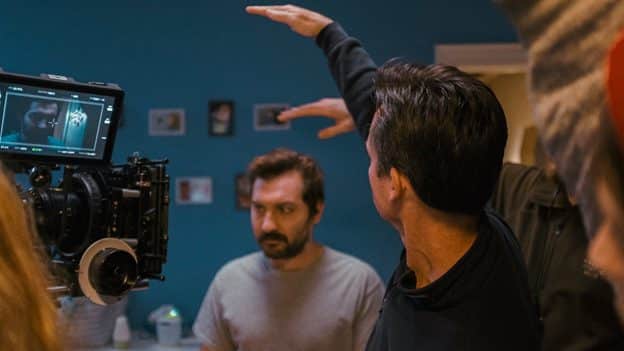
Under fairly normal circumstances you line up the shot and the slate comes in and out of frame and you push the button and make the move when necessary. However, there are many times when you need to move the camera around, the actor enters the shot, it is a dark scene or a close up and you need to re-frame the shot to get the slate, account for the height of the actor or simply know exactly what the starting and ending composition the director or cinematographer wants to balance the shot. The trick here is to become specifically aware of the edges of the frame using furniture, props, equipment on the outside edges or lighting on the set.
One example I had was a close up of an actor opening a door, so we had to move away to get the slate and re-frame for her height with the door closed. I couldn’t use marks on the door because we would see them when she opened it so I had to rely on small knicks on the door itself and the edge of the door jamb. Another tough scenario is when it is a dark scene and becomes hard to see details until light is supposed to come into the scene. You have to be acutely aware of the lighting and geometry of where objects are in relation to the corners of the frame. It’s all in the attention to details and the skill of your operator to retain that frame each and every take. And it definitely helps to use your eyepiece (EVF) and not some little monitor attached somewhere to the camera! You need to be the camera and retain the frame.
Free for members
Sign up free to keep reading
It’s free and takes less than 30 seconds. You’ll also get our Interstellar issue free, and a community of filmmakers sharing their work.
No credit card. Continue with Google or your email.