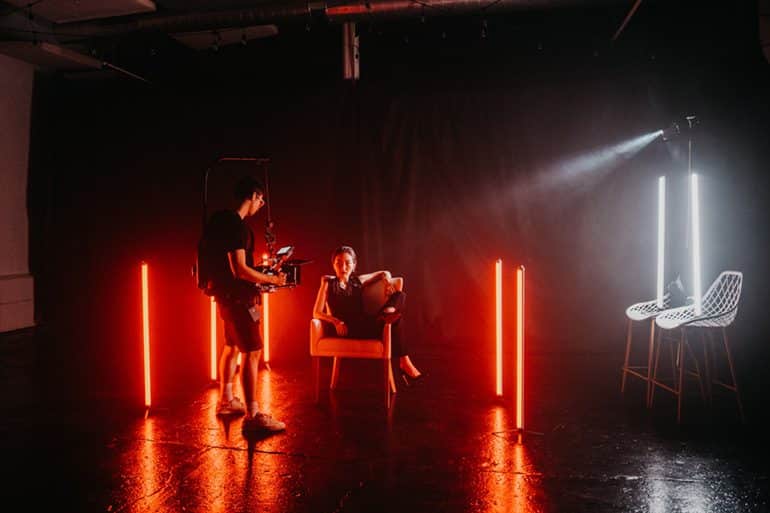
Photo above by @frankiefilms_xu, Boston-based cinematographer and filmmaker.
7 PRO Lighting Tips from Master Cinematographers
“Study paintings and photography from history. Study films and see how the light works with the story. Be present, look at light in life and your own experience. Remember what you see, let it become part of who you are. Don’t give up, every mistake is an opportunity.”
~John Simmons, ASC
“Lighting does not only means knowing what lights to set up and turn on but which ones to turn off. I often found myself walking up on a set and turning lights off. Turning them off took me to where I wanted to be. Just because a light is on when you work on a certain location, doesn’t mean it has to stay on.”
~Uta Briesewitz, ASC
“Observe natural light’s beauty, and use it as your main inspiration source.”
~Stijn Van der Veken, ASC, SBC
“Explore. Technically, there really isn’t a right way or wrong way. It’s about what feels appropriate. Use examples from existing films and shows as influence, but don’t be afraid to explore. Put your thumbprint on it!”
~David Moxness, ASC, CSC
“Always mix up the color temperature of your light sources. You look around the real world, and there’s light of different color temperature everywhere you look. So, you don’t use 3200K or 5600K as a rule, it’s simply a reference point. People will find if they light with one color temperature, it will look very flat and boring, and won’t contain all the complexities of color especially in the flesh tones. Color has emotional overtones – use them.”
~Peter Levy, ASC
“Block, Light, Shoot. But also if an idea is stupid but works, it’s not stupid. So, I’ve lit really dramatic scenes with a light bulb in a plastic paint bucket. If you don’t have the money, please take consolation that the gear isn’t always gonna make it at all better, your approach is gonna make it better. Good crew is better than great gear. Don’t put your foot through it. Don’t fix something that’s not broken. And as a cinematographer working with a good crew, I think the number one thing to work on, is explain your problems and not your solutions. What I mean is, I came up as an electrician and gaffer, so I know the way I would fix something, but it’s always better and invites collaboration (which is the reason we’re doing it) if you say, “I want to send hard light through here, and then, have it feel like it’s bouncing off the floor over here, so this person in the foreground will get a little glow on their face”. When you’re talking with the director, and when you find out what she wants, what the scene is about, explain that same problem to the crew and they can help you find the answer and everyone’s working toward a common goal.”
~Patrick Cady, ASC
“Do not over-light. Use the capabilities of the camera to reduce the use of artificial lighting as much as possible – this achieves a natural look.”
~Paul Gavin