
By Dean Goldberg
DP Rick Siegel talks with Dean Goldberg about lighting and shooting the concert film Jeff Beck Live at the Iridium in a small New York club.
Rick Siegel is a renaissance man. Not a new millennium, multi-tasking, attention deficit double mocha skim latte man—a true, master of many crafts, man. I’ve logged thousands of miles in various locations with my good friend, and he’s logged hundreds of thousands more without me, shooting everything from features to documentaries to talking heads. Rick is the DP of choice for the world’s most popular interviewers. His “faces” reel includes everyone from Jennifer Lopez to Barack Obama. But if you had to typecast this talented fellow, I guess you’d have to say that he’s the main man when it comes to taping live concerts. Ask Billy Joel or Elton John, or Cheryl Crowe or Eric Clapton. The list goes on and on. That’s why when Jeff Beck decided that he wanted to celebrate Les Paul’s 95th birthday (posthumously), Producer Barry Ehrmann and Enliven Entertainment tapped him for the DP duties.
We caught up with each other at La Bergamote, a lovely little patisserie on 9th Ave in New York City, to talk about old times, the state of digital video, and the most effective way to teach 19 year olds how to be great cinematographers. But by far, the hottest topic on this breezy, cool morning—at least for me—was Rick’s fabulous two nights at Director of Photography for Jeff Beck’s Tribute to Les Paul, featuring Imelda May, live at the Iridium.
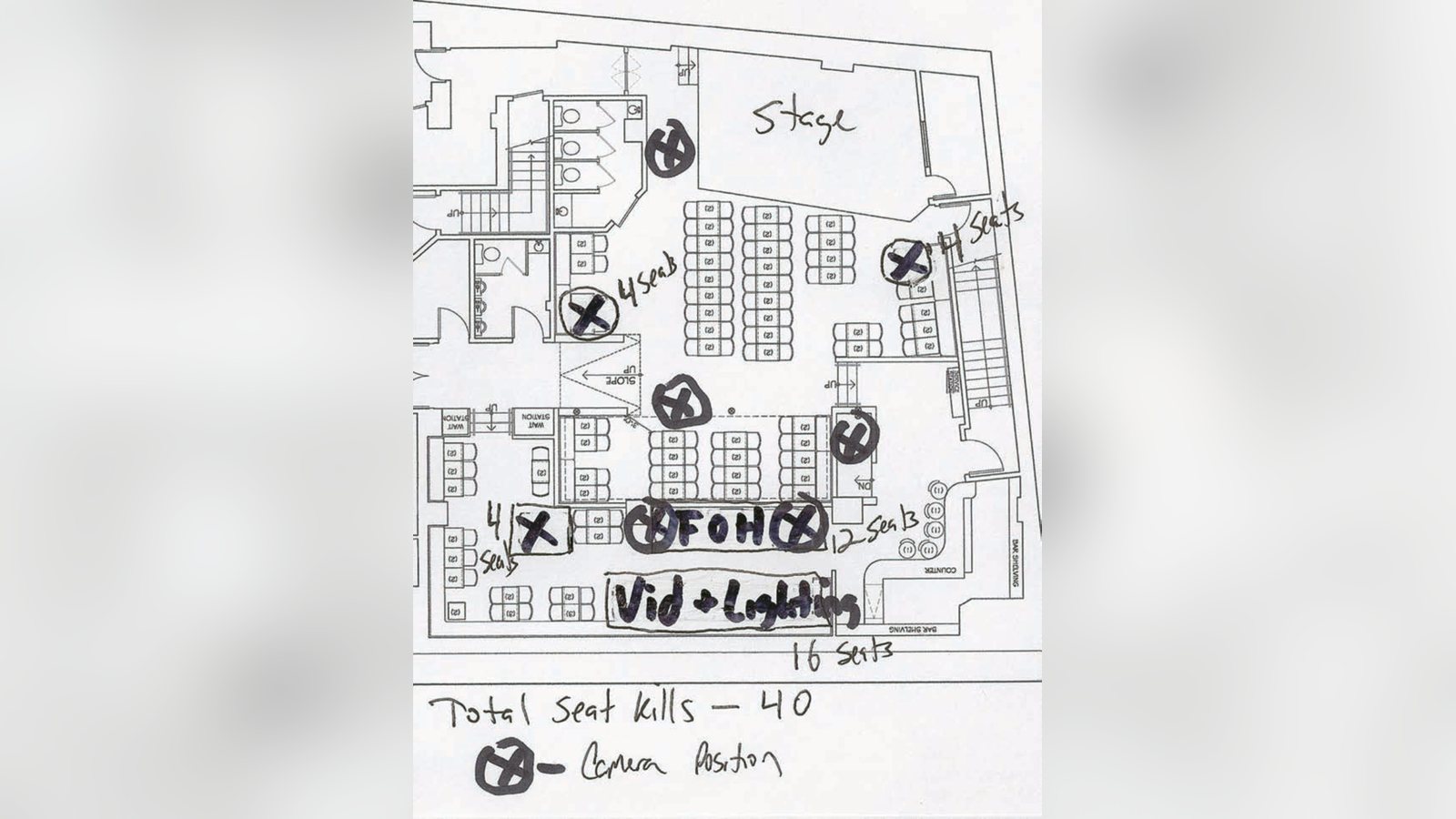
Siegel: Well, first of all you’ve got to understand that while the Iridium hosted Les Paul for years and is a world renowned venue, it’s also a small jazz club—140 seats, with a stage that’s 16 feet wide and 11 feet deep. We had our first production meeting several months in advance and I then proceeded to scout the jazz club several more times. My first scout was for aesthetics, so I could get the look and feel of the venue. It’s rather small and intimate when you’re in the audience, tiny when you’re trying to figure out where to place 8 cameras and lighting equipment. The second scout was to consider the logistics of how we were going to load in equipment, park what amounted to 2 New York City blocks of trucks. Also, this is a basement club, so we had to run our cables and lights from around the corner, through an office building, inside a kitchen, between working wait staff, hot soup, all that stuff—and into the club.
It’s one thing if you’re going to shoot doc style with a couple of Who will tell tomorrow’s stories in film and video—and who will enrich those stories with the sounds and special effects that help bring them to life? With an Art Institutes education, it could be you.
No matter which you choose, you’ll use hardware and software that industry professionals use. Work with experienced instructors. And build a portfolio to help you get started in today’s creative economy. Start by exploring our focused programs in the areas of: DIGITAL FILMMAkInG & VIDEO PRODuCTIOn, where you’ll study shooting, editing, graphics, screenwriting, and online communications.
AuDIO PRODuCTIOn, which focuses on producing music and designing sound for film, TV or online.
and more.
MEDIA ARTS & AnIMATIOn, where you can sink your teeth into 2D and 3D animation, digital video editing, cameras and the house lights, like you and I did at the House of Blues in New Orleans years ago. It’s a whole other story when you’ve got eight cameras, fifty lighting fixtures, a mobile control room truck and a generator. The day of the performance we rolled in around 4:00AM. We had to have the lights hung and rung by the time the back line loaded in at 9:00AM. This was all so that sound check could start by 2pm and once that happens, you’re essentially locked in for that evening’s show.
Goldberg: Tell me about lighting.
Siegel: My lighting design was to create a warm “Jazz Club Vibe” that would support the music of Les Paul as interpreted by Jeff Beck and company. Instead of follow spots, I used fixed 300 watt Fresnels and 600 watt Soft lights. Since the stage was so small and the musicians were not going to move very much, I used conventional lighting. This gave me the ability to really get specific with my design. For me this was a location shoot, rather than a theatrical venue. The Iridium venue is a very different lighting task than creating a show for a 20,000 seat arena. It has similarities, and it’s also a matter of scale. This was an intimate performance, where the audience was going to be, in some cases, three feet away. So I wanted an intimacy that comes from using single source lighting. While that may seem easier, when you think about it, it becomes incredibly complicated. We had over fifty lights placed in the ceiling alone.
Goldberg: So the house lights were of no use.
Siegel: First thing we did was take the time to map out what lighting was in the ceiling and numbering them. We took every single light out. When we scouted I realized right away that the house lights were not going to work for our needs. Each light had to have a specific position and reason. For example, Jeff Beck doesn’t necessarily play downstage; he likes to go across stage. So I could light him from the front but then he’d only be half lit. You have to watch your acts, and light accordingly. Billy Joel, for example, always plays stage left. Elton John plays on stage right. So when they were on tour it worked out perfectly!
Goldberg: What about the softlights you used in that background. Were they LEDs?
Siegel: Yes, they are Color Blast units. I use them for scenic. I rarely use them for talent—I just don’t think they’re handsome enough. The color balance isn’t quite right yet.
Goldberg: That’s interesting, twenty years ago, you had a precursor of the LED ringlite that I see advertised these days, that went around the camera lens. We used it on a series of comedy spots that featured a museum tour. Everyone’s faces looked incredible.
Siegel: And we shot that on Super 16. But those were homemade and were tungsten lights. But again, that soft, broad, front light is always going to give the faces and eyes a great shine. A positive attribute of the ring light is, if you have perfect skin, they show the perfection; alternately if you have imperfect skin, the problems show up as well. So the LEDs are great. But I don’t like to mix them with tungsten on faces.
Goldberg: And what about those beautiful shafts of light on stage at the Iridium?
What a slider and the Atlas FlT can do for you
Camera sliders allow you to achieve dolly-like camera movements without having to travel with a heavy track and dolly system. Boost your production value with smooth movements that add cinematic touches to your project. The Atlas FLT is lightweight, affordable and requires minimal set-up time so you can get more of the shots you want on location.
see the Atlas FlT in action at Cinevate.com/humandolly Siegel: We used 19 degree Source Four ellipsoidals, with a haze machine and fan to keep a consistent level of haze in the room. They’re mineral oil based so they don’t really affect the audience.
Goldberg: How about your crew.
How large was it?
Siegel: I think we had seven or eight in the lighting department, that’s all we could handle in such a small place. All in about 60 in the entire production, camera, stage and lighting departments.
Goldberg: How did you control the stage show and video look?
Siegel: All of the camera, lenses and related control equipment was provided is the man who makes it all happen effortlessly. We set up lighting control in the front of house position in the venue and was controlled by Rob Gawler who is Jeff Beck’s Lighting Director. This worked out very well. He was totally in sync with the look I was after. Because Rob worked the console in the house I was able to sit next to J.M. Hurley our Video Engineer and work from the truck to create the look I was after.
Goldberg: What was your credit on this show? DP or LD?
Siegel: That’s a good question, because they’re two very different things. A Lighting Designer needs to be able to design the light for a music show. A DP does as well, but also needs to know about lenses, camera placement. And the editorial process. But for me in the last couple of years the credits are being used more interchangeably.
Goldberg: One of the elements I found so attractive about this show, was your use of primary colors. Imelda looked wonderful and even Beck had a real colorful shirt on, rather than his usual tee.
Siegel: I know! And he had to wear it two days in a row for continuity! As far as the color palette, I think everyone felt plugged into the Les Paul and Mary Ford thing. I didn’t want a retro look, but I wanted a classic nightclub feel.
Goldberg: And you got it.
Siegel: And we got it with elegance, while keeping with the small club feel of the show. It’s got a little of the fifties look, good primary colors and warm fleshy tones.
Goldberg: I’ve been a Jeff Beck fan since I was a kid—and I’ve sort of kept it up by secretly checking out the latest performance on YouTube every couple of months. I have to say, I’ve never seen him look so good. What’s the secret?
Siegel: Every camera and lighting decision I make is in support of having JB look as natural as possible, same with Imelda. I keyed Jeff very differently than I keyed Imelda. He was lit with a series of keylights to accommodate several stage positions. For Imelda I used a “hard” key light to accentuate her stationary stage position and beautiful features.
Goldberg: So, any words of wisdom to our 19 year old aspiring directors of photography?
Siegel: Shoot as much as you can, wherever you can. But before you shoot look and try to see. Where are you? Where is the light emanating from? Do you go with the flow or create your own space?
Goldberg: Wise words. And the Beck shoot? Final words?
Siegel: It was absolutely awesome.
Goldberg: Thanks Rick. Now, who’s getting the check?
Dean Goldberg began his professional life working for a well known New York democratic political consultant, David Sawyer. As a film editor, then producer/ director, he was involved with more than fifty national campaigns, including races for; Senator Ted Kennedy; Senator John Glenn; Senator Frank Lautenberg; Governor Jim Hunt and Mayor Kevin White. He wrote and directed television episodes for, “Missing Reward,” “Hard Copy,” “A Current Affair” and many other shows featuring dramatic recreations.
Related filmmaking guides
Keep learning filmmaking
Want more lessons like this? Join StudentFilmmakers free for live webinars with working pros, and stream on-demand filmmaking classes in cinematography, directing, screenwriting, sound and post.






