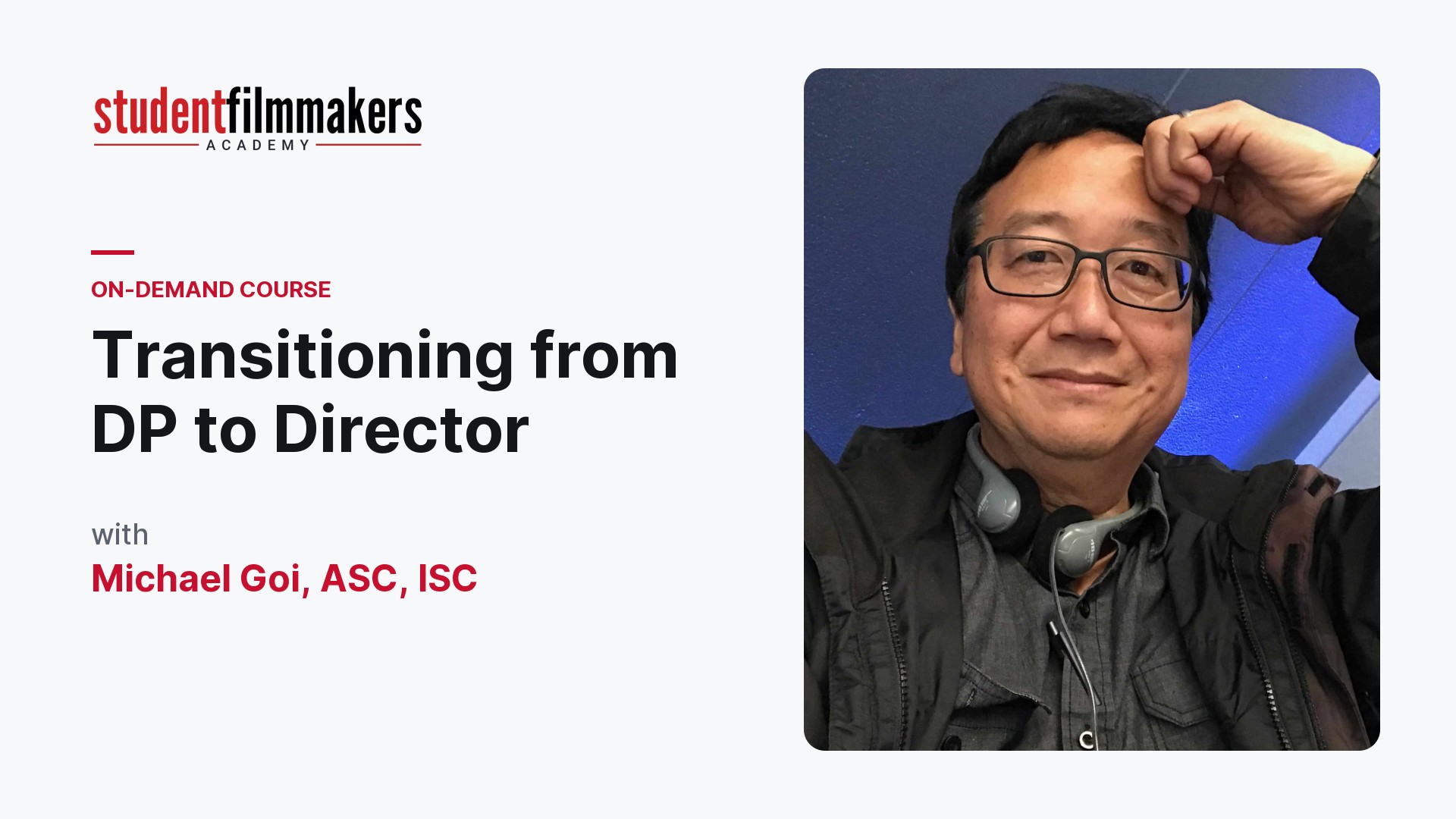
Michael Goi, ASC, ISC, a four-time Emmy nominee for cinematography and a past president of the American Society of Cinematographers, went from shooting American Horror Story to directing four episodes of it. Speaking to filmmakers live on Zoom for StudentFilmmakers, he described how that move happened, why he still applied to a studio directing program, and the working habits that let him finish every directing day in under 12 hours.
Did he leave cinematography because he was unhappy?
No, and he wanted that to be clear from the start:
“The thing I really want to make clear is that I wasn’t dissatisfied with being a cinematographer. There was no dissatisfaction.”
Goi had already directed low-budget work in Chicago and Los Angeles, including Megan Is Missing, which he wrote and directed with friends for $35,000 in eight and a half days. He calls it the only time in his career he made exactly the film he wanted, the way he wanted, because nobody else controlled the money.
His work with Ryan Murphy and Brad Falchuk on Glee and American Horror Story changed how Hollywood saw him: from a fast, solid DP to a visual stylist. Then an actor on American Horror Story, frustrated with a couple of directors, asked why Goi was not directing the show. That question is what started it.
Why turn down an easy directing job?
While he was shooting Salem, already lined up to direct an episode of American Horror Story‘s fourth season, friends offered him a very low-budget pilot to direct. The executive producer of Salem warned him off. A first union credit on a show every director wants would set his level. Taking the small pilot first would make him “a director who will just direct anything.” Goi took the advice and says it was right.
Even so, one episode did not change his standing. He describes a stigma around the “affiliated director,” the DP, editor or script supervisor who gets an episode because they already know the showrunner. Murphy became one of his strongest backers, but Goi wanted to prove himself to the rest of the industry.
How did a veteran DP get into a directors workshop?
He applied to every studio directing program. Warner Bros. called him for its Directors Workshop, which he says draws about 3,000 applications a year, interviews around 250 people and accepts 15. At the interview, the executive running it asked why he was applying at all, since he had shot hundreds of hours of television for the studio and could simply ask to be put on the director list.
Goi said he wanted to enter the pipeline from the beginning rather than assume he already knew everything about directing. Two or three weeks into the weekend program, the calls started. Within about five and a half months, the workshop had set him up with his first three shows, including Pretty Little Liars, Famous in Love and Shadowhunters.
What does a cinematographer bring to directing?
Goi calls it a “cut and paste” way of thinking. He loves silent film and believes nearly every technique used today was tried by 1927, by Buster Keaton or F.W. Murnau. He is also a stage magician, and he showed a photo of his Zig Zag illusion box. Practical tricks that fool the eye are, to him, the heart of filmmaking.
Two examples from the class:
- “Flicker,” American Horror Story: Hotel. To show Lady Gaga’s character waiting for a man who never arrives, Goi shot a railroad platform on a short dolly track while the dolly grip counted out loud, “one one thousand” through “five one thousand.” He made passes with many extras, fewer extras and none. A week later on a green-screen stage, he repeated the same run with the same lens and tilt, talking Lady Gaga through excitement, waiting and despair. Dissolving the backgrounds did the rest, with no motion control and no CGI beyond the composite.
- “The Silent Prisoner,” The Rookie: Feds. Everyone assumed a woman being hit by a truck would need CGI. Goi proposed a traveling split screen: shoot her stepping into the street, shoot the truck passing through the empty frame, then shoot the truck with a dummy, and blend them in editorial. After that, he says, the showrunner would ask for Goi’s cut-and-paste fix whenever a script called for a pricey effect.
On his Pretty Little Liars episode, he wanted a 10mm lens looking straight down on a night search in the Warner Bros. forest. The grip offered a condor that was parked nearby. Producers later told the camera crew his episode was among the best of the show’s seven seasons, with the shortest days, and began pushing other directors toward 10mm and 14mm lenses. Goi found that funny. The lens was never the secret; the point of view was.
How does Goi keep every day under 12 hours?
He has never had a directing day go past 12 hours, and his average is about 10 and a half. His methods:
- A full shot list on day one of prep. He reads a scene, stops, and lists the shots needed to tell it, before seeing any location. For a one-hour episode this takes six and a half to seven hours. The first AD gets it that first morning and can schedule accurately, and other departments flag problems early, like a set ceiling that cannot fly out for a high angle.
- Walk the crew through the coverage. After the blocking rehearsal, while actors go to touch-ups, he tells the whole crew every piece he needs, so nobody parks a cart where camera will turn around later.
- Trust the crew. After a take he loves, he asks if everyone is good. If someone needs another, he rolls again with no explanation required.
The reason goes back to an intern on a feature he shot. She followed him for 12 hours with a hand counter and clicked every question he was asked: 3,753. About a third, he figures, came because the director had not explained the plan. Clear information up front shrinks that number.
Which shot can a director never give up?
Goi sorts shots into three kinds: the one that tells the story, the one that makes the storytelling more exciting (a push-in as someone comes through a door), and the visual flourish you dreamed up. When time runs out, the flourish goes first and the enhancement second. The first kind stays:
“You cannot give up the shot that tells the story, because as soon as you do that, you’ve abdicated your responsibilities as a director.”
How should a director talk to actors?
Goi says it came naturally to him, partly because most of his friends are actors. He watched many directors walk in after a take with seven or eight notes. He gives one or two, and stops the moment the actor says they have it: “As soon as an actor tells me, okay, I’ve got it, I stopped talking.” Anything more, he says, only muddles the spark.
He likes the actors that ADs warn him about, the ones who always push back, because the pushback usually comes from a night spent thinking about the scene. On an episode of The Rookie, the cast brought so many good ideas in rehearsal that he dropped his planned shots. Seth Green noticed and asked why. Goi’s answer was that what they were giving him was better. His rule: “I will steal a good idea from anybody, but they have to be willing to give it to me first.”
Is rehearsing on set a waste of time?
A filmmaker said his producers think so. Goi’s answer began with one word: “Baloney.” He hates hearing that a crew will “shoot the rehearsal,” which he says simply means there will be no rehearsal. His own method is to rehearse the exact shot, then film exactly that.
Without rehearsal, he says, you set the crew up to fail, searching for the point of a shot while rolling. On one show, the producers told him the cast never gave a real rehearsal. When they started to drift through it, he stopped them and explained that every pan and dolly move would be timed to what they did. They gave him a real one, and he never had that problem again.
How do you get into the DGA?
You get in by being hired to direct for a DGA signatory company, so Goi’s advice is to take a union offer if one comes early. New members then take the guild’s one-day course for first-time episodic directors, which he helps teach.
More from Goi: his three tips for directing actors and Michael Goi, ASC on AI, Film School and Starting Your Career. For your own prep, see How to Make a Shot List.