Connecting the Dots
Crew engagement and collaboration.
By Hiro Narita, ASC
Diverse Beginnings
More often than not, filmmakers have their beginning in diverse disciplines – from writing, acting, music, architecture – the list is abundant. Having started in graphic design and illustration, storytelling with moving images ultimately became my aspiration. Through unlikely paths, some of us chose filmmaking as a fulfilling profession and our lives intersected and eventually converged.
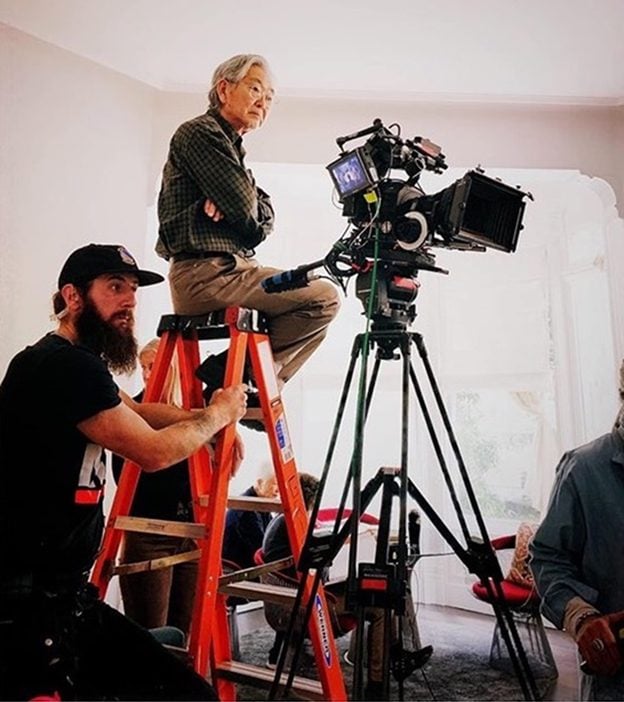
Earlier in my career, I was fortunate to hook up with a mentor gaffer with years of theatre lighting. At first, I communicated to him in plain jargon – light, shadow, and color – and he would convert my mental pictures into 1K here, 2K soft light there, with some gel, etc., into physical lighting units to create those images. As I learned to see and interpret the subtle quality of luminance with different lights, I began to use “foot-candle” (the measurement of light intensity) as terms of dialogue. Along the way, the gaffer taught me to use all sorts of practical materials for effects – tracing paper, discarded sheer curtain, aluminum foil, etc. His toolbox was full of them, and he pulled them out like a magician would out of his hat. He showed me that in a given space, light we see and experience is through something or refraction of it on something around us. His resourcefulness taught me that lighting is not simply mechanical, it is illumination and mirror of reality, and our imagination. Since then, I have welcomed input by the crew members’ collective knowledge. It enriched my cinematography and made it more practical, more personal. Similarly, I worked with a dolly grip who started as an ice skate dancer, whose sense of timing and rhythm were flawless like gliding on ice. I met a soundman who was a painter before entering filmmaking. I am sure fascinating and beguiling stories are waiting to be shared among us.
Cinema Is Collaborative
Cinema is a collaborative endeavor, and cinematography is one essential aspect of that effort. Pieced together into the mosaic of filmmaking are life experiences of those who play part in. From a distance, you see a picture, but upon close inspection, you see it is composed of small, distinct individual pieces. What drew some of us to filmmaking, a synthesis of art and technology, is that it is the best tool available now, to express our complex thoughts, feelings, and importantly, imaginations. Ultimately, to communicate with others. The two-dimensional moving pictures on a screen that can create so many dimensions in our psychic space is a mystery. The fact and the fiction crisscross and converge in our mind, giving us rich, unique perspective of the story. In a film, bits and pieces of images are strung together in specific sequences; they do not always follow a natural or logical progression. Yet we take them in, connect them and somehow make sense out of them, as if the images speak to us in code, but we decipher them into personal, meaningful experiences.