By Nash Choudhury
Writer-director Dan Rush talks about his debut feature Everything Must Go, starring Will Ferrell, adapting Raymond Carver and directing a comic actor.
Native San Diegan Dan Rush grew up on movies from Being There to Kramer vs. Kramer alongside the usual assortment of Star Wars and Indiana Jones blockbusters. It’s no surprise then that his debut feature Everything Must Go is a small dramatic picture with a lighter comedic touch. Starring Will Ferrell as a relapsed alcoholic who loses both his job and wife and holds a yard sale as a way to start his life over, Everything Must Go drew raves when released back in May for its deft handling of tone and a stark, exciting dramatic performance from the normally comedic actor. After directing commercials for over ten years, Rush is finally breaking in to the independent film scene. I talked with him about the challenges of this specific film and how to best maneuver making your first film on a low budget.
The Raymond Carver short story that Everything Must Go is based off of – what drew you to that as your first feature?
Dan Rush: I had a friend who was actually a writer who became quite a very successful screenwriter and he had a short story which I kept bugging him to adapt. He kept saying that he didn’t like the story and that it was no good. I kind of kept bugging him to adapt it for about a year and finally I said, I’m going to adapt your story and he said you can’t, I like the story now and I’m going to make it into a novel. It ended up being The 25th Hour which he then adapted into a movie quite ably himself and became a really successful screenwriter. But he had brought to my attention the Carver story. What somebody gave to me as advice, which is kind of good advice for a first movie, was try to write a really good role for an actor while keeping it a contained role meaning if you can get an actor to make a movie and the budget isn’t too high then you have a better chance of getting that movie made.
How did Will Ferrell get involved with the project?
Dan Rush: That was kind of the goal. Let me see if I can write a great role for an actor and then, hopefully, that actor will help get the financing to get the movie made. As far as Will, when the script first came out and the producers got on board, we started talking about all these different actors. We were talking about dramatic actors and comedic actors and my initial instinct because I kind of come from a comedy background and commercials was to go with somebody who was more dramatic. Then my producers suggested Will. I thought there was no way he would ever want to do it but why don’t I send it to him anyway and he really responded. The more I thought about it, the more I thought it was an interesting idea because he had never done anything like this before but I knew he could. I could just tell from his other work like Stranger than Fiction. I also thought that he’s an inherently likable, sympathetic guy and the guy in my movie does some things that aren’t inherently sympathetic or likable so I thought that would kind of be a nice juxtaposition. So I met with him for about an hour and we talked about the script and it was pretty clear from the meeting that he was a really nice guy who would be a good guy to make a movie with for a first time filmmaker and we just shared very similar opinions about the film. We talked about the tone of the movie and the character and it was clear that he kind of shared the same ideas that I did so we came out of the meeting and I said yeah I want to do it. Then I had to do that thing when you get a movie started where you have to wait for them. I ended up waiting for him for about a year or so.
The film has a lot of darker undercurrents while also having a slightly comedic tone to it. Was that always intentional or was that something Will brought to the role?
Dan Rush: The script had that in there. Everybody always asks did you ad-lib a ton or did you improv and frankly we didn’t have a tremendous amount of time to do that stuff. There were certainly things that he just does that he just makes them funny kind of just being who he is. But that was always there. We tried to be really careful about the tone and also making sure that there was nothing that seemed like it was so overtly comedic that it took you out of the movie and reference another one of his characters. There were a couple of pieces I had in the movie and one of them I just felt like it was a little bit Old School-ish and I kind of ditched it because I thought I don’t want people to get pulled out of the movie by seeming like another type of comedy that he’s known for.
Tell us about how you landed on Christopher Jordan Wallace for the role of Kenny.
Dan Rush: As you probably know, casting kids is really hard to get really realistic performances. A lot of them have a bag of tricks that they use and can develop bad habits. I was really looking for someone who could talk to Will as if they were kind of an adult. He’s the son of Notorious B.I.G. and Faith Evans and he’s a really grounded kid but clearly he’s led a pretty interesting life. When the two of them first met, they just kind of talked and it felt really natural. We went out and did a casting call in Los Angeles but at the same time we did a national casting call and we found a couple of really interesting people but I just liked his energy and the way that he underplayed everything. He was a real pro, just really good on set every day.
Where was the film shot?
Dan Rush: We shot in Arizona in a town called Arcadia which is kind of right in the Phoenix/Scottsdale area.
The neighborhood location that you guys shot in is really central to the story so how long did it take you to find it? What were you looking for exactly when you were location scouting?
Dan Rush: This is kind of how the vagaries of production affect what you do creatively. Will had just had a baby so he did not want to travel that far outside of the south west. The tax states like Georgia and Louisiana which had great tax breaks were out of the question and California we couldn’t afford to shoot in so all of a sudden you’re left with New Mexico and Arizona which, as you could imagine, are the two worst places in the country to find lawns. Everybody has cactus and stuff like that so we looked around New Mexico and it was still really cold there and kind of snowing which didn’t seem like it would be the best plan for a movie that takes place primarily in a single exterior location. We then looked all over Arizona and there was definitely a day I remember talking to my producers saying I don’t think we can make the movie. We can’t find the location. We had actually, earlier, driven around this neighborhood which was an old neighborhood in Phoenix which had these big lawns. It was an old orange orchard and we came back to that neighborhood. The other thing is we were looking for a house that was on the right side of the street for lighting and so there were a lot of requirements and one day we kind of came across this house and I stood there and I said wow that looks like it could be Samantha’s [Rebecca Hall’s character] house and that looks like it could be, there was a guy who ended up being cut from the movie, this crazy neighbor’s house. The geography just seemed to really work and I got, needless to say, very excited. I really felt that was the only place, that house, that street, that neighborhood, was literally the only place that worked. It wasn’t like we had a second choice. We looked at some housing developments that hadn’t been completed with the idea that we could use one almost like a big set but most of those didn’t have lawns yet and we couldn’t afford to put in a lawn and landscape a whole street so we got really lucky.
Were there any big production hurdles shooting on location?
Dan Rush: We got pretty lucky. It was the right time of year. It wasn’t too hot. It didn’t really rain. Shooting in a place like Arizona where there’s not a lot of production, what we really tried to do, was involve the whole neighborhood so we would have lunch set up in one neighbor’s yard and we would store equipment in all of the neighbors’ garages so that everybody was kind of involved. We tried to make it interesting for them because we were there for an extended period of time. Shooting exteriors everyday is hard because when the sun goes down, the sun goes down. So, we shot a lot of the movie as light was disappearing every day and that was very challenging because, you’re done.
How long did you shoot on location?
Dan Rush: Twenty-three days.
Was the film shot on film or digital?
Dan Rush: We shot this film in 35mm anamorphic. I’ll probably never get the chance to do it again. I had always wanted to shoot my first movie on film and I liked the idea of shooting that format for an independent movie that takes place in one location. I just thought you hadn’t seen that format used for that. You’ve seen kind of hand held anamorphic in things like The Thin Red Line. It’s been used in bigger things but I just thought the format was a very interesting format for this kind of movie and when we were shooting our coverage, it allowed you to get a lot more information around Will and his objects which I thought was kind of an interesting benefit.
Much of the movie centers on the items that Ferrell’s character owns on the lawn. How much time and effort went into finding all of those props?
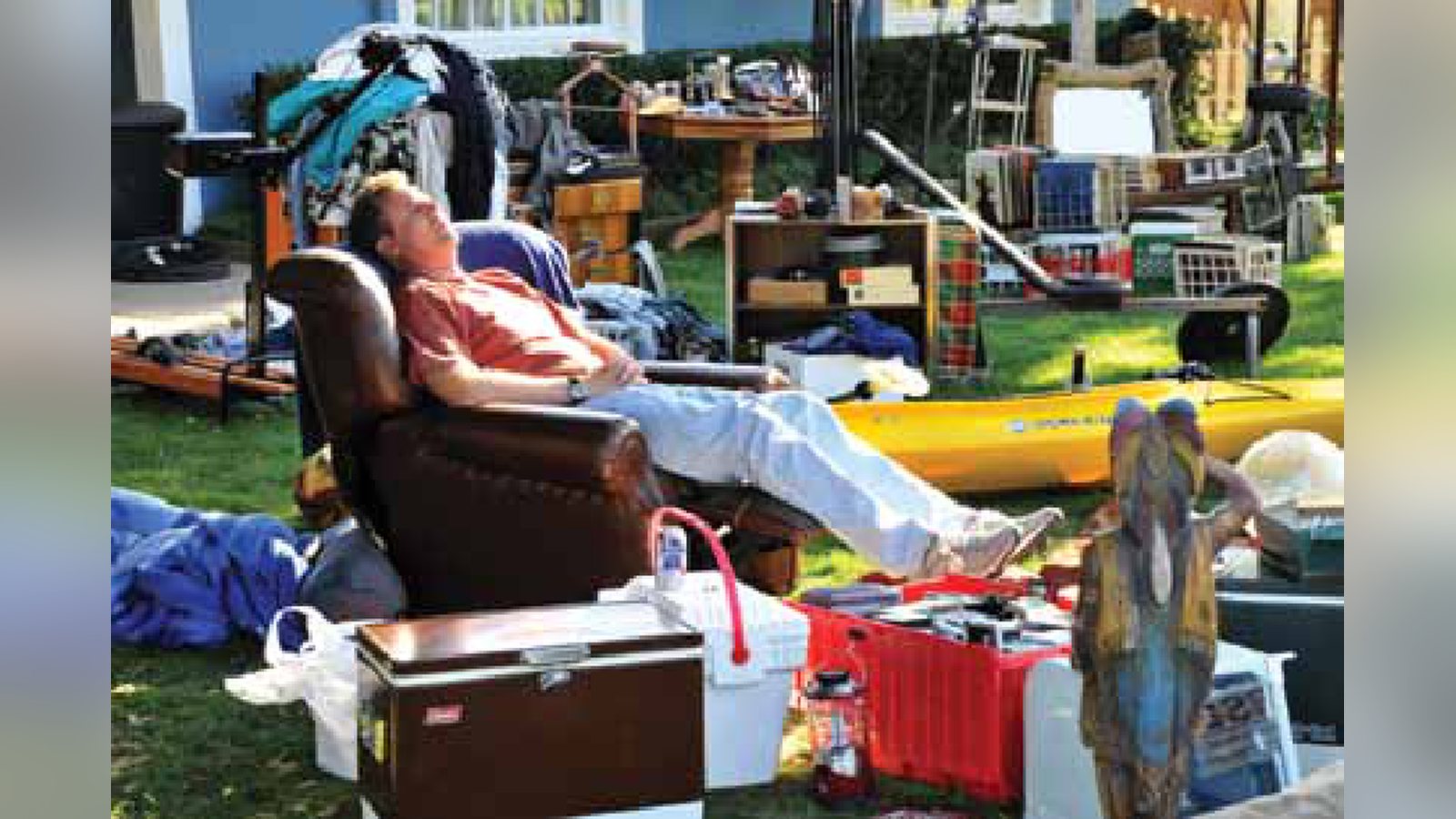
Dan Rush: There was definitely a fair amount of key objects that were called out in the script like the baseball and the album collection. We brainstormed with my production designer and our set decorator and we really tried to say, what are the things that this guy has done in his life? He’s been a guy who, in his attempt to fight alcoholism, has kind of gone through these fads like he has a Nordic track and he went, I’m going to be a kayaker, all of these kinds of things that you get and you never end up using. We got a huge assortment of stuff. Will and I walked around and we really picked out stuff that he thought was interesting like he had remembered he had an old record player and we had taken an image of that old record player and got something like that. He was also a baseball player so any kind of things that he could relate to as he walked around the lawn was important but that was really fun because of, I think, the nostalgia we all feel for that stuff whether it’s a Viewmaster or a Super 8. That was an enjoyable part.
For a low budget independent film like this, how important is it to cut things at the script stage rather than in the editing process so as not to waste time and resources?
Dan Rush: That’s a killer. When you see the movie for the first time and you’re on a twenty-three day schedule and you realize that you have two days of film you’re not even going to use, that’s ten percent of your shooting, that’s really painful so I would say as much as you can cut, if stuff isn’t moving the story forward, if it’s repeating beats, yes but it can also be dangerous to be kind of too editorial before you shoot because you just never know what’s going to happen in editorial and what you’ll need but I think doing things like being really smart about how scenes transition from one to the other is really important and thinking if there is an inkling that a scene might not be used you can make sure that you can transition to the scene after it so thinking that way can really help. But it’s a tough pill to swallow when you take a scene and you don’t use it but as you know just from watching DVD’s everybody does it. But in the indie world, it hurts.
Were there a lot of scenes deleted from the film?
Dan Rush: There were some bridge scenes. In the script, there was kind of a different ending and then there was a kind of very dramatic scene that Will did that we ended up cutting which I thought was one of his best performance pieces but it just didn’t work within the narrative. That was tough as well. Anything that you can do in pre-production to make yourself more efficient you should do and we had actually started with a longer production schedule and when it got shortened, all we ended up doing was shooting more pages a day. I did cut some stuff but I could’ve taken one more look maybe and said okay what can you really do without.
What are you working on next?
Dan Rush: I’m actually developing with other writers about three other things oddly enough. Stuff I haven’t written. Then I have two things that I’m working on as well. We’ll see which one gets there first. With a second movie, you want to do bigger and better, I guess. Well, not necessarily bigger but you want to expand your horizons a little. There are movies I might have done as a first movie before but I just don’t know that I would want to do that movie now. It’s not easy but it’s exciting. Nash Choudhury is a 25 year old graduate from Binghamton University with a BA in Creative Writing. He also spent time learning the craft of filmmaking, majoring in cinema before switching to the written word. He is currently a freelance writer with a passion for the process of filmmaking.
Keep learning filmmaking
Want more lessons like this? Join StudentFilmmakers free for live webinars with working pros, and stream on-demand filmmaking classes in cinematography, directing, screenwriting, sound and post.