By Scott Essman
Director Renny Harlin talks about 5 Days of War, his film about the August 2008 Russian invasion of Georgia, and how he brought the story to the screen.
From August 7 until August 16 of 2008, the sovereign nation of Georgia was invaded by Russian troops in a military offensive that might have shocked the world – if it had been widely reported. However, the 2008 Summer Olympics, officially known as the Games of the XXIX Olympiad, took place in Beijing, China, from August 8 to August 24 of that same year, which severely restricted the media’s coverage of the events in Georgia. Now, just three years later, director Renny Harlin (Die Hard 2, The Long Kiss Goodnight), mostly known for his action films, is unveiling his telling of an American journalist’s experiences trapped behind enemy lines in Georgia at the time. 5 Days of War not only retraces much of the activity in the area, but also features many of the settings from the actual conflict in practical locations. Harlin recently spoke to StudentFilmmakers Magazine about his process in bringing this true and largely unknown story to the screen.
Why did you choose to come aboard this project, whose subject matter is obscure to most of your usual audience for action films?
Renny Harlin: Through a series of coincidences, the producers of the project, who were Georgian, and I happened to meet, and as a result, I viewed pictures and videos from the war and studied stories about it. I thought it was an incredible chance to take my action movie experience and do something that every director wants to do – make a war movie.
Why do you think the true events on which your film is based are so unknown to the general public outside of Georgia?
Renny Harlin: The movie tells of the war between Russia and Georgia on August 8, which was the opening of the Olympics in Beijing. News services were more interested in the controversy in the Olympics than the war. People don’t really want to hear about [war] any more. In this conflict, one factor is Afghanistan and Iraq and before that Kosovo and Bosnia. The landscape and the way they dress and their customs seem very foreign to us. That’s made us close our eyes to it and not relate to it any more. In this case, the country, Georgia, is very Western and pro-America, a beautiful Mediterranean country. This paradise was invaded by a superpower.
How did you find out what had really happened to Georgia in this period?
The process in bringing this true and largely unknown story to the screen.
Director Renny Harlin directs Johnathon Schaech in 5 Days of War.
Renny Harlin: I went to Georgia to do my research and traveled the country. I felt that it was really beautiful with a rich history. It was worth getting on the big screen. They don’t have a film industry and equipment, so I had to bring that from other European countries. Filming it in Georgia would be a very powerful way of telling this story and I had support from the government there. I was able to get tanks, helicopters, and troops, all shot practically on camera.
How did you assemble your crew if Georgia has no film industry?
Renny Harlin: The crew came from all over. There were 17 languages spoken on the set – they came from Bulgaria and Russian and England, and also from America. I wanted to use the stunt and effects team from Russia who did Nightwatch. You think that just a year after the war, you are going to have Russian special effects people? But we had people from Georgia and Russia working to tell this story. I could speak to the crew and cast and extras through interpreters. I had the commander of the air force with big walkie-talkies.
How did you choose your locations for portraying real events?
Renny Harlin: Many locations were exactly the locations where just a year before, Russian tanks were rolling in and dropping bombs. As a director, you really don’t have to tell the background what to do because they know exactly what their feelings were. In the hospital scene right when the battle started, it was so shocking and gruesome, I recreated those sequences exactly where they took place, but I had to tone it down to make it palatable.
How accurately did you research and stage the violent attacks that occurred?
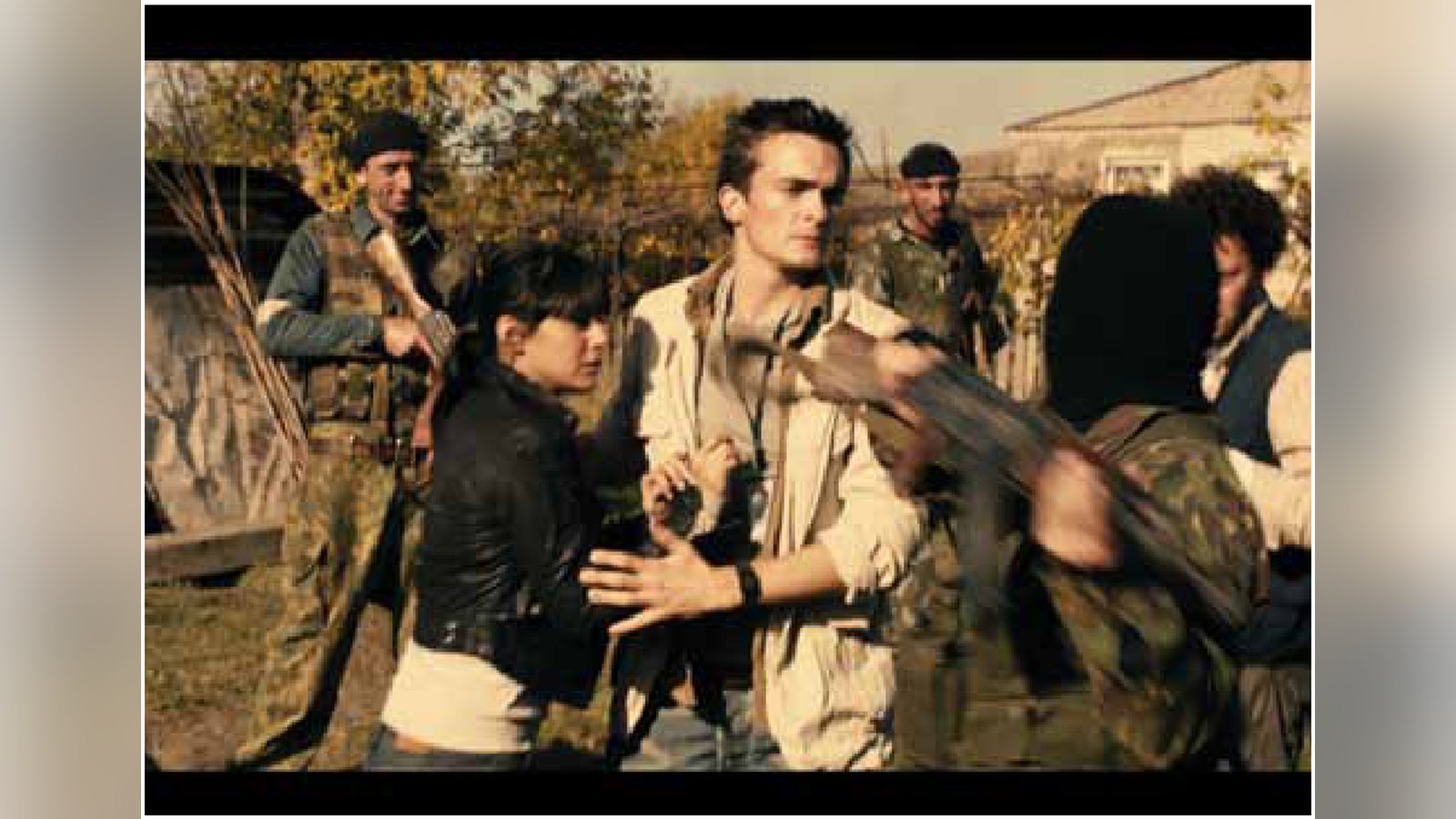
Renny Harlin: On, the first day of war, 90 Russian tanks rolled across the border and planes and tanks attacked villages, bulldozed them. It was swift and devastating. It took me a lot of time to get deep into my research. There were human rights reports about these events. While in theory it seems so ideal that a small country like Georgia has a relationship with America and is emerging like a poster child for the spread of democracy, it hurts because they built an oil pipeline Rupert Friend and Emmanuelle Chriqui star in 5 Days of War.
Photo Credit: Anchor Bay Films; courtesy of Iron Lion Film Production Inc.
Val Kilmer stars in 5 Days of War. over an American military base, this didn’t sit well with Russia and what Georgia was doing was very US-friendly. In my view, Russia decided to step in and stop this from happening. Now Russia occupied two areas in Georgia and has military bases there.
Was the inclusion of an American character – the main journalist – accurate?
Renny Harlin: I took the facts of the war and created a fictional story about a group of journalists who see these events unfold from an outsider’s point-of-view and create a relationship with the civilians. While they risk their lives to get the story, it’s not a given that they can get the story out. The new outlet’s policies on their news cycle are not necessarily in sync with the journalists on scene. Individual events are all based on stories that real journalists had seen. Trying to get a [camera card out of Georgia with evidence of the invasion] was part of the fictional element. Is it accurate to say that Russia acted ruthlessly during this invasion?
Renny Harlin: We were not trying to say that Russian people were bad guys. We were trying to say that governments in today’s world make bad decisions because of money and power and trying to get the minerals of the world. The [Russian commander] character played by Rade Serbedzija was not a bad guy or a bloodthirsty monster. Ultimately, I love his character. Anybody can go on the internet and YouTube and observe the commander of the Russian forces during the war and see that he was not a likeable guy. We wanted to turn that around and make him a good guy.
What do you hope that audiences take away from your film?
Renny Harlin: I hope that they would discuss this topic and realize more than anything the civilian suffering that goes on in these conflicts [including] the numbers of civilians that lose their lives and loved ones and homes – almost 100,000 [in Georgia]. While I understand that people don’t go to the movies to be lectured – they go to be entertained – maybe they will have some discussions about it and maybe change their views of these conflicts.
Since the mid-1980s,
Scott Essman has been writing and producing projects about motion picture craftsmanship. He has published over 350 articles as a freelancer and has produced over twenty publicity projects for Universal Studios Home Entertainment where he made video documentaries and wrote publicity materials. He published his first book, “Freelance Writing for Hollywood,” for Michael Wiese in 2000, and has a new book about Tim Burton.
Rupert Friend and Richard Coyle star in 5 Days of War.
Photo Credit: Nakanimamasakhlisi; Andy Garcia stars in 5 Days of War.
Related filmmaking guides
- Film directing: getting good performances
- Coverage and the master shot
- Camera angles in film: a beginner’s guide
Keep learning filmmaking
Want more lessons like this? Join StudentFilmmakers free for live webinars with working pros, and stream on-demand filmmaking classes in cinematography, directing, screenwriting, sound and post.