Reference: StudentFilmmakers Magazine, January 2007. Director/Screenwriter Ivona Juka: Details the Making of Editing Is It Life, or Is It Chroma-Key?. Pages 20 – 25.
Editing, a three-minute short by Croatia-based director and screenwriter, Ivona Juka, receives the second place award in the Summer Shorts 2006 competition. Juka is a student of film directing at the Academy of Dramatic Arts (ADU) in Zagreb, Croatia; and she has directed short films, music videos, TV commercials, animated films and won several national and international film awards. Juka talks about the inspiration for her short, Editing, and the making of key scenes.
What was the inspiration for your short film, Editing?
This film was inspired by our desire and our need to be the masters of our own destiny, but also by our impossibility to do that in full. We all thrive and want to “edit” our own future, but at the same time are being “edited” by others.
I’m not a fatalist who thinks it is impossible to do anything, impossible to take our lives in our own hands or change things if we want to. I believe there is much that we can and should do. Although, even when we change things of our own free will, the choices we make are only the fifty percent of the opportunities being offered, because we can never know what would have happened in our life if we had made a different decision. We can only suppose, but not really know.
Thus, the main character of this movie, constantly dissatisfied with the destiny forced upon him by the editor, decides to take things in his hands, escape from the film and finally be the master of his own fate. When he flees from the film reality into the real reality, he finds himself in a mine-field, and since he is a small character – from a 35 mm tape – as he is happily running after a butterfly, he is not aware that the real reality is much worse than the film one, and sometimes created by much worse editors. The same goes for us, who are so often unaware of the “mine-fields” which surround us.
In Editing, a lot was said in just three minutes. How long did it take to develop and write the script? In your own words, what is the story about?
First, I wrote the idea, and then developed the story. I want to stress that this film is a kind of homage to film editors as creators of a much better reality than that created by various power-wielders in our real life. I divided the film in two parts: what is going on in the film material manipulated by the editor, and what is going on as the main plot.
The main plot was easy to write. It could be expressed in two sentences: The main character is not satisfied with the “editing” of his life in the film and therefore decides to escape. When he escapes from the film tape into the real world, he finds himself in a mine-field. That was a piece of cake.
The problem was the part which takes place at the editing table, that is, the part of the script which describes the film reality and the editor who changes it. Every scene had to be written in such a way that it was later possible for the editor to either rearrange the same shots or takes and get a different meaning, or cut out certain frames and get a different outcome of the story. I wanted to respect the actual possibilites of the editor in the process of filmmaking, because as we well know, the editor cannot edit what hasn’t been filmed; he/she can only manipulate one and the same material to obtain different meanings of the same scene.
In the first scene of Editing, the protagonist gives the girl a flower and she smiles, and then pouts her lips, letting him know she is ready for a kiss. When the editor makes a second variant of the same scene, he cuts out the shot with pouted lips, and we are left with just the smile, which gives the scene a completely different meaning – she smiles not because of a flower but because he wants to kiss her. This was difficult to write, and I had to be almost mathematically precise in calculating what would be the effect of rearranging or cutting out of a particular shot in each scene, in order to get its two variants: before and after the editor’s intervention. The only fictitious element after each sequence is the display of the protagonist’s discontent with the editor’s intervention.
All scenes were written to make it obvious that the main protagonist was showing off, and had the editor left them as the main protagonist wanted, we would have got a horribly pathetic film about a super seducer.
In writing the script, I also had to bear in mind that it should be clear that the aim of the editor’s interventions is to make a wittier film. The changes he is making are not meant to spite the main protagonist, but to make a better film, regardless of the main protagonist’s displeasure. Therefore, the script had to include the procedures that the editor is including in order to make the second scene better, and at the same time to anger the main protagonist. I also had to include the editor’s reasons for such course of action, and I hope they are clear from the last scene at the editing table. This scene clearly shows that the editor is planning the happy end for the main protagonist only when he has stopped showing off and deserved it, that is, that his destined sweetheart is the girl that the main protagonist saves from the attackers. But the main protagonist is not patient enough to understand the editor’s good intentions, and flees the film before that, so that the girl is carried by the “invisible” protagonist, a hole in time and space, in which the main protagonist should have been, had he been patient enough.
The elaboration of the script took about a week.
How long did it take to shoot?
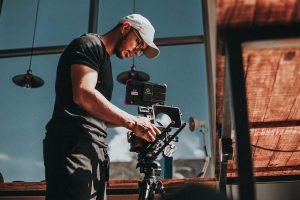
The shooting took three days. We used a digital betacam we borrowed from a professional studio. A lot had to be shot in front of the chroma-key background, and I planned a lot of compositing, so I wanted to get a camera with a higher quality optics than those at our Academy. I visited several professional studios and asked them to lend me the equipment they don’t use. Since I have already worked with some of them, they trusted me and agreed to lend me both the camera and the light for free, until a certain date when they had to be available for renting. The digital betacam was free for three days, and that is why I had to shoot the whole film in that time. It took two days to shoot all the scenes in the film and in the editing room, and one day for the scenes in front of the chroma-key, when the main protagonist runs from the tape in the editing room and escapes to the meadow. The preparations for the shooting lasted three weeks. I had to think hard how to shoot particular scenes and come to different solutions. A lot of paperwork had to be done, everything had to be elaborated in detail, and the whole team had to be fully prepared, so that we could shoot the film in such a short time. All of us who worked on the film are students, but we have some experience in professional productions. It was not the first time we worked with the professional equipment, but for all of us, it was the first time we were shooting a film with this many effects. We collected a modest budget from the sponsors, but the majority of costumes, props and locations were provided or found by us.
Could you describe what you did in the introduction scene?
First, I shot the whole scene with the main protagonist and the girl at the lake. The same was done with all the other scenes in the film – they were all shot in standard way and on their real locations. After that, we shot all the ‘editing room’ scenes; and we put the chroma-key screen instead of the projection on the editing table. The camera was set on a dolly behind the back of the ‘editor’. At the beginning of the shot, the editor could not be seen, but only the chroma-key screen. The beginning of the shot had to be shot long enough, so that later I could key in the scene with the main character and the girl, shot at the lake. After I’ve measured the time necessary for the camera to film the static pasted chroma-key screen, into which the scene at the lake was later keyed, I had the camera move backwards. When the camera starts going backwards, we notice the editor sitting at the editing table and realize that what we have seen is the projection at the table which has just been stopped. In this, it was very important that the gliding of the camera on the dolly be as smooth as possible, because it was quickened in the post-production of the image in order to obtain the effect of jumping from one reality into another. After shooting, in post-production, I inserted the scene at the lake into the first, static part of the shot, and when the scene finished, the camera started moving and revealed the editor’s reality. The same principle was applied to every ‘jumping from one reality into another,’ with some small variations, when necessary.
How did you create the part where the actor sticks his head through the monitor into the editor’s world?
When I thought about how the main protagonist would get the idea to flee from the film, I concluded it would be best if it ocurred to him by accident, motivated by something. In that scene, he is rather irritated and angry at the editor who spoils his every opportunity to have his way, and in that rage he bends violently towards the editor and in his emotional outburst accidentaly breaks the surface, that is the border between the two realities. When it happens, he is confused, but that gives him the idea that he could take control and run away.
First, I shot the whole scene on its natural location, except the frame when he thrusts his head. That shot was done “empty”, that is without the actor in the role of the main protagonist, only with the background which was supposed to be behind him at that moment – a wall covered with graffitti.
After that, I shot the editing room, in which the actor in the role of the editor nervously runs his fingers through his hair and doesn’t look at the projection screen. In the shooting of this shot, the projection screen was replaced by the chroma-key again.
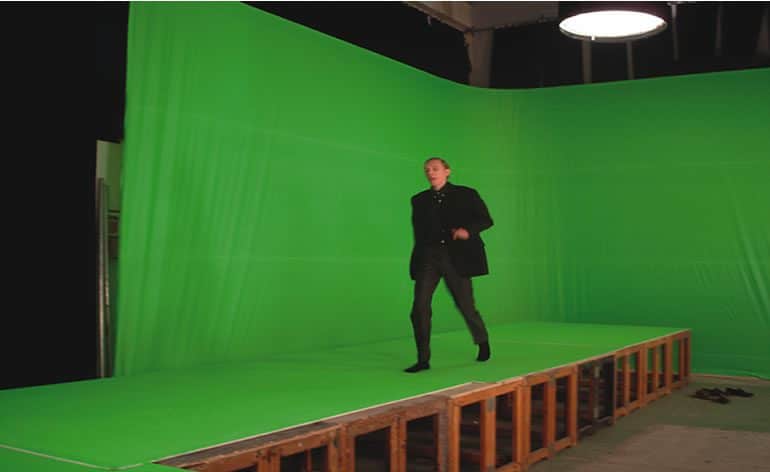
Then I shot the main protagonist in the studio, in front of the chroma-key screen. He just thrust his head forward and played surprised. I was careful that the movement of his head be shot from the same angle as the projection screen in the editing room.
In the postproduction of the image, we first keyed the “empty” shot of the natural location in the chroma-key screen in the editing room. Then, we made the actor’s head suitable for the size and shape of the projection screen and keyed that into the image of the projection on the editing table. When the actor’s head pops out of the projection screen, we added the ripple effect on the surface of the screen, in order to achieve a stronger impression of breaking the border between the two media. We added glow to his face to make it as plastic as possible. When he retreats his head, we added ripples again to get the impression of the closing of the border between the two media.
How did you make the actor ‘jump out of the film’?
I shot the detail of the editor’s hand pulling the tape. Around that detail, we can see the table surface and a part of the plate the tape is winding around. The plate is rotating so that the tape can wind around it.
After that, I filmed the actor in the role of the main protagonist in the studio. The actor was running in place on a big wooden box painted in the chroma-key color, placed in front of the chroma-key screen. At one moment, the actor just jumped from the box onto a chroma-key surface and waved his hands as if he were losing balance, that is, as if he had jumped on a rotating surface.
In the post-production, we made him “smaller” and “positioned” him onto the film tape. As the editor’s hand pulls the tape, we get the impression that the main protagonist is running in the opposite direction from the hand pulling the tape. When he “jumps out” of the tape, he lands on the rotating plate and thus we get the impression he is losing balance, since he is waving his hands.
How did you accomplish the part where the actor runs across the editing table?
First, I shot the surface of the editing table, but in such a way that all the details on it – plates, screws,… seem like a huge architecture. The camera was placed on the same level with the table surface. The actor was filmed in front of the chroma-key screen again, but this time the screen was behind and under him, so that the actor was running on the chroma-key, with the chroma-key background. For this part it was very important to have the same camera direction on both locations. We only shot the actor in front of the chromakey from a mild upper angle, in order to emphasize his smallness when we make him smaller in the post-production. At the end of the shot, the actor jumped, and that was it.
How about when the actor jumps into the cardboard box?
We filmed the cardboard box full of the tape rests in the editing room and while we were filming, I threw a cigarette lighter inside to make the tape shake a little. I could throw anything, as long as it was little and shook the tapes inside the box, so that later we get the impression that somebody had jumped into the box.
In the studio, we placed the camera real high, and climbed the scaffolding. Beneath the scaffolding, the actor was on the ladder with a chroma-key surface in front. We filmed in such a way that the ladder with the actor could not be seen, and the actor was supposed to jump as far as possible onto the chroma-key surface. We filmed the actor jumping onto the chroma-key. When the actor peeks from the hole on the bottom of the cardboard box and runs
away – I filmed the cardboard box in the front – and in the distance, there were the legs of the editor, sitting at the editing table. The actor was hidden in the studio behind the chroma-key screen, and he just peered out and then ran through the frame.
In the post-production, we made him smaller and placed him instead of the hole in the cardboard box, and then showed him getting out of the box and running away.
In Editing, the actors inside the editor’s monitor, the editor in his editing chair, and then, the man entering the new
realm at the end of the story – these all had a different ‘look’ to them. Could you describe what was done to accomplish this?
I wanted those worlds to differ both visually and by their atmosphere, so that the transition from the “film reality” into the “editing room reality” and the “real life” be as clear as possible.
Even when I was working on the script, I decided to place the plot into the old-fashioned editing style, so I chose the
editing table, the tape and the editor who literally cuts and pastes the tape. Although I’ve been editing in Avid for the last two years, I decided to show the old-fashioned way, because I felt it was better suited. It is no longer in use, unpractical, hard and a time-consuming way of film editing, but it is somehow nostalgically beautiful. Besides, the editing at the table seemed better because of the escape scene as well.
On the editing table, the tape is present physically and not just as the digitalized image on the monitor screen, as in Avid, and the physical presence of the film tape seemed to be the better visual choice for the scene of the escape of the main protagonist, and offered more possibilities of making the scene more vivid. The protagonist could “jump out” of the real tape, there are sprocketing wheels which turn, and such editing room is dark because of the
projection, so that the protagonist could “sneak away” unnoticed. After I decided upon the old-fashioned way of editing, it ocurred to me to use the silent comedy style to obtain the difference between the “film reality” and the “editing room”. The film reality was shot as a silent movie – with faster image, from 12 to 16 frames per second, and more grain – and thus, what we see in projection is separated from the editor’s reality. With the editor [character],
the photography should convey the feeling of loneliness and utter concentration onto another reality – that of the film. As far as the “real life” – the meadow that the main protagonist escapes to at the end of the film – is concerned, it was filmed without an artificial illumination, but the photograph was coloured in post-production, with the
aim to make the grass and the nature as fairytale-like as possible, to the very end of the movie when the camera reveals the ‘Mines’ sign and the grey, steel clouds above that magic beauty. The magic colors of the grass and the flowers in contrast to the steel clouds and ‘Mines’ sign, symbolize the beauty and the horror of the reality which
surrounds us.
How long did it take to edit Editing?
The editing took four days. Everything was so precisely shot and calculated ahead of the shooting, so there wasn’t much work in editing, except to choose good repetitions and put the shots together. This type of film does not request much thinking in editing, but before editing. I edited in Avid. The postproduction of the image, though,
lasted for two weeks. Day and night. Color grading, compositing and keying were done in Lustre and Smoke. They had to be done in professional studios which produce TV commercials, since our Academy doesn’t have the necessary equipment and programs. The people in the studios were very kind and explained everything, showed
us how to do it and gave their equipment for free, but when they didn’t need it. Those two weeks, the producers and I worked day and night, almost without sleep. The sound design, which was very demanding, was done at the same time.
What was the most challenging part about making this short?
The most challenging part in the making of this short film were the preparations. When I brought the script to my associates, who are all my good friends and colleagues, they all asked me “how do you plan to do this?” When I brought the elaboration and the storyboard, and started to explain, they all nodded their heads in content, but still
asked “how”. I have to confess that it was very challenging to persuade them into the plausibility of the idea. Especially because in Croatia hardly anybody makes movies with compositing, chroma-key and similar.
That is done exclusively in high-budget commercials, not in the films, because it is too expensive. Our films are low-budget because they don’t have commercial value. It was also challenging to find the solutions to the questions of how to shoot certain things in order to obtain what I wanted.
And the hardest part?
Most definitely, to overcome the poor conditions of work. We are a small country with 4,5 million people, which is less than the population in the most American cities, and our film production is not rich. Nevertheless, when there are limitations, imagination often works better and harder, resulting in creative solutions. Bad conditions have often motivated me to give my best, not only in work. Besides, I have the best friends in the world who are, apart from being my friends, great experts in their work, and they are Anita Juka – producer, Mirta Puhlovski –production student, Maja Vukic – producer and editing student, Mario Oljača – camera student, Vlado Gojun – editing student and many others. Good films are always made by good teams.