Documentary producer and cameraman David Lent shares hard-won lessons on documentary camerawork, difficult locations and lighting on the run.
Independent documentary producer and cameraman David Lent shares unique and challenging experiences working in the trenches on documentary shoots. Lent discusses lighting issues that documentary film/video crews might face and shares lighting techniques and advice for filmmakers.
Could you share with us one of the most unique or most interesting situations you experienced working in the trenches as a cameraman on documentary shoots?
David Lent: Watching the news reports, in the spring of 1999, about the alarming flood of refugees pouring into Macedonia from Kosovo, I recalled how much money I’d made freelancing in Saudi Arabia and Kuwait during the first Gulf War and decided: “This is for me!” I packed my bags and promised my wife and daughter I’d stay out of the line of fire. Arriving at the Alexander Palace Hotel in Skopje – Media Central for the international networks – I was horrified to discover they were all fully-staffed. No work for me. I had rented a room with a local Serb family and it didn’t take long to sense that something ominous and chilling was growing in Macedonia. Under the noses of the foreign networks – too focused on the much sexier refugee crisis and NATO bombing to notice – a civil war was brewing. Faced with the choice of cutting my losses and returning home or staying in Macedonia to document what only my intuition perceived as a looming conflict, I went all in.
Problem was, Americans were viewed as the bad guys in this tiny, tense and hapless Balkan nation. As NATO bombers terrorized Macedonia’s Serbian brothers and sisters, I took a lot of heat and occasional abuse on the streets whenever I was recognized as an American. Unlike many of my colleagues who thrive on madness, I have relatively thin skin and days passed when I was barely able to leave the house, petrified of getting beaten up or worse. I remember thinking, “How am I going to make a documentary if I’m too scared to leave the house?” Dave Lent rehearses the unlocking sequence for Jeff, before he can be cleared to fly. Jeff makes sure Dave can get out of the harness in case of water landing. In Van Nuys Airport, Flight Coordinator Jeff Miller of Guardian Helicopters instructs Dave Lent in the sequence of steps necessary to release the harness connecting him to the helicopter, get himself out of it and inflate his life vest, in case they were to go down in the ocean. Behind Jeff is Max Flint, the host of the BBC series of documentaries called Liquid Assets. Photo by Dave Sampé.
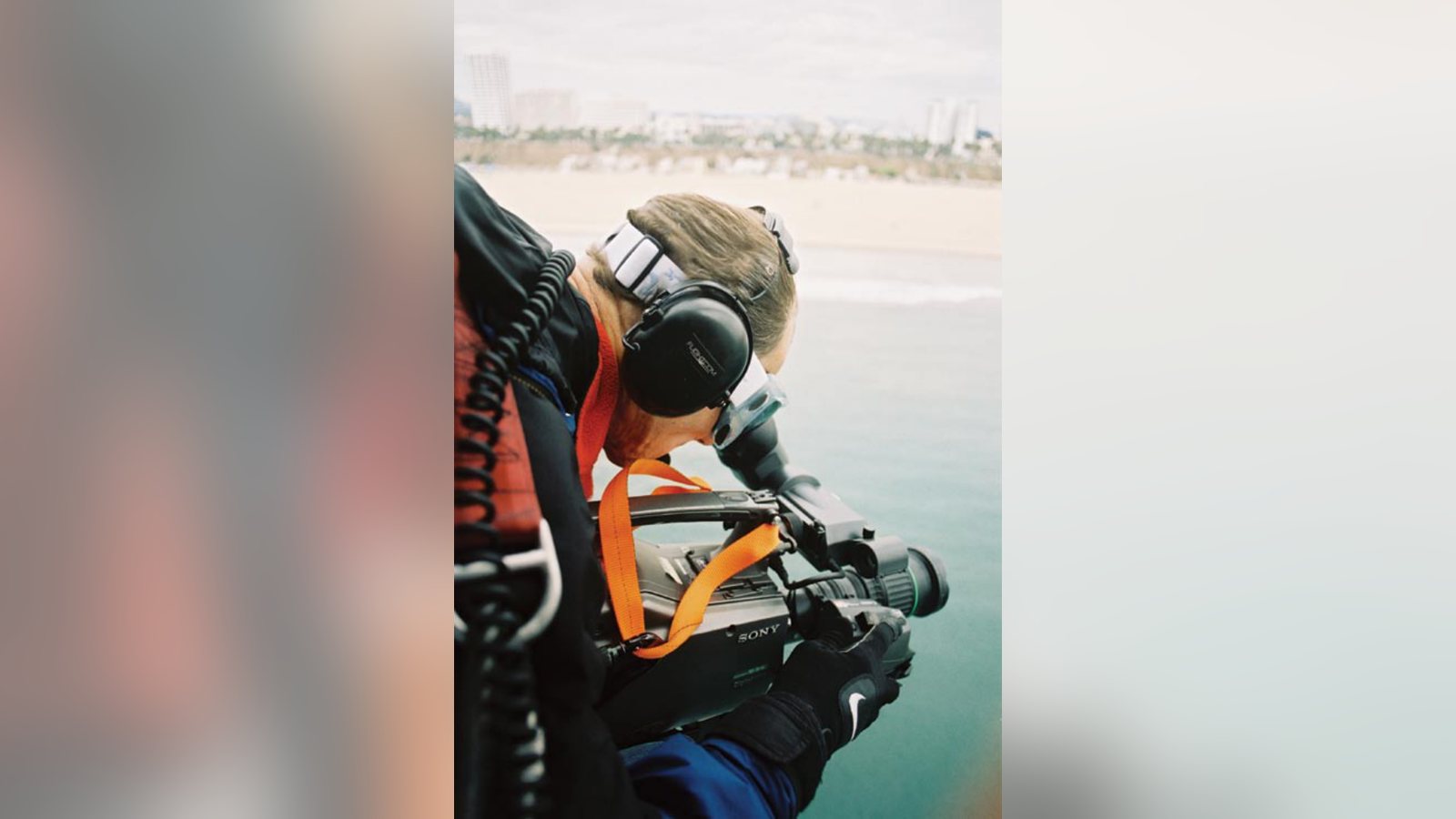
“In this shot you can see that if I were to lose my grip on the camera, it’s not going anywhere. In the early 80’s, while flying over Kings Canyon National Forest in California, a gust of air ripped the camera away from me. But in those days, the camera was attached by an umbilical cable to the record deck; it dropped about six feet and I was able to hoist it back on board. Ever since then, I put a leash on it.”-DL. Dave Lent with his Audio Recordist and longtime colleague Dave Sampé. “Dave put a lavalier mic inside my headset so the conversation between the pilot and me could be recorded. On some aircraft, the sound person can plug directly into the communications system.”-DL. “As we head for the Hollywood Hills, let me direct your attention to some of the unique challenges of shooting from the open door of a helicopter. First, it’s cold up there, even though it might be mild on the ground. So I’ve got my North Face jacket, liner and gloves. Without appropriate eyewear – tinted ski goggles are ideal – the wind would tear up one’s eyes making it impossible to see the viewfinder. I removed the camera mic and lens hood – both could be easily blown off against 150mph windspeeds. I’m cradling the camera so my arms can act like a Steadycam, absorbing the vibration. And I have a microphone and headset to communicate with the pilot.”-DL. Photo by Dave Sampé.
“This shot gives a better view of the harness. I’m wearing a seatbelt, but don’t feel comfortable unless I’m also attached to the bulkhead by a separate harness.”-DL. Photo by Dave Sampé.
I came across a quote from Friedrich Nietzsche: “Go joyfully into the horrors of the world.” This became my mantra. I decided that whatever happened, even if I went down, I was going down having a good time.” I put a “F—k NATO” sticker on my camera and carried a half dozen amulets for safety and good luck. My driver, who I trusted with my life, became my bodyguard; I supplied him with a two-way radio and earpiece and instructed him to alert me to any approaching threats. In three trips to the Balkans, I shot Hotel Macedonia, recording the sequence of emotional changes that lead a society to war. Among the things I discovered there is that we learn courage by being courageous. It’s just practice. I also discovered, in the place I least expected to find it, the darkest side of human nature. I saw it in myself.
Did you ever experience “Murphy’s Law” on a news or documentary shoot?
David Lent: I’m frequently humbled by the sheer number of ways that things can come undone in our business. Fortunately, over time, experience teaches us ways to respond gracefully to the pressures of things (or people) falling apart, not showing up, getting lost or damaged or mysteriously malfunctioning. I’m often reminded of this quoted from Arthur Jones, inventor of the Nautilus (exercise) machines: “Success comes from good judgement. Good judgement comes from experience. Experience comes from bad judgement.” Whether it’s an equipment or people problem, I find that stepping back, approaching it from a different direction, trying something different – as many times as necessary – usually leads to a solution.
Example: I work with a news anchor and making her happy with the way she looks is challenging. Often she needs to do a standup in the midday sun, making it difficult to light her since it’s just me and a sound recordist with five minutes to set up. So I bought a 42-inch translucent flip-open reflector and asked the sound guy to hold it over her. She now looks much better in this light than she did with a 400w HMI in her face. Low tech solutions are often the best ones.
What would you say was one of the most beautiful locations that you had the opportunity to shoot in?
David Lent: It’s not easy to pick one because there is so much beauty everywhere. But the Arabian desert is breathtaking. One of the most inhospitable yet haunting and beautiful environments I’ve experienced.
And the most challenging location?
Chinook C47 moving sandbags for barrier on Louisianna beaches. Photo taken by Cheryl Gerber, shooting for the New Orleans Times-Picayune.
“The downwash from this giant Chinook helicopter would have blown me over had my producer not wrapped himself around the tripod.”-DL David Lent: I had stupidly shared my remaining bottled water with my Sudanese traveling companions before arriving at a home for street kids outside of Khartoum. Once there, our hosts offered Pepsi and, dizzy with the early symptoms of dehydration, I eagerly accepted. But it was delivered in a glass with ice cubes. In my compromised judgment, I actually convinced myself, “If I drink it fast, I’ll be ok.” Wrong. The ice was from contaminated water and I was fortunate that (1.) I didn’t get sick until I arrived home two days later and (2.) A local urgent care physician with experience in tropical diseases provided the right treatment, allowing me to make a policy: Don’t share your water with people who don’t need it. The Sudanese, like many in that part of Africa, don’t perspire as we do and their bodies have adapted in ways that use water more efficiently than ours do.
What are common lighting issues that documentary film/video crews often face?
David Lent: I’ll speak for myself. Occasionally a producer or correspondent will ask me to put a “slash” of colored light on a wall behind an interview subject. As a student of the Sven Nyquist (Ingmar Bergman’s cinematographer) school of lighting, it must be logical and I don’t want a viewer wondering, even unconsciously, “Where the hell did that slash come from?” So I find myself in the position of doing my best to please my client and at the same time needing to please myself. If I win more of these small battles than I lose, it’s because I feel strongly about lighting and am usually able to convince the client, in the words of the great director John Huston, that “notice the work and the magic is gone.” This is as true for camerawork, audio and editing as it is for lighting.
Another issue I find common is the tendency of many of us to throw up artificial lights without exhausting the natural light available to us. Today’s cameras are so sensitive that artificial light is often unnecessary. Hell, just move the chair close to the window. Pull that lamp over. Replace the 60-watt bulb with a 100-watt and there’s your key light. Switch the gain to +6 and you have a nice fill. Perhaps I exaggerate a little but my point is to first use what’s there, if for no other reason than it’s free.
I recently shot a short doc about DC gang violence. Never used an artificial light. The gain switch, flashing police lights and streetlights were the only sources.
Could you share with us one or two lighting techniques or solutions?
Photo taken by Cheryl Gerber, shooting for the New Orleans Times-Picayune.
Interview with BP Exec after spill.
“Airboat trip to damaged marshlands, Grand Isle, LA. My soundman on left is Rob Shire. We’re joined by a still photographer and our airboat captain.”-DL David Lent: When I light a one-person interview, for news stories in darkly-lit government buildings and think tank conference rooms, I use a Lowel Rifa 44 – either tungsten or fluorescent – as a soft key, placed above the reporter’s head. I put up an opposing backlight – a Lowel Pro Light 125w with a snoot covered by 1/4 blue gel – on a small boom arm behind and above the subject so it hits the shoulders and, softly, the back of the head. The quarter blue on the back light is something I learned from a Hollywood DP; it gives a slight color temperature contrast between the key light and backlight – not distinctly visible but the effect is a slight coolness. I’ve been doing this for 20 years and clients love the look while having no clue as to why it’s so appealing.
The HD you do is limited to live shots for Fox News Channel. Could you tell us more about this and kind of give us a behind the scenes of what goes on and your workflow?
David Lent: If I didn’t have to do the job of a mule to pack, haul, unload, set up and reload all the gear required for network live shots, the work would be totally fun. So I don’t do it often, usually only when my partner Grant Peacock (The Washington Group) is overbooked or needs a second camera at a location. For me, the fun part is the pressure. While we’re setting up, say at one of the Senate or House office building Rotundas, the assignment desk will email a schedule of “hits” for the day. Video and audio lines will be connected to a central patch bay serving all the crews in the Rotunda and the shooter will be connected to a “bridge” so we can hear the director of the particular show whose host will be conducting the interview. Either a Senator or Congressman, with or without media staff, will show up, get a mic dial up box and earpiece so they can listen to the show. Quite often things go wrong: the control room can’t see the Senator or she or he can’t hear the anchor or the volume on his or her dial up box is barely audible or the battery is dead. Or you suddenly find out from the desk there will be two guests, not one, and you only have one dial up box. Or one of the other crews has a problem with your light being in their shot, across the Rotunda. Or you can’t break for lunch because you’ve got to be available for an unexpected, last-minute hit. Amazing how much can go awry. But it’s live television and brings great satisfaction when it’s done well and nothing unforgivable happened, i.e. no one notices the work.
What are your favorite cameras and film/video making tools?
David Lent: I’ve always been a Sony camera / Canon lenses / Lowel lights guy. That being said, I can assure you Panasonic, Fujinon and Arri make equally wonderful tools. I’m learning the PDW-700 and like it a lot, especially for its weight, but I often shoot P2 with an HPX2100, heavier but equally beautiful images. I took a Sony PDW-350, a half-inch XDCAM, to Honduras this year, with a 13×3.3 lens and loved it.
My favorite videomaking tool is one I designed myself: the SteadyBag. In the early 80’s a guy in a wheelchair came up to me while I was shooting a local news story in San Francisco. He said he wanted more than anything to be a shooter but he couldn’t use a tripod from a wheelchair. I couldn’t get him out of my thoughts and eventually made a beanbag camera support so anyone could have a rock-solid shot from any surface. I was the butt of jokes until one of the KRON-TV veterans, Dick Williams, started using a SteadyBag I made for him. Then the station bought twenty of them. Now they’re everywhere.
What are your thoughts on HDSLR filmmaking and 3D?
David Lent: My dad used a Polaroid 3D still camera as I was growing up and the photos he took with it, viewed with a stereoscopic viewfinder, are mind-blowing and make me feel as though I am there. I can only imagine that 3D videography will produce similar amazement and pleasure. I’d love to get my hands on one of these cameras.
HDSLR. Everybody I know who has a Canon 5D or a T2i loves it. These cameras bring people into the craft that might not have had easy access before. And throughout my career it’s been heavy cameras that have discouraged a lot of women from the field. Most of what I do is hand or shoulder-held so a wide angle lens is critical for these small, lightweight cameras. I understand that many of the issues associated with HDSLRs, such as overheating and audio limitations are being worked out. Much of what I do, professionally and personally, involve interviews lasting up to an hour, so I’ll be near the head of the line when that limitation is pushed away.
If you could share one piece of advice for new and aspiring filmmakers and video makers around the world, what would it be?
David Lent: When I first picked up a video camera in 1971, I didn’t know the value of a great teacher as I do now. Granted, the technology was new and there weren’t a lot of us practicing the craft, let alone good enough to teach it. But now I know that with a mentor or coach the level of mastery I reached in twenty years could have been accomplished in ten. So my one piece of advice is: Get a Guide. Find someone whose work you admire, someone who is doing the kind of work you want to do. Find a way to make yourself useful to that person. Do whatever you have to do to become an apprentice.
And I can’t resist adding one more absolutely crucial piece of advice: Follow your passion. “When you follow your bliss, that thing that truly electrifies you,” as Joseph Campbell said, “four things happen automatically. (1) You put yourself in the path of good luck. (2.) You meet the people you want to know. (3.) Doors open where there weren’t doors before. And (4.) Doors open for you that wouldn’t open for anybody else.” David Lent’s Filmography Includes:
1990-Present: Dave and Company provides news and documentary cameraman for numerous domestic and international broadcast clients.
2005: “The 5 Keys to Mastery,” Video Documentary; Director/ Cinematographer/ Producer.
1970s: David co-produces and shoots three prison documentaries, including the critically acclaimed PBS special, Life Without…Inside San Quentin.
1980s: David produces, shoots and edits a large body of news, corporate and documentary programming. With Susan Burgess-Lent, he co-produces the documentary feature, Staying Alive, inspired by Studs Terkel’s best seller, “Working.”
The expanded and updated edition of “The Laws of Camerawork,” called “Video Rules,” will be out in the spring of 2011.
Related filmmaking guides
- Film directing: getting good performances
- Coverage and the master shot
- Camera angles in film: a beginner’s guide
Keep learning filmmaking
Want more lessons like this? Join StudentFilmmakers free for live webinars with working pros, and stream on-demand filmmaking classes in cinematography, directing, screenwriting, sound and post.