By Saro Varjabedian
What medium best serves the story? Saro Varjabedian explains why he chose the Canon 7D for a DIY feature and the advantages of shooting on HDSLRs.
Choosing any camera system, whether film, Red, HD or now HDSLRs, always comes down to: What medium will best serve the story? Often, the creative choices are also weighed against practicalities in terms of resources, space or time restraints. On the production of Elliot Loves, a DIY indie feature shot in New York, the choice to use a Canon 7D became a topic of hot debate between the director, Gary Terracino and myself. Terracino was understandably wary about using such a new and somewhat unproven system. In addition, he’s a visceral filmmaker. Terracino needs to feel connected to the camera, so he doesn’t believe in using monitors. Rather he wants to look through the viewfinder.
Having shot several shorts with the 5D Mark II and the 7D, I am more comfortable embracing the system but am concerned with how to appropriately use it in conjunction with an EX1 and adaptor footage.
What allows for the possibility to mix camera systems is the style in which Terracino wants to film Elliot Loves and the construction of the story. The story moves between two different periods in Elliot’s life. Half the film takes place in Elliot’s childhood and the other in young adulthood. Terracino wants to constantly shift the color palettes and tone of the film from a lush, vibrant playful tone to a drab, gritty reality.
Keeping in mind the need to “switch between tones” makes the decision to use the Canon 7D that much more appealing. What I have found is that the HDSLRs are really good at getting color saturation; whereas the EX1, as a result of the adaptor, is better suited for getting grittier images because the glass in the adaptor adds a texture to the image while pulling out some color saturation.
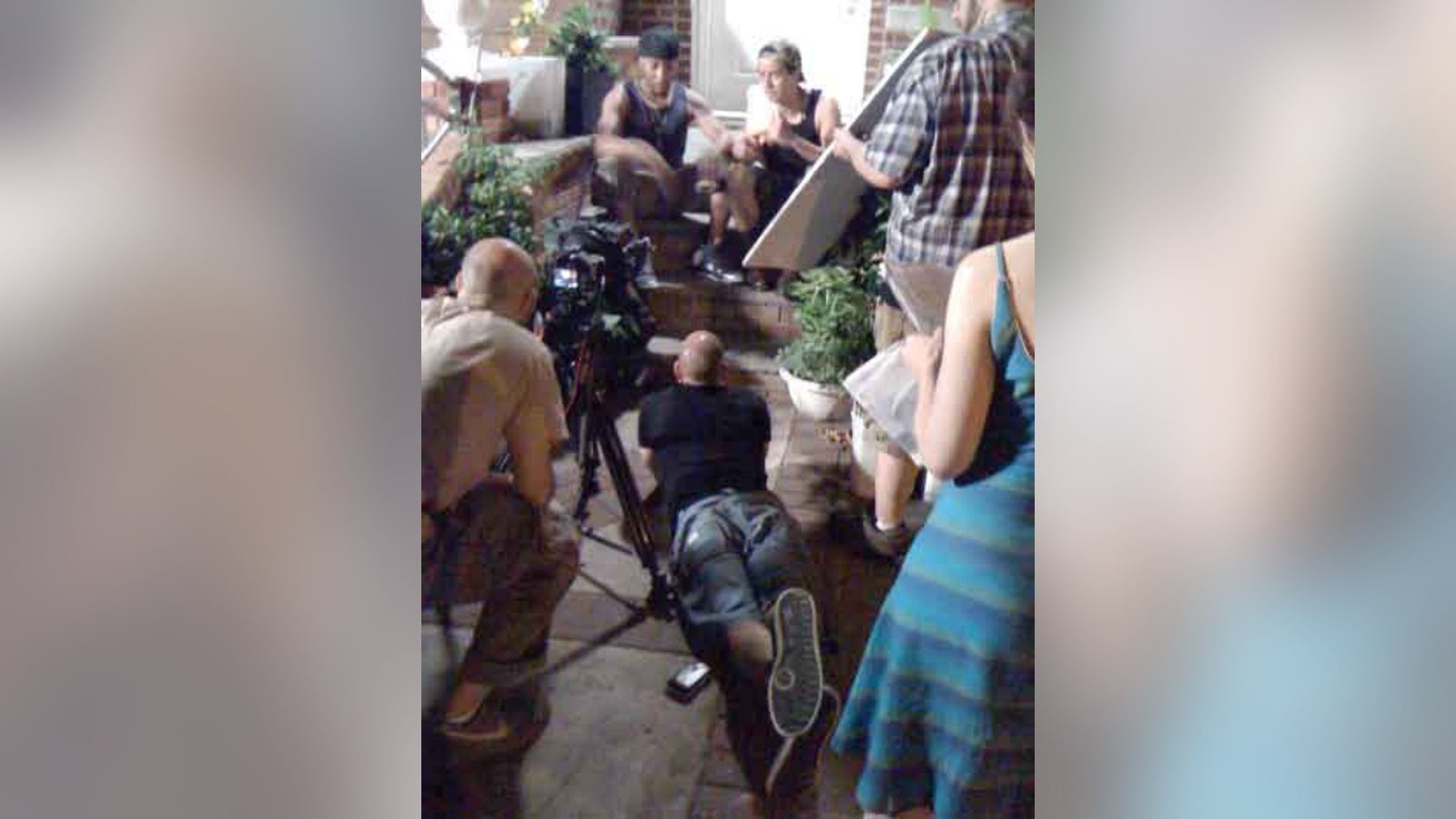
Secondly, we very quickly discover that the nature of this DIY project creates practical restrictions which the Canon 7D resolves for us. We are shooting on location, often in small, cramped spaces, and because of limitations in resources, we can’t afford to get a generator to power up larger lights. So the Canon 7D offers us more camera angles in the tight spaces and the ability to use smaller lights. (But not less lights; we’ll talk about this a little later.)
So the reason why I am choosing the 7D over the 5D is that we know we are going to film this at 24p. At the time production began, Canon had not released its 24p firmware update for the 5D. In addition, while I think the 5D does get a better image in terms of latitude, I do feel like the sensor is a bit too big making focusing far more difficult. The 5D sensor is closer in size to 65mm film, while the 7D’s sensor is similar in size to Super 35. The extra frame size of the 5D makes the depth of field very shallow, and in low light situations where you can have a lens set at f 2.8, hitting focus marks in tight time restraints on long takes following actors becomes very difficult. Secondly, to blend the two systems I am choosing to use Canon glass for both the 7D and the EX1 and adaptor.
One of the considerations I need to take for the Canon 7D is that the film requires a lot of movement. Often this movement needs to be clean tracking shots, but when the story gets grittier, we would go for a more breathing, handheld feel. The HDSLRs, while great on slow movements, sticks or focus pulls, are terrible when going handheld because of the weight of the camera. To go handheld with the Canon 7D you must weigh it down or else the movement becomes too jagged and unnatural. To weigh it down, I place a matte box and rod support, and then, add weight to the bottom of it. I use Canon lenses which have the image stabilizer function, and when I need to get even smoother, I use a glide cam rig. And, I always make sure to avoid quick pans because of the rolling shutter effect of the HDSLRs.
In terms of exposing for the Canon 7D, my biggest concern is how far I can push the ISO before it starts getting noise. From what I’ve seen at around 800 ISO, the 7D starts becoming noisy. The 5D was a bit higher, about 1250 ISO. So with the 7D, I make sure to never go over an ISO of 640. And like other HD recording devices, I shoot to protect the highlights of the Canon 7D. I find that protecting the highlights for the 7D is particularly important because I don’t like how it handles blow out.
Talking about lighting, a funny story comes to mind. One of the locations we are filming in is a giant church. What I want to do with the church is boost the light coming through the beautiful windowpanes.
So I tell Terracino that I want to place HMI’s outside the windows. He tells me that the condition in getting the church is that we do not place any lights outside. So not wanting to lose the window as a source of light, I tell Terracino that I won’t place any lights outside the windows but that we’ll be using the Canon 7D. Terracino says, “Great,” and thinks that to mean that I won’t be using any lights at all. So he reassures the apprehensive priest by telling him that we won’t be using any lights in the church as well. Well, come the day of the shoot, I have my crew rush in twenty or so lights, and the priest starts getting agitated, calling Terracino a liar. Well, no one wants a priest calling him or her a liar, so Terracino comes to me and says, “I thought you said we wouldn’t need lights with the Canon [7D].” I said, “No, I just promised I wouldn’t use any lights outside of the church”.
I tell this story because the common mistake is to think that because the Canon 7D camera is so sensitive, you just don’t need to use any lights. And that might be true if all you’re trying to do is expose an image. But that’s not what we’re trying to do in filmmaking. In filmmaking, we’re trying to create an image that affects us emotionally. So lighting isn’t something you do just so you can see what’s happening. Lighting is used to create tone and mood, through contrast, color, and the placement of it. So when thinking about lighting with the HDSLRs, it’s helpful to think of it as needing less light in terms of wattage but not sources. So you can use smaller lights, but you’ll probably still be using the same number of lights.
Saro Varjabedian, has been working as a freelance DP in New York for over five years. As a DP Saro has photographed many short films, music videos and features. Currently, Saro is in production as a DP for the feature “Elliot Loves” and is attending Columbia University as an MFA film student. Saro Varjabedian can be contacted at: www.sarodp.com
Keep learning filmmaking
Want more lessons like this? Join StudentFilmmakers free for live webinars with working pros, and stream on-demand filmmaking classes in cinematography, directing, screenwriting, sound and post.