The Importance of Having a Camera Operator on the Set
“Choosing Your Film Crew Wisely: Key Departments and Roles,” omits the role that camera operators play in the collaborative process.
Steven Poster, ASC, believes that this is a serious omission, and wants to set the record straight. Poster is president of the International Cinematographers Guild and an A-list cinematographer who has earned some 50 feature film credits, including Donnie Darko, Southland Tales and the soon to be released The Box, Spread, and Cats & Dogs 2.
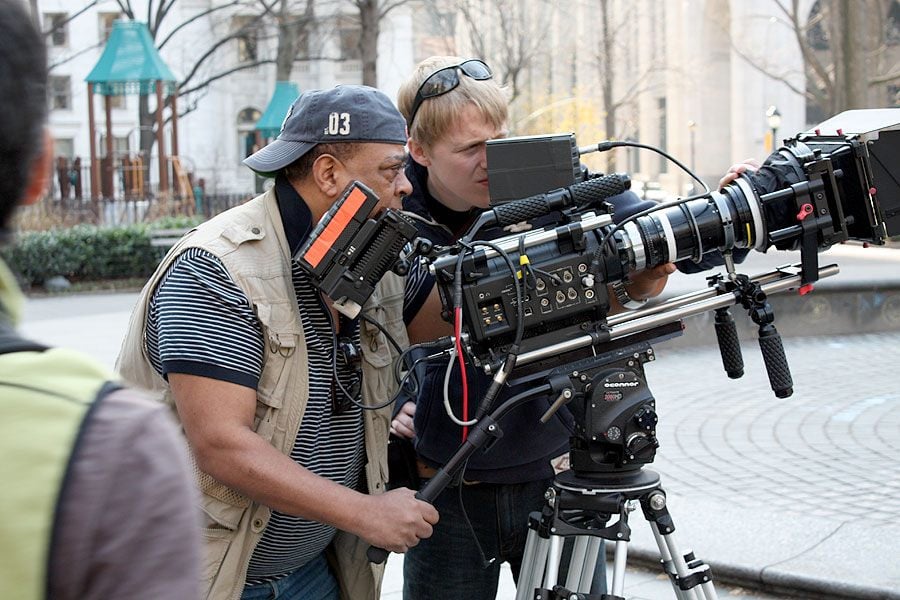
“Having a student concentrate on this crucial aspect of filmmaking – the placement and movement of the camera, the framing and composition – produces superior results, uses less time and money, and better prepares the student for the way film crews work in the professional world,” says Poster. “Let’s remember that the vast majority of directors of photography use operators. They know the value of having another set of experienced eyes. The operator can help the director of photography achieve the desired look in the least amount of time. The operator can find flaws, help with eye lines, and concentrate on the frame, which after all is why we are all there. It’s about efficiency, but more importantly for me, it’s also about a level of artistic excellence. The bottom line is that I can get a better result by having that partner on the set.”
On the set of a student film, using an operator serves the project well, but it also serves the students who are there to learn about filmmaking. “It gives an additional student a chance to train their eye, a chance to be involved in the creative filmmaking process,” says Poster. “No matter what the student’s eventual role in the filmmaking process, what better way to learn than to see the image as it comes through the lens?”
Dan Kneece, SOC, is the president of the Society of Camera Operators and a master Steadicam operator. He has earned more than 160 credits on projects of every size, budget and description.
“The idea that low-budget films can save money by having the cinematographer operate the camera is a misconception,” says Kneece. “The reality is that it invariably costs more money because it slows down production. Cinematography teachers at respected programs like Chapman University, USC, UCLA and AFI require full film crews with operators because they understand the importance of learning to work collaboratively. The films become calling cards for the students, so that they need to be of the highest quality.
“When two people collaborate – the cinematographer and the operator – the cinematographer can concentrate on lighting and working with the director,” says Kneece. “The operator can be lining up the camera move and rehearsing with the stand-ins. It’s a better way of realizing the director’s vision.
“Our system here in the U.S. has evolved for a reason,” he says. “It breeds efficiency and quality work. This system has been behind some of the best filmmaking for more than a century. Our expertise at communicating with the visual image is one reason American-made films are so successful and admired all around the world. That seems to speak for itself.”
Paul Babin, SOC has more than 40 credits as a camera operator working with top directors and cinematographers. Prior to his professional career, he earned a master’s degree in filmmaking from USC. He is also a member of the ICG National Executive Board.
“Filmmaking in the real world is collaborative,” says Babin. “This business is time-sensitive. There is always the pressure of the clock. I never work on anything where the schedule isn’t weighing on everyone. Filmmaking is so expensive, and there are so many unknowns and variables, so there has to be a system to cope with that. And the reality is that a camera crew works most efficiently with an operator. The work of the director of photography is wide-ranging. He or she is burdened with thinking and planning ahead. An operator makes that possible.”
Babin points out that operating a camera gives students insight into all aspects of filmmaking. “I’ve learned an enormous amount about directing, for example, by being a camera operator,” he says. “I see what works and what doesn’t. I know what the director is envisioning. I am privy to many of the conversations between the director and the actors, and I am able to talk performance with the director, and to participate in the visual storytelling.”
Camera operating provides film students with an unparalleled opportunity to learn, regardless of which role they hope to play on a film crew, according to Babin.
“A camera operator also sees how the cinematographer’s choices affect the movie,” he says. “Creatively, it’s the best job on the set, because you are responding instinctively. The dolly is a great platform from which to observe what is happening across all departments. Communicating with all these departments is a requirement of the job. You get to have an impact on all the factors involved in creating the shot and the movie.”
What Film School Teachers Are Saying
We also spoke with cinematography instructors at top film schools. They all agree that it is important to train future cinematographers how to collaborate with operators.
“Collaboration is the name of the game,” says Judy Irola, ASC, head of the cinematography faculty at USC, where she holds the Conrad Hall Chair in Cinematography. “We would be irresponsible to teach that anyone can make a top-quality movie on their own. This fall, we are starting a revised graduate curriculum that brings together all five disciplines from day one. We are making stronger connections with the USC writing, animation, theater and music programs, for example.”
Bill MacDonald has been teaching cinematography at UCLA for more than 20 years. “Students come to us sometimes with an auteur sensibility, because that’s what they read about in the popular press,” he says. “They read reviews that talk about Steven Spielberg lighting scenes when in reality he collaborated with Janusz Kaminski, the cinematographer who shot his last 11 films, and Mitch Dubin, a master camera operator. They are told that all you need is a camera and an iMac to make great films. They soon discover they can’t do it all by themselves.
“Teaching them to work with each other is absolutely a fundamental principle of our approach,” says MacDonald. “We’re building a collaborative environment that requires well-defined, clearly articulated visions. Generally speaking, filmmaking is maybe the most collaborative environment ever created by humanity to create art. To make a certain kind of film, you need to know how to get others on the same page. Our focus is on making very individually-driven and passionate work, but in an incredibly collaborative environment.”
Bill Dill, ASC is head of cinematography at Chapman University. “Any complex undertaking requires a group of skills that rarely resides in a single person,” he says. “In addition to that, the advantage of the collaborative process is that you have lots of great ideas coming from a number of different directions. Filmmaking has always been a group endeavor. Quality art tends to come from a concentrated effort. It’s an intense experience that comes from many minds feeding into the creation of the end result. That is much more of a determining factor of how we will make movies than mere mechanics.
“Technology has never been the determining factor in human creativity,” says Dill. “That’s a naive attitude. Smart directors don’t believe that hype. They are interested in making the best films they can by working with other people who share their vision. The people who do that do very well in their careers.”
Stephen Lighthill, ASC is the Senior Filmmaker in Residence, Cinematography, at the American Film Institute. “It’s great that people can shoot little movies and put them on YouTube,” he says. “However, we teach traditional team filmmaking. Fellows in our two-year MFA program shoot five films in collaboration with directors, producers, editors, production designers, writers and camera crews, often including operators. The very essence of what we teach is collaboration. The crafts we are teaching take second place to learning how to work in a team environment. We see having a camera operator on the crew as another opportunity for fellows in our program to learn effective communication in narrative filmmaking production.
“We also find that cinematographers can often concentrate more effectively on the range of production challenges while working with operators,” he adds. “They have more time and energy to collaborate with their gaffer, key grip, AD and director.”