By David Kaminski
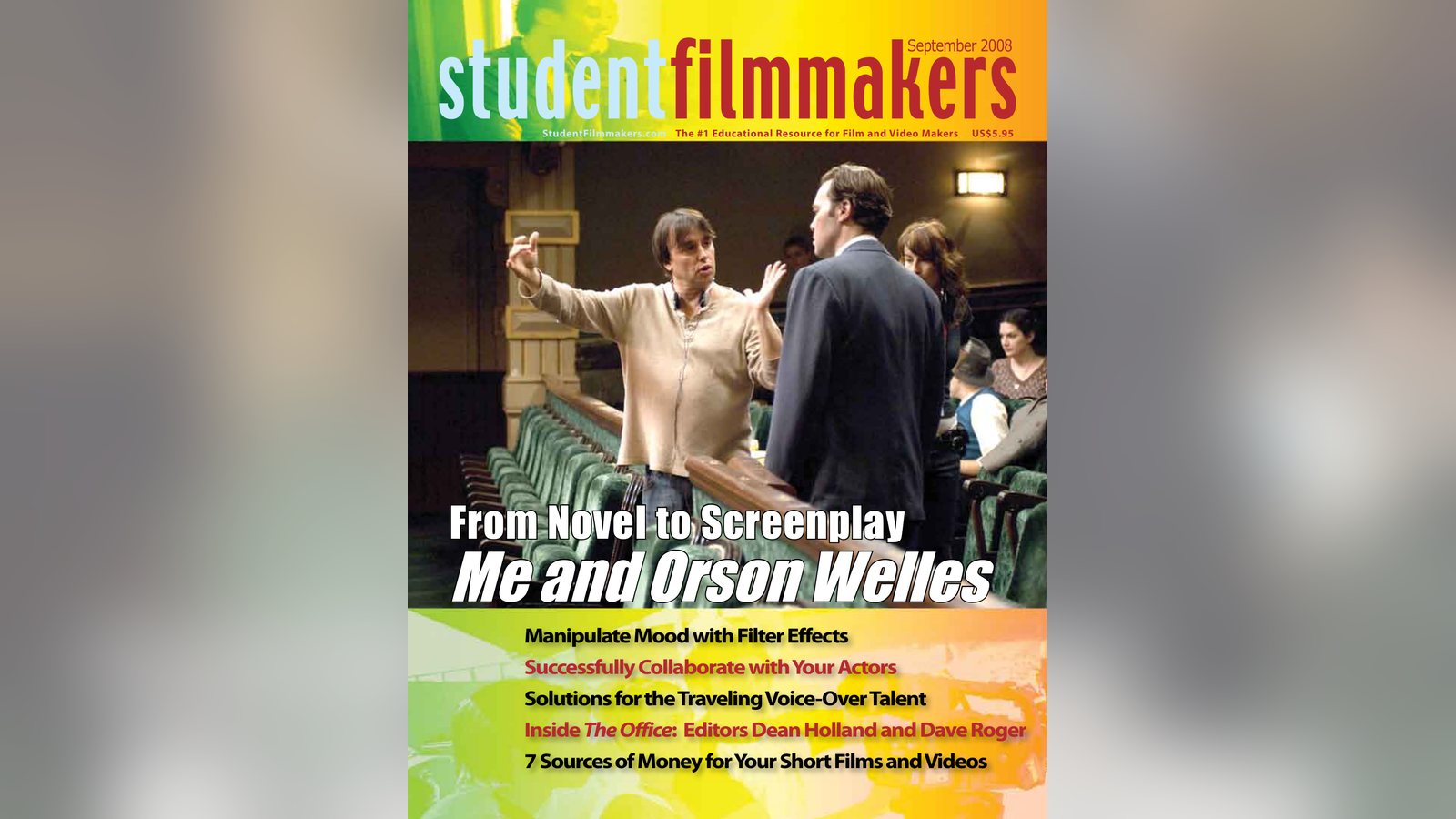
No filmmaker stands alone, not even Orson Welles. David Kaminski looks at adapting the novel Me and Orson Welles into a screenplay and film.
Even the best writers and filmmakers do not stand alone. Not even such immortals as Orson Welles. They are surrounded by people of many talents who help them realize their vision during their careers, and others must resurrect them after they die.
This winter you will see Orson Welles alive and well on the screen in your neighborhood multiplex and art-house cinemas, and he will astound you. In a new movie by director Richard Linklater, Me and Orson Welles, you will see the great actor (played by newcomer Christian McKay) as large as he was in life in 1937 during his rise to greatness at the Mercury Theatre in New York.
The brilliant beginnings of his career will be on the screen because of a novel by Robert Kaplow, a writer and fan of period music and culture—and most especially, a writer with a sense about how to get inside the world of Orson Welles. The journey behind the stage doors of the Mercury Theatre in New York comes to life through a young narrator (played by Zac Efron) who longs to know the fame and splendor of New York, though he also gets his first adult lessons about love, friendship, betrayal, ego, forgiveness, and show business.
Robert Kaplow reflects on the process of writing the novel and of its transformation into a screenplay.
“The novel takes place in one specific week in November of 1937. This is nearly twenty years before I was born. The challenge, then, was to try to recreate that lost period of time—of New York, of the theatre, of the everyday world—in enough detail that the reader could believe it, and then the reader could forget it and become engaged in the narrative.” “I’ve spent almost twenty years writing satirical songs and sketches for NPR’s Morning Edition. Most of these were performed as ‘Moe Moskowitz and the Punsters.’ I think that experience might have given me a certain polish in writing comic dialogue. With dialogue, the touch has to be very light. The effect has to appear effortless, though it often involves tremendous effort. The great theatre writers of the 1930s can teach you quite a bit: George S. Kaufman, Philip Barry, Clifford Odets. I mean, go back and read Kaufman’s libretto for the old Gershwin musical ‘Of Thee I Sing.’ It’s brilliant and funny and still sharp and surprising.”
“I think what gives this story its universality (if it really has that quality) is that every generation of young people yearns to leave a mark. To leave some artistic fingerprint on the world. Some people yearn to immortalize their names, but for some others the yearning is to immortalize the work. My friend the novelist Barbara Wersba always tells me: ‘Actors need to be loved. Writers want to be respected.’ It’s this longing to be respected for your work that sort of haunts Me and Orson Welles. With Orson Welles, of course, it’s a compelling war to watch between his egotism and his work. That’s one of the engines that drives the story.”
“The play-within-the-play was really the origin of the novel. I had a former student of mine writing me letters one summer about the summer-stock production of The Best Little Whorehouse in Texas for which she was playing the violin, and her letters were so rich in detail and humor and gossip that they really made me feel as if I were there. And so that was the seed of the novel: to write a story about people putting on a play in enough detail that the reader would feel he was a part of it. That the cast members were his friends. That he knew their foibles and voices and who was sleeping with whom.”
“I met the director Richard Linklater in New York where we saw a play [starring Welles actor Christian McKay] together. This was about a year and half ago. He had purchased the rights to the novel. I had seen all his films so we had, at least, some common vocabulary. What surprised me, and flattered me and delighted me, was that from the beginning everybody wanted to make a film that was true to the spirit of the novel. Linklater and I talked about the tone of the film, about casting, about music, and a great deal about Orson Welles, whom we both admired. A few weeks later I received a draft of the screenplay with a note encouraging me to tell him what I liked or didn’t like. This draft was good shape, but I began making notes, and by the time I was done I had ten single-spaced typed pages of notes. I was a little embarrassed to send this back to him because I thought the screenwriters would think I was an officious pain in the ass, but I sent it anyway. Maybe a month later I received the next draft of the script, and about 90% of what I had suggested was incorporated into it. This was very generous of the Palmos [screenwriters]. And suddenly the whole experience was beginning to feel like a collaboration. Further drafts and notes followed. Phone calls. Discussions about the music cues. We wanted to use as much period music as possible. Explanations. Clarifications. Fixing of errors I had made in the original novel! Then came the discussions about casting. Every day was another phone call. Another surprise.”
“What impressed me from the first draft of the screenplay I read (which I understand was not the first draft but about the fifth draft) was that the story was told with no voice-overs. This was technically hard to pull-off, and it meant finding visual or dramatic equivalents to the narrative voice of the novel. Here the Palmos were extremely successful. They added a lot of nice touches which I would have been happy to have stolen for the novel.”
“I traveled to the London and the Isle of Man in February to watch a week of rehearsals for the movie. The best moment was coming into the Gaiety Theatre on the Isle of Man and seeing that the stage had been converted to a perfect replica of the 1937 Caesar production: in exact scale, made from the original blueprints. This set hadn’t been seen in sixty years, and here it was—right down to the back brick wall and the holes cut in the stage so that the lights could shine upwards. And onstage were Zac Efron playing the ukulele, Ben Chaplin standing on top of the funeral pulpit doing ‘Friends, Romans, countrymen…’, and Christian McKay as Welles bellowing to Eddie Marsan in the audience [Marsan plays John Houseman]. And Claire Danes sitting on those green velvet theatre seats as Welles’s assistant. And all around me were technicians laying cables. Blindingly white helium lights were suspended from the ceiling and balcony. And then smoke machines began making the whole stage set appear spooky and spectral. Actors walked up to me asking me questions about their characters: ‘How does Evelyn really feel about Richard?’ I sat in the first balcony of that theatre and looked down at the spectacle of actors and technicians and thought: ‘I gave work to all these people. Well-paying work.’ That made me happy. And a little overwhelmed that this was the result of a story I began writing on my porch in New Jersey in the summer of 1993.”
“I hope they remember what it feels like to be young and drunk with the possibilities of life.”
David Kaminski teaches TV Production/Media at Clarkstown HS North in New City, NYóabout 25 miles north of New York City. His students have earned five Telly Awards and over 50 national awards for their work. They also have screened their films more than 200 times in festivals across the country and internationally.
Keep learning filmmaking
Want more lessons like this? Join StudentFilmmakers free for live webinars with working pros, and stream on-demand filmmaking classes in cinematography, directing, screenwriting, sound and post.