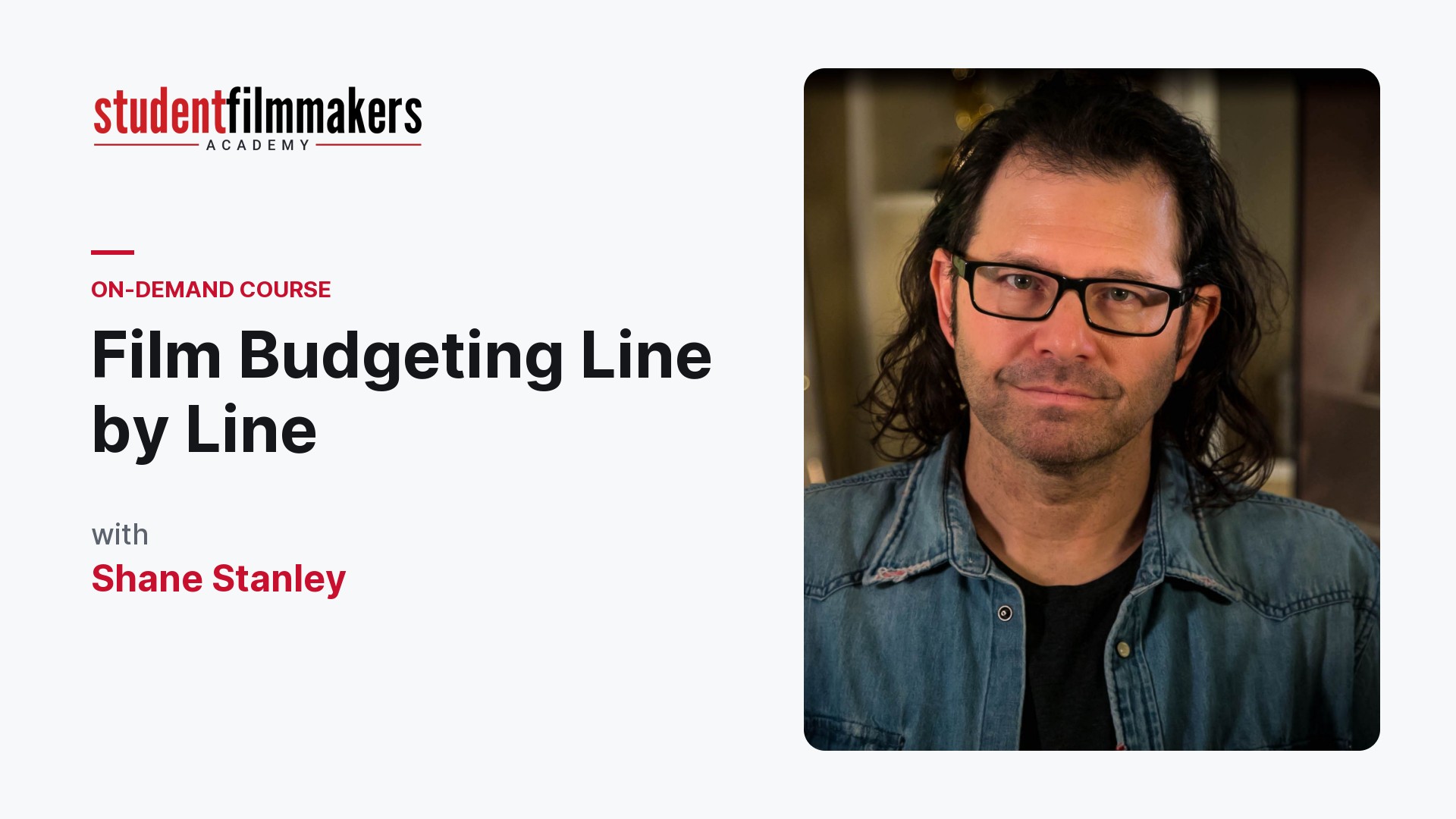
Shane Stanley, a producer with multiple Emmy wins whose directing includes Double Threat and Night Train (he was also an executive producer of Gridiron Gang), walked through an indie film budget line by line in this class. His lesson after 37 years of producing: the costs that sink a low-budget film are rarely the big ones you plan for. They are the 40 percent on top of an actor’s rate, the generator that triples, and the “free” location that comes with a paid babysitter.
Stanley taught the class five weeks before starting his next film, so many of his examples came from that week’s phone calls. He kept a sample budget open and went top to bottom: above the line, below the line, post, insurance and the closing lines most first-timers leave out.
What goes above the line in a film budget?
Story and rights, producers, the director’s unit and the cast. Two things he flagged early:
- Register the script with the U.S. Copyright Office. A WGA registration isn’t a copyright, he said, and isn’t what clearance and distribution look for: “Go to the United States Copyright Office and do it properly.”
- Pay for script clearance. At about $1,200 to $1,500, a clearance house checks names and places against real people. The report also earns a discount on errors and omissions (E&O) insurance later.
Keep every receipt from development meetings, too, from parking to lunch with an actor. Those become a “historical costs” line that investors and banks understand.
Cast is the most detailed section. Weekly SAG-AFTRA contracts can save about 20 percent over scattered day rates, so group an actor’s days when you can. Then add the extras nobody quotes you:
| Cast cost | What to budget |
|---|---|
| Fringes (pension, health, payroll taxes) | Add 40% to every SAG-AFTRA salary, plus a point or two for the payroll company |
| Agent’s fee | Sometimes 10% on top: a $30,000 deal becomes $33,000 |
| Schedule F | A $65,000 guarantee when an agent asks for it, though it is negotiable on lower-budget contracts |
| SAG-AFTRA bond | 40% of the total including fringes, held until wrap. He usually puts up about $12,000 and has always gotten it back |
| Perks | Manicures, special makeup, private car rides, a hair appointment after wrap |
On a half-million-dollar film, he said, above the line can easily reach $225,000 even when everyone gives a break.
Which below-the-line costs surprise producers most?
Locations top his list. Permits, parking, police and fire officers all cost money, and even a friend’s warehouse may come with a paid watchman.
“In this business, free is never free.”
Food comes close. Count your biggest day, not your average one. Eight actors, 30 extras and a crew of 20 eat very differently from four actors and a crew of 12. “The food is what bankrupts a lot of independent productions,” he warned. For craft service, he buys fruit that lasts a week, like oranges and apples, and skips sweets that melt on set.
Then there is the generator. He had budgeted about $3,000 for a 500-amp towable on his upcoming film. A call that morning, after the DP saw the locations, made it look closer to $11,000 once a driver, fuel and truck use were added. Other line items he never skips:
- Loss and damage. A C-stand blew over onto a borrowed $78,000 Jaguar on one of his early sets. On another film, a crew truck’s oil leak ruined a 200-foot driveway in Malibu, a $65,000 claim. Insurance helps, but deductibles are yours.
- Walkie-talkies. A good set of eight costs under $600 to buy, or about $500 to $600 to rent for a six-week shoot.
- Hair and makeup. With three or more women in the cast, hire two people. A second artist at a couple hundred dollars a day saves hours of waiting.
- Wardrobe bumps. Pay an actor $200 to $500 to wear their own clothes and save a shopping trip.
- Fuel. About $3,500 for gas on a four-week shoot.
Can you skip per diem when the shoot travels?
Stanley calls it the “three hots and a cot” rule. If the production provides breakfast, lunch, dinner, a place to sleep and rides, the guild and agents have generally been fine without per diem. A hotel deal with a breakfast buffet covers one meal, lunch is on set, and a standing cast-and-crew dinner invitation covers the third. In 12 years, he said, an actor has handed him a dinner receipt once.
How much does the camera department cost?
On a low-budget four-week shoot, $65,000 to $85,000 is not unusual, even at reduced rates, and some camera assistants won’t work for less than $600 a day. He sends the DP’s wish list, often ten pages, to at least three rental houses and lets them bid. To save on crew, he hires a DP who operates well, and a second operator who can also fly Steadicam and a drone.
His DIT doubles as assistant editor, syncing dailies and handing over a ready project three days after wrap. Every day’s media is copied three times before anyone leaves set, and shuttle drives rotate to the editor. He said that a producer who skips the three copies is “an idiot.”
What do post and delivery really cost?
- ADR. Write a day rate, around $500, into each actor’s deal so a looping session six months later isn’t a surprise bill.
- Music. “Don’t fall in love with music.” A famous song can cost $250,000. Hire a composer or a soundalike.
- M&E mix. A music-and-effects track with no dialogue, for foreign dubs: allow $8,000 to $10,000.
- DCP for theatrical release: $1,000 to $3,000.
- Closed captions: around $125 for a 90-minute film through Rev.
- Quality control. Distributors require a QC report. On Night Train, mic wires on an actress in a crop top had to be painted out with CGI about half a dozen times.
Which insurance does an indie film need?
He carries five policies and allows about $15,000 total, not counting E&O. General liability runs $2,000 to $6,000, inland marine for gear about $8,500, plus hired and non-owned auto, workers’ comp and excess liability for stunts or horses. Cast insurance is about $800, with physicals costing $150 to $300 each. His rule is to tell your broker exactly what you are shooting: “Nothing worse than being under insured on a film.” Buy E&O, about $5,000, only once a distribution deal is lined up, because the policies lapse after three to five years.
At the bottom of the budget: a 10 percent contingency, which SAG-AFTRA requires (13 percent if you add a 3 percent completion bond), legal costs, a new single-purpose LLC for each film (about $875 in California), fringes, and a negative line that returns the SAG-AFTRA bond. He also advises putting “films” or “entertainment” in the LLC name and paying a CPA rather than doing the taxes yourself.
His last warning was about actors who say yes to everything to land a role. The guitar player who has never touched a guitar becomes a $2,500 line for lessons.
For more on money and planning, read Balancing Budget and Schedule, feeding a crew cheaply and Think Twice Before You Hire Your Crew as Independent Contractors.
In the full class, Stanley also answers questions on aggregator distribution, insuring the director, asking actors to arrive camera ready, and selling a script from overseas.