By Saro Varjabedian
Saro Varjabedian explains how he used a tilt-shift lens on the short film LoveBug to put several planes in and out of focus for an unreal, futuristic look.
On a current short film that I’m working on entitled, LoveBug, the writer/director Alain Alfaro wants to build a futuristic/other dimension world where cybertronics have been imbedded into people so that they can now download programs, which alter their state of consciousness. So in early discussions with Alain, it became very clear that we had to create a world that is unsettling and somehow falling apart at the seams. To achieve this, I decided to try my hand at using a tilt-shift lens. Using a lens adaptor, I used a 35mm still photography tilt-shift lens, the result of which is that the planes of focus can now be manipulated in such ways that traditional lenses cannot.
Actor Ines Lucas rendered in and out of focus simultaneously. (screenshot)
Example 1. Actor Arturo Castro is in focus while actor Ines Lucas is out of focus, even though they are sitting on the same focus plane. (screenshot) Example 2. By shifting the lens horizontally, the focus has been pulled from Arturo to Ines. (screenshot) Foreground out of focus, midground in focus, and then background on screen right is in focus. (screenshot) Tilt-shift lenses give such detailed control over where the plane of focus will be placed, that you can now isolate one subject from another in ways that would normally be evenly focused along one plane. For example, by shifting the lens from left to right, a straight-on frontal two-shot can now be focus-pulled between the two subjects as shown in the screenshots, Example 1 and Example 2.
The second benefit in which the tilt-shift lens offered the “depiction of the world” is that I can now have multiple planes in and out of focus simultaneously. This helped in enhancing the feel that something is unreal or as if the world is somehow unhinging. An example of this is illustrated in the screenshot, Example 3. Notice how the subject in the foreground is out of focus, the subject in the midground is in focus, then the background is simultaneously in and out of focus.
Finally, there is a sequence in the film where the protagonist is having a seizure because of a failure of his cybertronic implant. The shot is meant to be a POV of the protagonist laying down on a gurney as nurses and his fiancé come rushing by his side. By racking focus and shifting/tilting the lens simultaneously, the image moves in and out of focus in such a way that is almost like looking at the world through one of those trick mirrors used in fun houses. The screenshot labeled as Example 4 illustrates the effect. I should mention that cinematographer Janusz Kaminski, ASC, who used it in the film, The Diving Bell and The Butterfly, inspired this effect.
As always, a tilt-shift lens, like any tool is only used because the story calls for it, and so the tilt-shift lens was necessary in servicing the concept of this film.
Saro Varjabedian is a New York based director of photography and has worked on numerous independent feature and short films, music videos and corporate videos. He is currently pursuing an M.F.A in Film at Columbia University. Saro can be reached at www.sarodp.com.
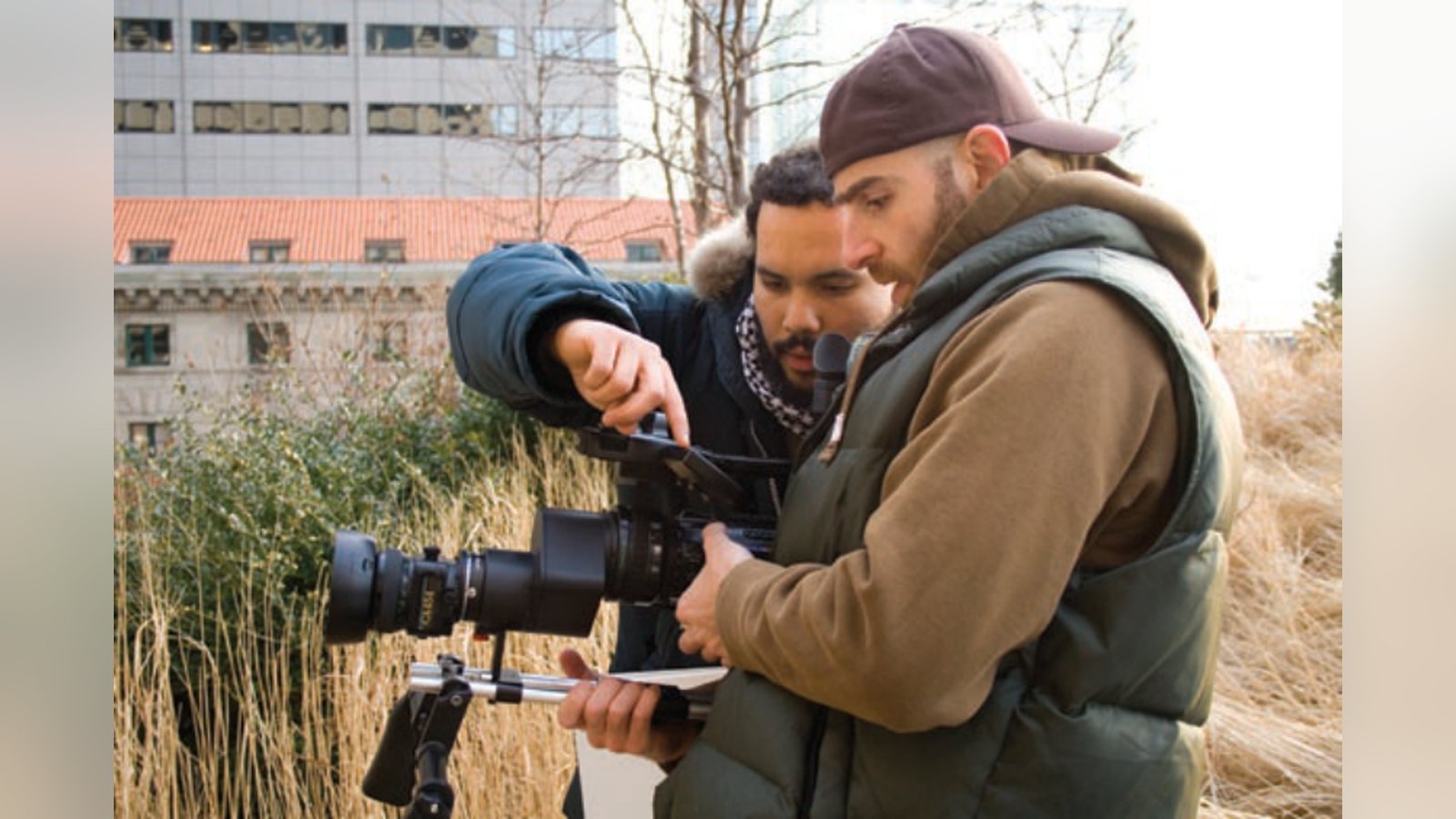
Director of Photography Saro Varjabedian decides where to place the focus with Writer/Director Alain Alfaro on the set of LoveBug.
Keep learning filmmaking
Want more lessons like this? Join StudentFilmmakers free for live webinars with working pros, and stream on-demand filmmaking classes in cinematography, directing, screenwriting, sound and post.