By Kevin Zanit
Shooting in a cramped practical location? Cinematographer Kevin Zanit shares how to light small rooms with limited gear, power and space, without a stage.
On a project with limited funds, we often find ourselves shooting in a practical location when a stage would be far better suited to the project. My last project, Room Service, directed by Kevin Castro and starring Howie Mandel, took place in a practical hotel room. This small space combined with a large ensemble cast created some unique lighting challenges, many of which are found in lighting other small spaces such as apartments, kitchens, and bedrooms.
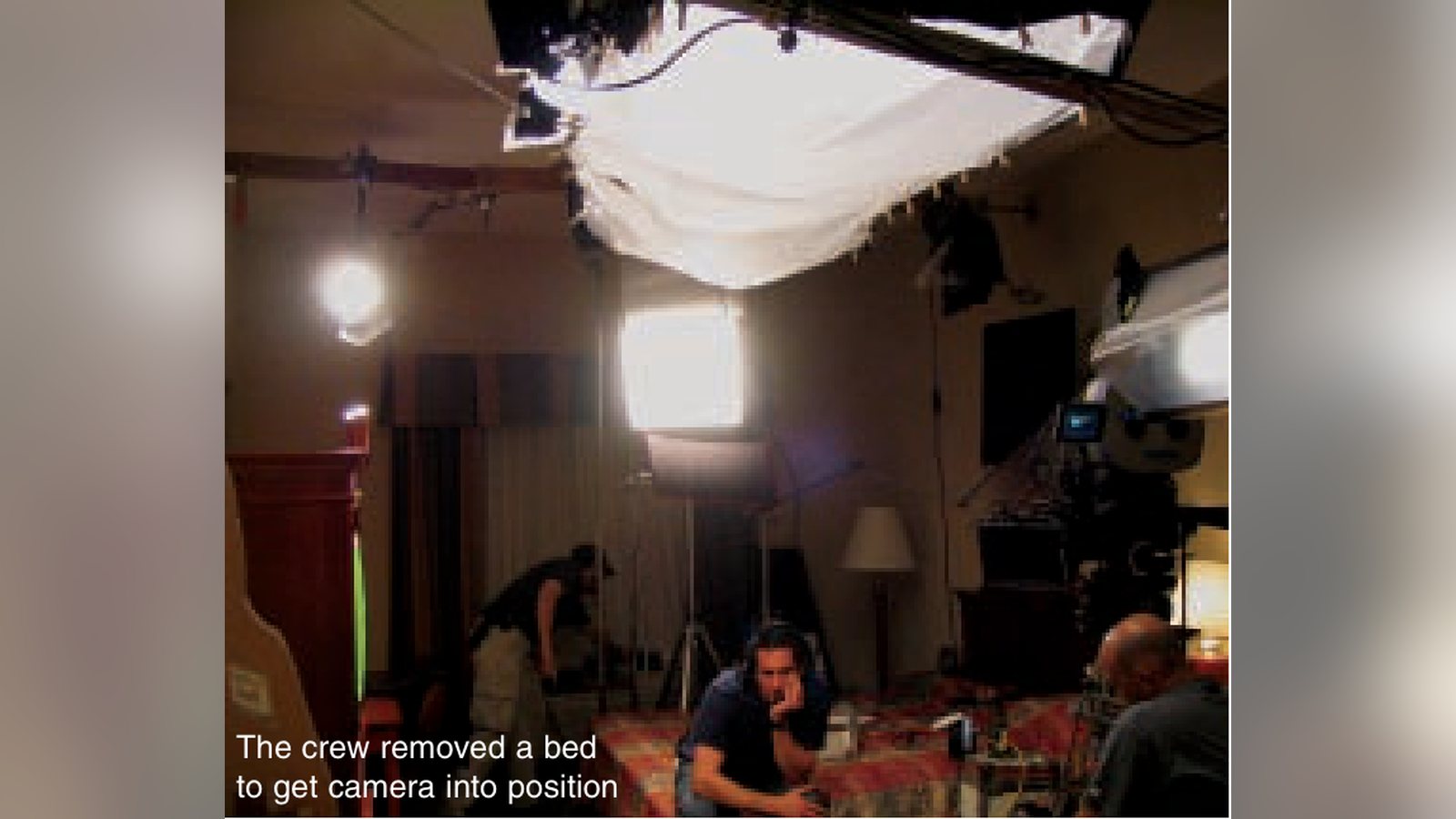
One of the many challenges of shooting in small spaces is simply fitting the camera into a small area, let alone working that small area in a way that allows you to get the best compositions. Proper planning helps to address this issue. To fit equipment in the room, expect to move furniture. Group as many shots as you can from that one position so you don’t find yourself moving furniture back and forth, wasting much time.
Perhaps the biggest issue in small spaces is lighting. It is one thing to get an exposure, but good creative lighting often requires space that you just don’t have. For example, I prefer to have distance between the people I am lighting and the light source. This causes the light to have less “fall-off.” Without getting into a physics lesion, “fall-off” refers to how much the intensity of light on a subject changes as he gets closer or further away from the light source. The further away you have your light source, the subtler the effect of distance is on intensity as the subject gets closer and further away to the light.
Because it is impossible to get this distance, we often have to surround the light with various nets and cutters so the subject doesn’t “burn up” as the performer gets closer to the light. This leads us to the whole other challenge of controlling the light in a small space.
In Room Service, I mostly used soft light, which requires larger flags and nets to control and keep off the walls. It is important to first choose the right lighting units for the space. Because I knew that I wanted mostly soft light for the film, I chose to use a package that was mostly made up of Kino Flos because they are easy to put in difficult positions due to how light and shallow they are. For creating harder light that was easy to control, I used Dedos because they are small in size and easy to cut.
Some Experiences and Tips Garnered from Shooting Room Service
I also knew that because the film featured an ensemble cast, and we were framing for 2.35:1, it would be very hard for me to hide light and grip stands. Thus, my crew set up a system of wall spreaders and arms to keep stands off the floor. This took more setup time initially, but it paid off as we moved through our days because we did not need to keep moving the equipment every time we changed setups.
A big part of my approach to lighting this film was to create a general ambience of light in the room, and then key the performers from the direction of onscreen practicals. This ambience was created by a large overhead light designed by my gaffer, Chris Hughes, which consisted of eight Kino Flo tubes attached to a large 8 foot by 4 foot piece of black show card. He then made a skirt all the way around the light that helped keep light off the walls.
Having onscreen practicals can be very helpful in grounding your lighting in reality. This can be difficult because in a small space you often don’t get to see the “big picture” of the room such as windows and overhead lights. Often you can even use the practicals as a light source by using ND gel on the camera side of the lampshade.
New film stocks have so much latitude that you can get away with allowing the practicals to go quite a bit overexposed. I often let the lampshades go over by five or six stops. It is also important to work with the production designer in not only getting enough practicals, but also getting the walls of the location the right shade. Having darker walls can really help you fight the fact that you often cannot cut your lights off the walls due to space limitations. This simple step makes a huge difference.
Essentially, having a good plan is often the key to working in small spaces. If you take the time in the beginning to establish an overhead system that covers most of your lighting needs, you can avoid trying to “tweak” for every setup in a small room filled with people and other equipment. This helps prevent getting frustrated with the small room.
For me, Room Service was an interesting and challenging experience. We were helped greatly by Phil Radin at Panavision, who helped us get a great camera package that we could afford, and of course my crew: 1st AC Ken Bender, 2nd AC Darrell Harrington and Elhanan Matos who filled in for Darrell, as well as my Gaffer Chris Hughes and his crew, and Key Grip Alex Simon and his crew. Working in tight spaces requires a flexible and good humored crew who can get along. These guys were amazing.
Kevin Zanit is a cinematographer based in California. His experience is mostly in music videos and does narrative work as well. His filmography in addition to Room Service includes These Days (2006), Inner Prison (2005), and Passing Moments (2003).
Keep learning filmmaking
Want more lessons like this? Join StudentFilmmakers free for live webinars with working pros, and stream on-demand filmmaking classes in cinematography, directing, screenwriting, sound and post.