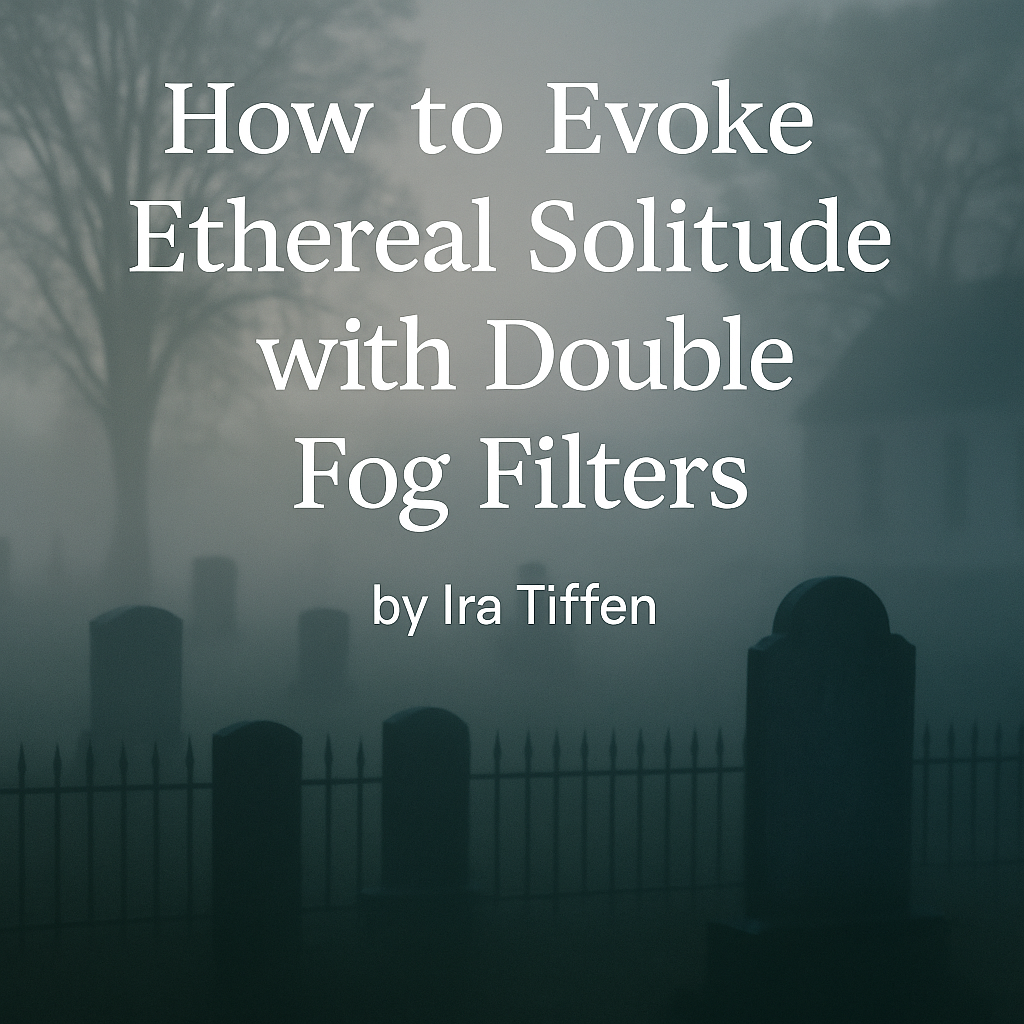
How to Evoke Ethereal Solitude with Double Fog Filters
by Ira Tiffen
Peace. Quiet. Solitude. And a sense of the ethereal. Today, we are in a cemetery (pictorially speaking) and seeking to convey the sense of actually being there through our imagery.
Standing upright in the fading sunlight, the markers appear starkly white against the surrounding darkness. Without a filter, the scene is much as it would appear to the actual visitor, but without the otherworldly veil that being there drapes over the mind.
In telling our story, we want to involve our viewer emotionally as well as intellectually. In this grave situation, we must visually impart that sense of the earth below and its connection to heaven above. In our unfiltered scene, we clearly see the stones, the fence, the trees and the building in the background. This is both too much and too little. We want to emphasize the stones and the surrounding fence, the latter as a sort of boundary between two worlds. And we want to diminish the rest.
How to do this? Well, we can use what is known as a Double Fog filter. These were originally developed to simulate the appearance of a natural fog, since in their stronger grades they combine both a strong reduction of contrast with a modest amount of highlight flare, much like an actual fog. In today’s case, though, we don’t want fog, just the suggestion of it, so we turn to one of the milder grades, the Double Fog ¼.
With the filter in place, the image goes through some not-quite-subtle changes. The centers of our attention, the stones and the fence, visually come to center stage, their faint glow and paler tones further separating them from their more mundane surroundings. The contrast is softer, rendering reality a bit less real. The result is the infusion of a sense of the otherworldly, the solemn, yet hopeful contemplation of what is to come for us all.
Or at least as far as our story is concerned!
Photos by Brian Austad
In over 30 years of making optical filters, Ira Tiffen created the Pro-Mist, Soft/FX, Ultra Contrast, GlimmerGlass, and others, netting him both a Technical Achievement Award from the Academy of Motion Picture Arts and Sciences and a Prime-Time Emmy Award. Elected a Fellow of the SMPTE in 2002, he is also an Associate member of the ASC, and the author of the filter section of the American Cinematographer Manual.
Featured in StudentFilmmakers Magazine, September 2008 Edition.
Sign Up for your own subscription to StudentFilmmakers Magazine.
- Click here to sign up for the Print Subscription.
- Click here to sign up for the Digital Subscription.
- Click here to sign up for the Bulk Subscription for Your School or Business.