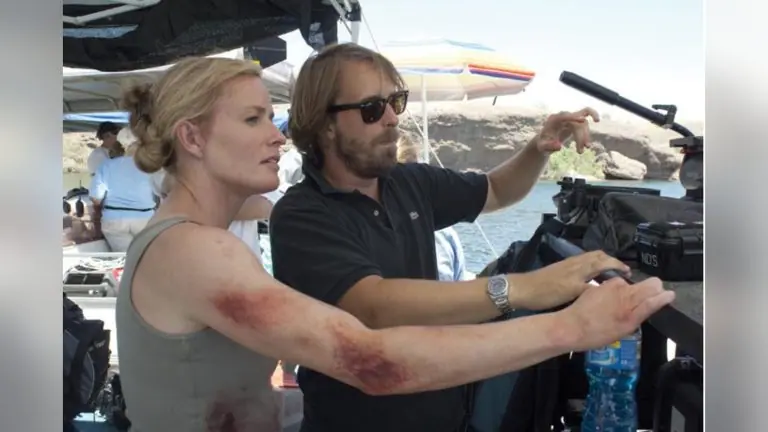
Michael Goi, ASC, led the American Society of Cinematographers as its president from 2009 to 2012, has shot and directed American Horror Story, and directed and photographed the first two episodes of Netflix’s live-action Avatar: The Last Airbender. In a short recorded Q&A for StudentFilmmakers, his message to new filmmakers fit in a few words: fail boldly, treat every new tool as part of your kit, and stop waiting to make your movie.
The session runs about eight minutes. There is no gear talk and no lighting diagram. It is a pep talk from someone who has spent a long career behind the camera and in the director’s chair, aimed at people who have a story they keep putting off. He moves through four ideas in order: what pulled him into film, why failure is useful, how the industry keeps absorbing new technology, and why the only real qualification is a finished movie.
Why does Michael Goi say film school is the place to fail?
Goi looks back on what first drew him to filmmaking, then turns to the years when a student has the most freedom. School, in his view, is the one stretch of a career where a failed experiment costs you very little and teaches you a great deal. That makes it the right time to try something risky.
His comparison is between two kinds of student films. One plays it safe, follows the rules and is forgotten by the end of the screening. The other reaches for something difficult and misses. Goi argues the second filmmaker comes out ahead, because a bold miss shows you where your limits are and how to push past them. A safe film shows you almost nothing.
What does success look like to him?
Not one big break. Goi describes success as a habit of walking through doors you have never been through before, and then doing it again with the next door. Each new kind of job, crew or story is another one. That idea runs through his own path from cinematographer to director to producing director on a large streaming series.
How should filmmakers think about AI and new technology?
Goi puts artificial intelligence in a long line of changes the film business has already absorbed. Sound arrived and silent films ended. Color arrived. Digital cameras replaced film for most productions. Each shift brought fear, and each one ended up as part of how movies are made.
His suggestion is to treat AI the same way: as another drawer in a toolbox, to be opened when it helps the story you want to tell. The point is not to chase a trend or to refuse it on principle, but to pick each tool, old or new, because it serves your vision.
He makes the same case for older techniques. A foreground miniature, a small model set close to the lens so it lines up with a real location in the distance, can still build a scene that would be far too costly to construct at full size. A trick that has been around for a century can sit in the same toolbox as the newest software.
What is the one real step to becoming a filmmaker?
Here Goi removes the last excuse. Many people wait for the right camera, the right budget, the right crew or the right moment. His answer is that none of those makes you a filmmaker. Making a movie does. With the tools now within reach of almost anyone, there is no reason left to wait.
That is why the class works well for film students, first-time filmmakers and teachers who want something short and encouraging to share before a class project. No experience or equipment is needed to take its advice. The phone in your pocket and a story you care about are enough to begin.
A short list to take with you
- Use school, or any low-stakes project, to take a real creative risk.
- Count each unfamiliar job or story as a door to walk through.
- Judge every tool, from miniatures to AI, by whether it serves the story.
- Start the movie you keep putting off.
For more from Goi, read his thoughts on AI, film school and starting a career, his three tips for directing actors and his article on creating a new reality to enhance the fantasy in your story.