By Sebastian Corbascio
Director Sebastian Corbascio shares notes on casting and directing young actors, from first-timers to experienced kids, to get natural performances.
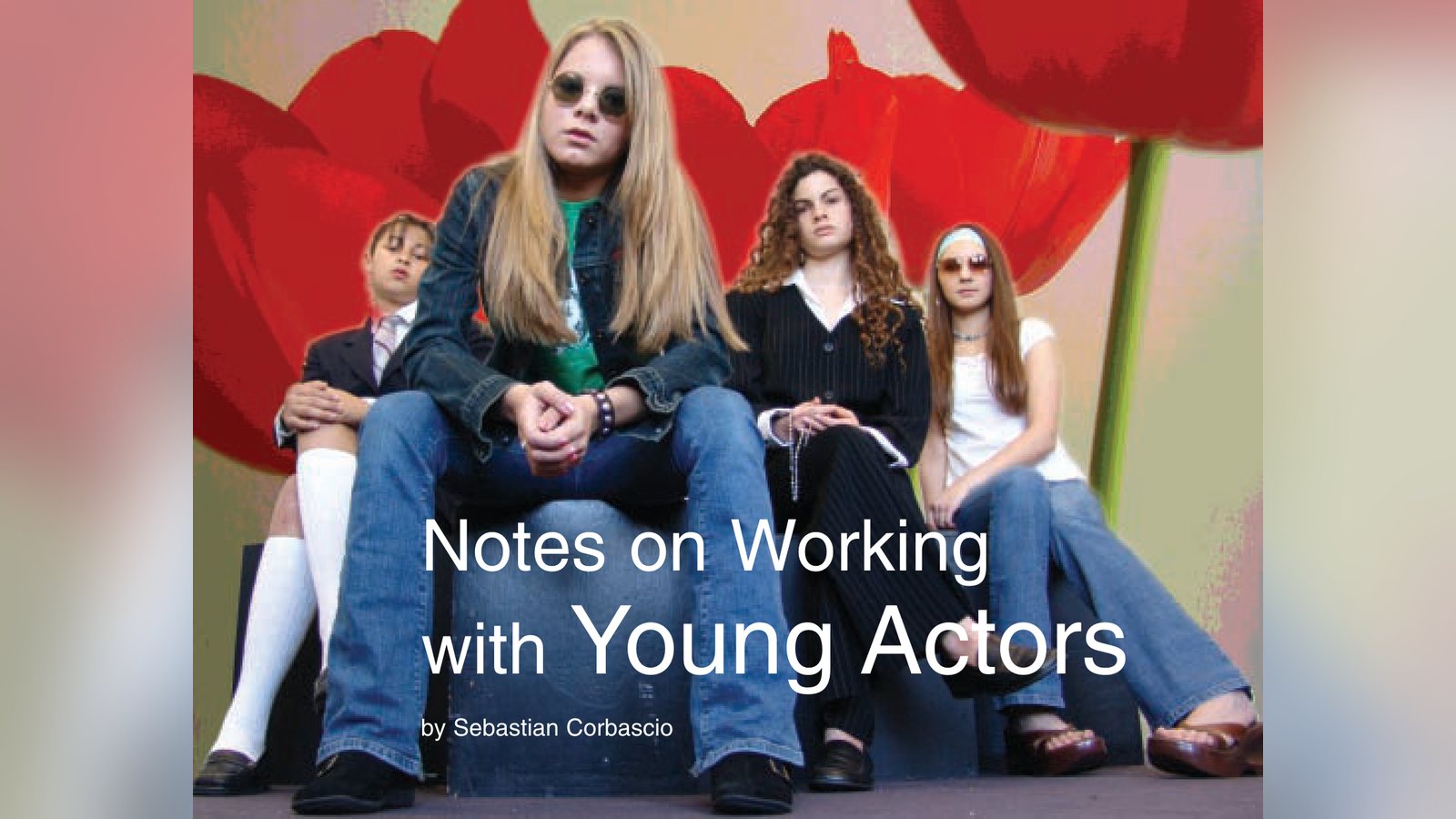
Brittany Garrido, 13, had won a slew of beauty/scholarship contests and had never acted “professionally” before. Dominique Bonino, 15, had logged more time in the chorus of Broadway favorites than any human being ever should have to. Ella Ruban, 20, had modeled and acted and had to drive from Carmel, CA, (about two hours each way) to rehearse. Jessica La Rocca, 16, was in independent study and was fiercely determined to be an actress. Shelley Appelbaum, 15, was a staple in school plays (Zzzzz…).
These young people had “that certain something” to become the most exclusive girls club at Altamont High
School in an upscale town named Fidelis where one
Sarah Luger, a popular fifteen year old girl was murdered on her front doorstep by an unknown assailant. There were many challenges that came down to one main challenge: how to make these kids act, and think and behave like the members of an exclusive girls club. The short answer: build the girls club from the ground up using what you have.
“Sarah Luger” is a murder mystery with some pretty gory scenes, some mature themes and some cursing. Knowing we may work with minors, we posted an ad at various Bay Area casting websites, and thoroughly detailed all the parts. We also posted a link to the “Sarah Luger” screenplay so parents could read it before going further.
After Dominique, Jessica, Shelley, and Brittany were offered parts, (Ella was 20 at the time), I took the additional step of sending the storyboards of every shot in the film via certified mail with a return receipt. I highlighted each shot that the child was to appear in and gave the parents the option of pulling out at the last minute for whatever reason without retribution of any kind. All parents signed on.
Before rehearsing with minors, take the following steps:
- All productions should give all production staff a memo regarding child labor laws. It is crucially important to know and abide by the State child labor laws of working with minors in entertainment. These rules are very strict and are zealously enforced. They are usually available at the State home page.
- All minors need a work permit issued by the State to work in entertainment.
- All minors need a photographic release. Legally, a minor cannot make a contract. The parent or guardian is the sole arbiter of the child’s work, and a parent or guardian’s signature has to appear on all contracts.
- The production needs copies of insurance.
- The production needs authorization to provide medical care in case of an emergency.
- Policy should always include talking with the parents about even the smallest details, even if it feels innocuous. The production has to be especially sensitive to issues of obscenity, religious beliefs, body image, self-confidence, and just about everything else that falls under the banner of parenting. (For example, Brittany Garrido’s mother and I decided that Brittany’s attendance should be staggered to the first workshop so if there were any allusions to mature themes, I would get them out of the way with the older kids before Brittany came.)
- Policy should be if the parents are not present, there should always be another adult present at all times, (in this case, usually my assistant director Kerry Golden).
These are the notes given to the cast members (through their parents’ email) before they came to the first rehearsal:
- “You will be creating a member of the Legionaires. You will give her a name, and you will write a one-page monologue about your relationship with Sarah Luger. It will be delivered
while you are talking to the police, so keep that in mind when you write.”
None of the actors had met each other before. We introduced ourselves one at a time (much like home room on the first day). Shelley couldn’t make it because she had the flu. I had the flu. Another kid who we cast had a major stress attack and dropped out.
Since the entertainment field is so competitive, the production should keep an eye peeled during pre- production for kids who are over-committing themselves.
- ” When we workshop, you will bring in the first draft of the monologues, not put names on them, and throw them in a hat, and then pick one to read to the rest of the actors. We will critique the monologue and give suggestions, etc., without initially knowing who the writer is. After a few minutes of this, the writer will reveal herself, and we will further discuss the monologue.”
This I learned in one of my college creative writing classes. It is an effective way of adding candor to the critique. It also removes any hierarchy for the minutes that the author remains anonymous.
- “During the workshop, actors will randomly pair off. Your partner is now your new Legionaire best friend. You have heard each others’ monologues and now you both will go away for five minutes or so and create a 30-second presentation about your best friend.”
Another exercise I learned in acting class. It adds cohesion, and the actors learn to trust each other. I paired Brittany and Ella since they were the oldest and the youngest respectively; they could feed off each other’s energy. Jessica and Dominique paired off. I wanted to examine the hierarchy of the club. Through the work, Dominique became the President of the Legionaires, Jessica the second in command, Brittany the brain, and Ella the sensitive one who went along with everything even with huge reservations. The exercises went phenomenally well. I myself ended up rewriting the kids’ monologues because the actors had very little time between school and other activities. Plus their hard work pumped nitro into my creative muscles.
Later, Shelley petitioned to play outcast Chloe Graf, a character already in the full-length script who is pegged as Sarah’s killer by the community. I gave her the “part” and made the necessary adjustments in the trailer screenplay. I think it’s important to listen to kids, especially when you are making a movie about kids. They know a lot more than you do.
At the next full rehearsal, the girls felt like a club. At the rehearsal space, the class letting out openly asked what our project was, instantly fascinated by the energy the young women brought just walking into the room. All clubs have a rite of passage, we had one which was not traumatic, and I believe it worked. It’s as if they all belonged to a club, which they in fact did!
Schedules again were an issue: chances are if you are working with young actors, they have plenty of irons in the fire, and you have to work around that. After calling and trying to schedule another mass rehearsal and realizing it was impossible, I decided to have one-on-ones with the kids when their schedules permitted.
In rehearsal, I start by having the actor read the text out loud and let auto pilot take over. If the diction is there the body will make movements involuntarily that go with the words (if you let it). The actor catalogs those movements. The movement is what triggers the brain to recall the line and the delivery. It allows repetition and opens the door to variation at the same time. Telling the actor to scratch his nose when talking about his dead father will make the performance blossom, inspire variations (most of which will be good) and above all take the boredom out of repeating performances.
For Jessica, whose excitement overwhelmed her a little bit, I brought in some green apples and made her eat them while reciting her lines. Her focus would drift towards what she was saying, killing the spontaneity, so I told her to focus on the apple and just say the lines. She was surprised by what came out of her. The problem was that she was so impressed with herself, she paid attention to saying her lines again and ignored the apple. She had a hard time letting go and just focusing on the apple. I believe she was having the kind of moment where you ride a bike for the first time or win a contest.
We also used Stanislavski’s Circle of Attention. This was especially important for Ella. Along with the Stanislavski physical actions, she had to turn her attention to inside herself. I told her to tighten the circle of attention to picking at some peeling linoleum on the table. She spoke about her characters’ learning disability and how much she hated the murder victim. She could now focus herself; her audition was great in spots and rough in others, and the Method gave her a skill set which she is still refining today.
Another pickle we were in was that the kids had to portray girls who were on average two years older than they actually were. Dominique, who had just turned fifteen at the time, was supposed to be the Queen Bee of the Legionaires. Her vocal register at the time was a little higher than what I pictured her character having. Knowing she is a trained opera singer, I asked to “sing” her lines at a lower register but take all the music out of it. What I got back was something akin to “Luke, I am your father. Join me on the dark side, and together we will rule the galaxy!” Two thumbs way up!
Brittany had a Steve McQueen delivery style, so she was perfect to play a girl with a photographic memory who dwells in a Spock-like Universe of Logic. She also can hate with a Brando-esque virtuosity. We used that in a pick-up shot where she passes by Shelley in a school hallway, and hates the paint off the walls. Slam dunk!
In total, we squeezed out two one-on-one sessions per actor over the course of two months (again, schedules are a nightmare). Each Legionaire appeared on screen for maybe 30 seconds, but the performances were very much alive. They were “bit” players but the small roles are equally as important as the big ones. I think the audience gets tired of looking at a Humphrey Bogart or an Ingrid Bergman for two hours, no matter how charismatic they are. Imagine “Casablanca” with Joe Schmo and Bill Bland instead of Peter Lorre and Sydney Greenstreet. Same movie? No way!
When working with kids, the process has to be very structured, but in a way which gives the actor a great deal of freedom and breathing room. Always allow creative people to bring their ideas to the table, especially youth, whose energy, enthusiasm and devotion are singular. The Josef Von Sternberg school of directing with a riding crop will never yield great results (unless you are Josef Von Sternberg).
Sebastian Corbascio is a two-time award winning screenwriter and motion picture director from San Francisco, California. He is currently writing a film about rock and roll “Electric Boogie Wonderland”, editing a documentary on an up and coming local San Francisco rock band, Miller, and writing two novels, “The Legionaires” and “The Spartans.” Sebastian Corbascio can be reached at his site, www.greatsocietyfilmworks.com.
Related filmmaking guides
- Film directing: getting good performances
- Coverage and the master shot
- Camera angles in film: a beginner’s guide
Keep learning filmmaking
Want more lessons like this? Join StudentFilmmakers free for live webinars with working pros, and stream on-demand filmmaking classes in cinematography, directing, screenwriting, sound and post.