By Carl Filoreto
Cameraman Carl Filoreto explains how he shot vertical-format video for a permanent exhibit on large screens, and the framing challenges it brought.
Vertical. Wow, that’s not one of those frothy web 2.0 era buzzwords that are usually found circulating around heady video production meetings these days. Permanent. Hmmm, at a time when tech cycles can be measured in months and viral web strategies can play out in days or even hours, permanent is another alien concept to attach to a major video project.
Yet as I was listlessly pushing my coffee mug around the table, listening to the conference call unwind, these were the concepts in play. They were being combined with more trendy terms like pixel maximization, CGI integration and hero shots. And eventually, I learned, these disparate elements would combine and form the foundation of a large scale video project commissioned by the Chicago Museum of Science and Industry.
It’s part of a major new permanent exhibit called Science Storms, which will be featured at the museum for many years.
“We’re updating presentation of chemistry and physics through the lens of natural phenomena,” summarizes Dr. Olivia Castelini, Senior Exhibit Developer for the museum. “The target age group is ten to fourteen, but the exhibit is suitable for a wide range of ages.”
The museum chose seven of the most compelling natural phenomena for the exhibit including fire, lightning, tornados and tsunamis. Each “science storm” is demonstrated with a large physical element like a 40-foot tornado, or a Tesla coil creating lightning storms. And each physical element is accompanied by a large video screen. Did I just say large screen? You bet. Let’s try 28 feet by 8 feet for avalanches, 16 feet by 9 feet for lightning, or 12 feet by 21 feet for tornados. Oh wait, did I really mean 12×21? For the video practitioner, that’s an odd dimension. It’s, well, let’s see, uh, vertical. And, yes, we’d shoot the screens natively, meaning that the video would be shot vertically in the field. It was one of the interesting challenges I faced as the DP for the video side of the project.
“The video pieces move toward the spirit and heart of Science Storms, to learn about the scientists, their motivations and their passion,” Castelini explains. “The videos create a human face for the exhibit.” Each video loops on its screen, and they run between four and seven minutes in length.
“We were diligent about presenting science an understandable and inspirational way.
It’s not about technological facts but really, how much cool stuff can we show about what scientists around the world are doing. It’s a balance between art and science,” explains Stephen Platenberg, Director of Production for Cortina Productions of McLean, Virginia. Cortina Productions is a media design, production and management company with a focus on large scale exhibits. It’s their job to develop the video material for Science Storms, which includes both the screens and interactive games.
“Everything about the exhibit is big, which led us down the path choosing hardware using a 1920×1080 imager for the best picture quality,” relates Platenberg. “Our aim was to capture the highest resolution in the field.” And in this case the field was massive. The production contingent traveled to over twenty different sites around the United States over a period of seven months. To capture the highest video quality and maintain the portability needed in the field, the Sony F900 Cine Alta HDCam became the choice as the tool for video acquisition. Editing was accomplished through the use of Final Cut Pro and After Effects.
Field production concentrated on telling the scientists’ stories. Captivating storytelling is the art form that’s the underpinning of a large percentage of successful video undertakings. And this venture would follow that model. Of course time and budget are always nagging but unavoidable considerations. With highly unpredictable and difficult to capture events like tsunamis and avalanches forming a dramatic video core of the story, Cortina Productions decided to use stock footage of the various wild natural phenomena to illustrate the focus of the scientists’ work.
In field, there were two production constants. First, in depth interviews with each scientist were conducted in a green screen setting. As the DP, I supplied the camera, a 17-inch LCD monitor and a portable 8-inch LCD monitor, tripod, matte box, and various and sundry video widgets. I tried to keep my case count to about four or five to save on excess baggage fees. Grips were hired in each location to supply lighting gear and their individual expertise. A 12×24 foot green muslin background was used as our faithful green screen.
Audio was handled on a situational basis. Most of the primary audio was acquired during the interviews, but at times the scientists delivered lines to camera on location. If the location dialogue was limited, I would engage in a more and more familiar production undertaking these days, multitasking. Since we had grips handling the lighting, I had time to handle the audio chores. For the green screen interviews, I’d provide a four channel field mixer and capture audio with a Schoeps capsule mic hung from a boom and backed up by a lavalier mic worn by the scientist. I also used an MP3 recorder with a time code adapter to create transcript files that I posted on an FTP site for easy downloading.
The second production mandate was to create visually compelling “hero” shots of the scientists. “We wanted to portray scientists in a different light, to make them appear more like movie stars or athletes,” Stephen Platenberg adds. “We wanted to change how they’re perceived by the casual onlooker”. So think NFL pre-game introductions or profiles of Olympic athletes. The head turn and stare into the camera were being merged into the world of physicists and chemists.
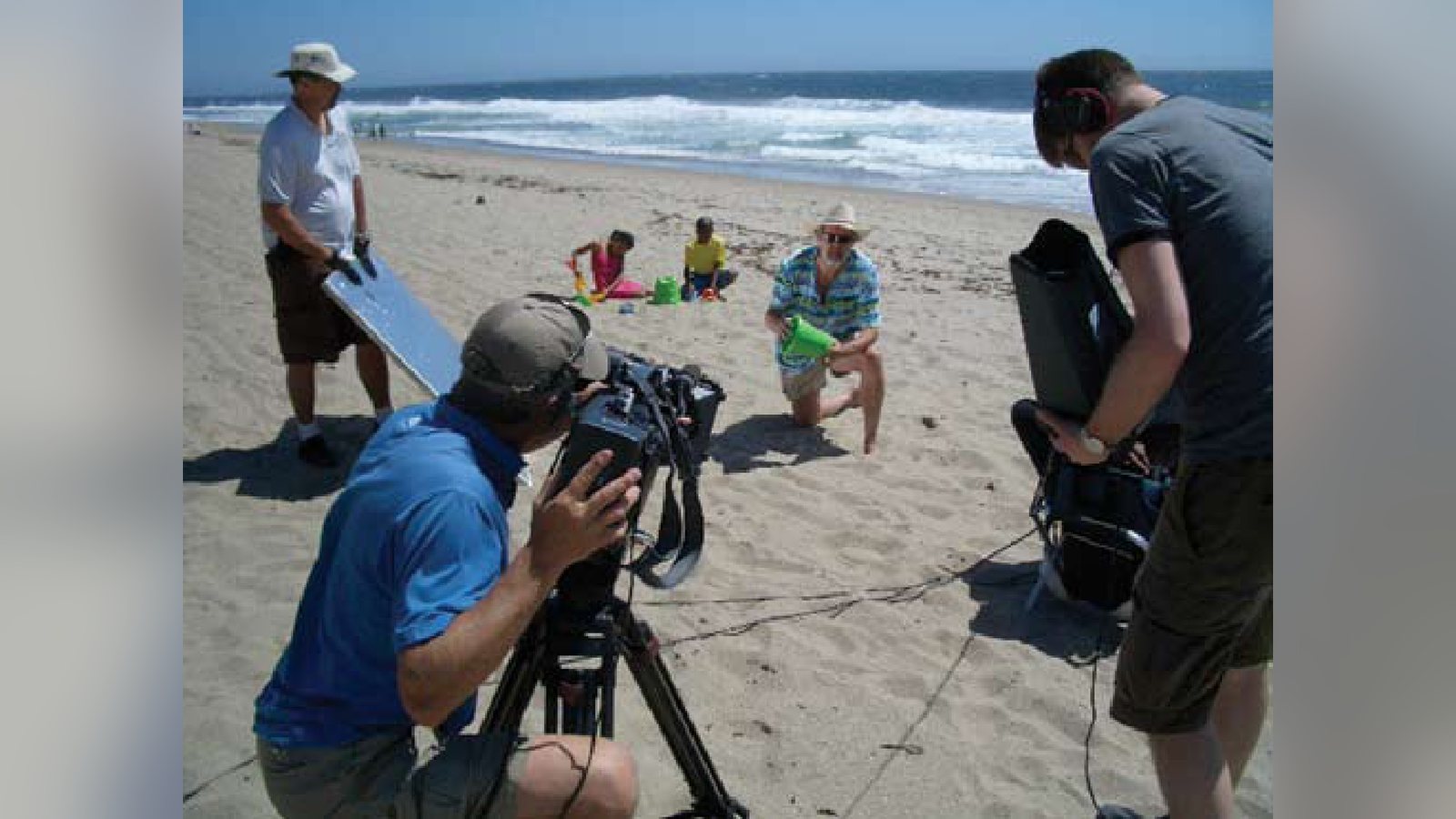
My job was to help create situations and looks that would make the scientists appear larger than life. Stephen and I quickly agreed that motion was a key element in our visual palette. So in keeping with the fluid nature of these shoots, and to remain as portable as possible, we used a fixed jib arm and a Hollywood Microdolly to provide mobile motion platforms for our work. We were able to maneuver the jib arm onto an Oregon beach to shoot quickly moving facial close-ups of a tsunami scientist with the crashing surf serving as the background, and lugged it to the top of a lightning gathering platform in northeast Florida to illustrate the work of a scientist studying that phenomenon. At N.Y.U. we were able to combine painstaking lighting with the motion of the dolly to craft dramatic shots of an incredible laser research apparatus complete with its scientific creator, and to create a dramatic environment for a laser physicist at a lab in Berkeley, California.
As I mentioned earlier, another quirky element came into play on these shoots. “For the exhibits on fire and tornados, we decided to use a vertical screen in order to match the subject matter,” added Platenberg. “We’ve shot in a vertical manner before, but we’ve never really pushed it like we did for this project. We wanted to shoot vertically so that the video could be represented at a 1:1 pixel ratio. We didn’t want to have to expand the images to fit the screen,” he concluded. My reaction was akin to the refrain in a familiar “Saturday Night Live” skit, “Vertical? Really?”
Yes, really. And this veteran of several decades production business was about to learn a new trick. As I found out, the key to making vertical images lies in the camera mount. Charlie Kendall of Moon Bounce Media (which often works with Cortina Productions on different projects) has invented a handy device called the Ringo Head camera mount. It’s an L-shaped bracket that allows the camera to lie on its side and still be securely supported on a tripod. After some experimentation, sound guru and generally great support guy Tom Levy and I got the F900 on its side with the viewfinder at the top. The bracket allows access to the tape transport, so we were able to easily load and unload tapes without dismantling the entire mechanism.
There was still an issue though. When I looked into the viewfinder, I was looking at what was essentially a sideways image. And if the tripod was low to the ground, it was awesomely inconvenient to kneel and twist my head around to look into the viewfinder and make sense of what I was seeing. It became immediately apparent that this was not a situation conducive to creating great images. But the long held video axiom, “It always works, we can make it happen,” came into play. Our solution was to attach an eight-inch LCD monitor (powered by a battery) to the camera, and then, spin it so that it was mounted vertically. First, we tried an articulating arm but it proved to be a bit weak, and it refused to reliably hold the monitor in place. Then Tom got the idea to use a combination of a Cardellini Clamp and a knuckle to attach the monitor to the handle of the camera. The knuckle allowed us to both place the monitor in a vertical position, and to easily adjust as the situation dictated. Voila, welcome to the realm of vertical video.
Immediately, though, we realized it was an understatement to say that the combination of a fairly heavy camera, a tripod, and a monitor with its mounting hardware attached was a bit unwieldy. We certainly weren’t going to move anywhere in a hurry. And, since one of our primary shooting opportunities was with the always roaming, fast moving, nomadic tornado chasing scientists of the Vortex 2 project, we realized we needed another option. So we decided to use a smaller format camera, a Sony EX-3, to provide a more mobile option. It produced a nice quality image that matched our 1080i 30p frame rate, and packaged files in an easy to use XDCam file wrapper. As it was fairly easy to use, Stephen or another producer could shoot b-roll while Tom and I maneuvered the rigged F900 to essentially get master shots of the activity.
It’s exciting to delve into something new in the production world, and looking at the world through a vertical lens was a creatively interesting proposition.
The familiar became new again, and a creative spark was ignited.
Carl Filoreto is an award-winning DP, and his company is Elk Run Productions, Inc. (www.elkruntv.com), which has a roster of clients that spans corporations, production houses, crewing agencies, and broadcast and cable networks, including Dateline NBC, The Food Network, and The Travel Channel. Prior to starting his business, Carl won seven regional Emmy awards, numerous national and regional National Press Photographers awards, and multiple awards from Colorado Ski Country and the National Snowsports Journalists Association, while working at KMGH-TV in Denver, WTNH in New Haven, and WGGB in Springfield, Massachusetts.
Keep learning filmmaking
Want more lessons like this? Join StudentFilmmakers free for live webinars with working pros, and stream on-demand filmmaking classes in cinematography, directing, screenwriting, sound and post.