By Camille Haimet
Cinematographer Rasmus Videbæk explains how he researched 18th-century Denmark and used period paintings to shape the look and lighting of A Royal Affair.
“A Royal Affair” is set in 18th century Denmark. This must have been a refresher on Danish history. How much research went into getting everything right historically for you personally?
Rasmus Videbæk: Of course a lot of research had already been made during the scriptwriting. But when Niels Sejer (production designer) and I got on the project, a lot of effort still went into talking to historians and collecting information about the Danish court in 18th century. For instance, we needed to know what they ate, how many servants and guards should be around the king and the queen in different situations, what the etiquette was, what light sources were used… etc.
What was your collaborative process like with the art department? What kinds of issues do you address?
Rasmus Videbæk: Most of the film is set in the castle in Copenhagen. So a big challenge was to recreate the castle from this period (the original castle burned down and none of it exists today). The castle we see in the film is a mix of castles, churches and monasteries from roughly 15 different places in the Czech Republic and Germany. These are cut together with chambers built in the studio in Prague, and CGI matte paintings. Putting all these smaller elements together and creating a new world within the movie is really one of the most enjoyable things about filmmaking. Striking a balance between historical accuracy and dramatic functionality is an important part of the dialog between DOP, the director, and the production designer.
What were the challenges of working on a period piece? How did you translate your personal sense of esthetic to this time period? And, where do you start in translating that visually to a screen?
Rasmus Videbæk: When trying to recreate a certain period in history, the images that were “recorded” back then and preserved up to our time play an important role. I guess every period in history has been “recorded” in its own specific media, and that has a big influence on how we imagine this period. For instance, the texture and color of the Kodakcrome-emulsion that was used back in the 1960’s has now become identical to how we imagine what that period looked like. For the18th century, the “recording media” are the oil paintings. So looking at painters from the century, was a logic starting point. One of the most characteristic stylistic elements in these paintings is the way the faces are standing out from the background. Often in these paintings, the faces are lit flat frontal, up against a dark, sometimes almost black background. There’s not a lot of ambient light floating around in these paintings, so to speak. For a lot of the night interiors in “A Royal Affair” we tried to create that same feeling. Hopefully the audience recognizes that feeling from paintings of the period.
Could you share with us some of your insights into lighting scenes for this film set in the 18th century?
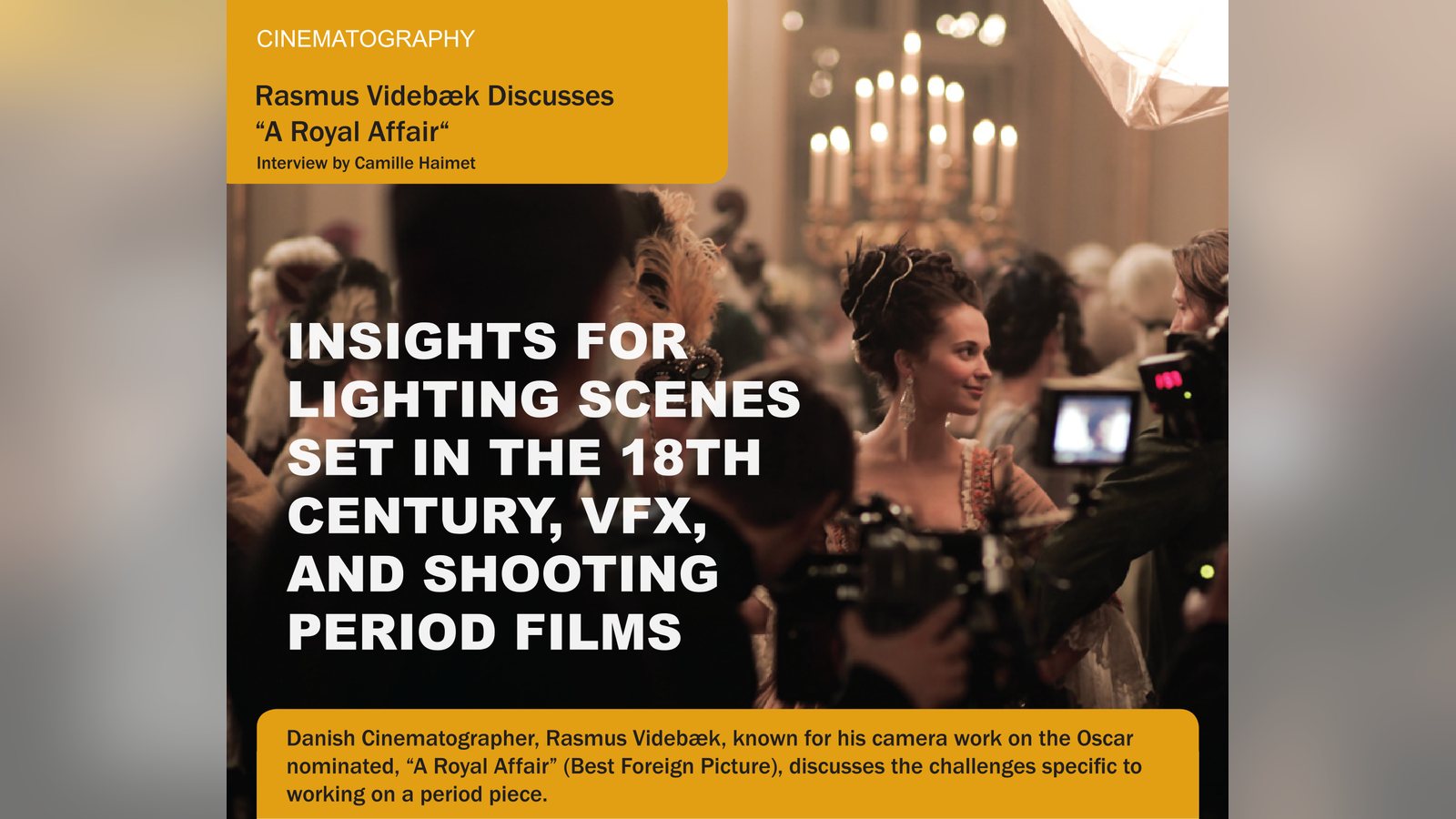
Rasmus Videbæk: Obviously the biggest challenge was working in very big rooms and making it look like they were lit by the candles you see in the frame. Most candles were mounted on the walls, and, to augment the feeling of source light, we mounted LED strips behind every candle so that the light emitted on the wall looked more powerful. Having these hotspots on the walls, we could “cheat” in some soft light on the actors and you would sort of believe that this light came from the candles. The light on the actors was mainly made with chinaballs that we boomed in above the frame as close to the actors as possible. That way we could control the fact that we didn’t get too much ambiance in the room and kept some areas of the room very dark.
Could you tell us about your camera and lens selection process? Would you recommend certain cameras and lenses to help in creating and achieving the right mood, feel, and “look” specific to historical pieces?
Rasmus Videbæk: The film is shot on Kodak Vision3 500 and 200 ASA, using an Arricam Studio 2 perf for the entire shoot. Aspect ratio 1:2,35. Lenses were Master-primes, mainly because of the extra speed, to get as much power from the candlelight as possible.
Almost all scenes are shot handheld. But for some shots a dollytrack or some steadicam was applied. Shooting handheld was partly decided in order to avoid a certain stiffness that often occurs in period dramas. I think the more contemporary the shooting style the easier it is to relate to the psychological drama. Looking at “A Royal Affair” today, I think we managed to do this in many scenes, and it really works quite well; for example, the opening scene in the stable. But I would have loved if the film had had more of this contemporary feel. [The technique] could have been applied to more scenes in a more radical way. You really have to liberate the camera and not let the big and expensive setups, with horses and costumes and large ballrooms , dictate your shooting style, or take away focus from the emotional drama and the main characters. That was an important lesson for me.
Could you tell us about some of the VFX challenges and solutions? What was your collaborative process like with the VFX team for this film, compared to other films you’ve worked on that required a lot of VFX shots?
Rasmus Videbæk: Ironically, our first idea was to try to make this film without using CGI too much, but in the end the film has something like 100 CGI shots in it… Most of the shots were exteriors, like streets of Copenhagen and shots showing the castle from the outside. I think the most important thing when you are designing CGI shots, is to get as much as you can from the original cameraplate. I think of it as circles that are surrounding the camera lens: the closest circle is something that’s very close and out of focus as foreground , then the next circle is the object of the scene ; usually the actors. And then at least one or two extra circles further away; are buildings trees or people. If you can get all that into your original camera plate, it’s much easier to add a CGI background , like a mattepaint, and make it look real. If you only have the actors clean on a greenscreen and then add the CGI background, sometimes you just feel that there’s something unreal going on; that it is a CGI-composite shot.
All the CGI shots were carried out by Ghost, a very experienced Danish company, with whom I’ve worked a lot before. This link to Ghost.dk (www.ghost.dk) shows the process on some of the CGI shots in “A Royal Affair”, http://www.ghost.dk/?p=1141.
If you could share some tips or insights for shooting period films, what would they be?
Rasmus Videbæk: Shoot it as if it were any other story set in our present time. Focus on the drama, and don’t let your camera be too impressed by the architecture, the coaches, the costumes and the gold. It’s sometimes difficult, because creating all these scenarios, has been very expensive, but don’t point the camera (too much) at it. Try to implement some characteristics from the images that are preserved from the period that you portray. Like the texture or lighting. Because our common memory of that time in history is based on those pictures.
Keep learning filmmaking
Want more lessons like this? Join StudentFilmmakers free for live webinars with working pros, and stream on-demand filmmaking classes in cinematography, directing, screenwriting, sound and post.