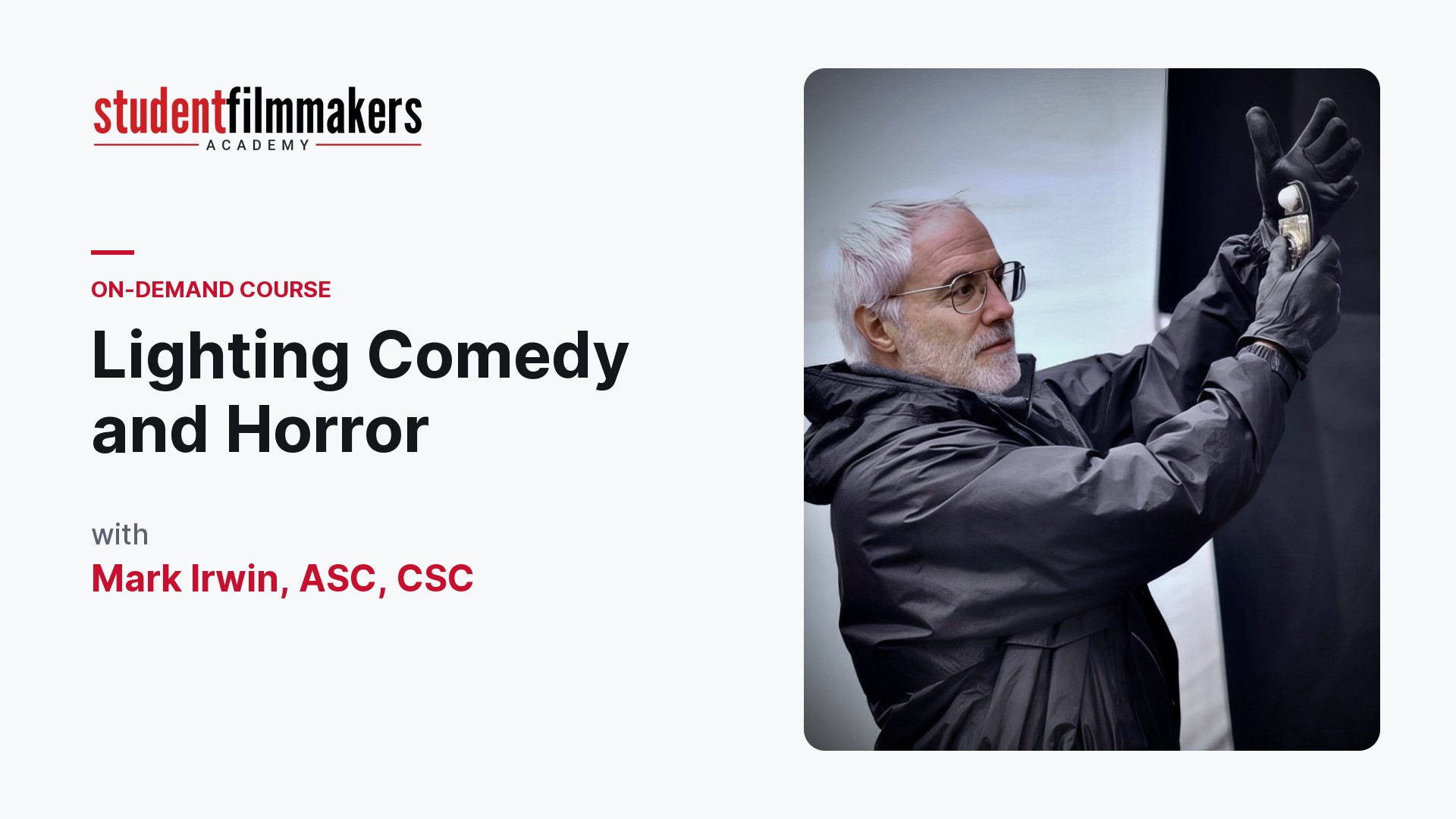
Mark Irwin, ASC, CSC, the director of photography on Scream, The Fly, Dumb and Dumber and There’s Something About Mary, lights horror and comedy the same way: make it look real. In a live class with StudentFilmmakers, he explained why “brighter is funnier” is a myth, how Wes Craven and David Cronenberg ran opposite sets, and how he lit Freddy Krueger.
Should comedy be lit brighter than horror?
No, says Irwin. He blames the idea on an old Hollywood habit from the 1950s and ’60s, when everything was simply lit up, and he points to two cinematographers who never changed style between genres:
“The man who shot The Godfather also shot Annie Hall. He didn’t make them look different. He didn’t use funny lights and funny filters. The guy who shot 1917 also shot all these Coen Brothers comedies.”
That is Gordon Willis and Roger Deakins. Irwin puts himself in the same line: he shot The Fly and he shot Dumb and Dumber. “What you have to do is make things look real, and the humor comes from there. If you turn on the funny lights, people say, okay, okay, I get it.”
What lighting ratio does Mark Irwin use for comedy?
He gives a number: “To me, ratios on comedy, two and a half or three to one is about as far as you want to go. That’s key to fill.” Inside that range he still sculpts faces. He grew up on Conrad Hall and Owen Roizman and likes character lighting, with a low fill and small lights to shape the face.
On 10 Things I Hate About You, director Gil Junger looked at the monitor and said it looked great but was “too dark for comedy.” Irwin’s crew cheated: when Junger turned away, they dropped in a scrim to bring the ratio to two or three to one. “They’re the games we all play with directors, but in the end, it’s their film, and I’m there to support it.”
He also told the story of the film he shot right after The Fly, a Mel Brooks-style Salem comedy shot in Toronto. Everything was candlelight and sunlight, because Salem had no electricity, and it worked: “These people are funny. I’m going to surround them with something that supports their environment, but I’m not going to turn the lights on brighter.”
The brighter-is-funnier idea is where he and the Farrelly brothers parted ways after Dumb and Dumber, Kingpin and There’s Something About Mary. “Their premise was that brighter is funnier.”
How did Wes Craven run a set?
Irwin shot three films with Wes Craven, starting with Wes Craven’s New Nightmare and including Scream. In the late ’80s and early ’90s, Craven typed his shot list on his own typewriter and made copies for the crew. “Everyone had a shot list. And it was just an assembly line.” Irwin compares it to Hitchcock:
“He would just say, here’s the shot. And he’d sit in his chair doing the crossword puzzle.”
The New York Times crossword, which Irwin says Craven went through “like a chainsaw. That was how his mind worked.”
And how did David Cronenberg do it?
The complete opposite. Cronenberg, Irwin’s director from Fast Company in 1978 through The Fly in 1986, used no shot list and no storyboards. Irwin remembers him asking, “How would a cartoonist know where I’m going to put the camera? I don’t know where I’m going to put the camera.” Only the actors, Irwin and the script supervisor stayed on set. Everyone else left the stage, the scene was run in silence, and Irwin wrote the shot list on the back of his sides.
| Wes Craven | David Cronenberg | |
|---|---|---|
| Shot list | Typed by Craven, handed to the whole crew | None. Irwin wrote it after the run-through |
| Who stays on set | The whole crew | Actors, DP, script supervisor |
| Films with Irwin | New Nightmare, Scream | Scanners, Videodrome, The Dead Zone, The Fly |
Irwin doesn’t rank one method above the other. Craven’s lists kept the day moving; Cronenberg’s silence was, in Irwin’s words, “how David found his way to tell the story.”
How was Freddy Krueger lit in New Nightmare?
A filmmaker in Italy asked about the Nosferatu-style shadow of Freddy’s claws. Irwin said the crew was playing with shadows when Robert Englund raised his claws, and they shot it as a shadow and then a silhouette. Freddy got “a traditional bottom light when he attacks,” which Irwin calls “textbook horror lighting,” while everyone else kept an innocent look. In the fire-pit finale, “it wasn’t an angelic light. We weren’t trying to redeem Freddy.”
Does Mark Irwin miss shooting film?
“I’ll go on record saying I don’t miss film at all.” What he does miss is trust. He still operates his own camera and dislikes directors watching from a video village “a city block away.” His advice to directors: “If you stand here, you can see it all in color and in 3D.”
What to take onto your next set
- Light the world of the story, not the genre. Make it look real.
- For comedy, keep key to fill around 2.5:1 to 3:1 and still shape faces.
- Learn both ways of working: the typed shot list and the organic run-through.
- Save the classic horror tricks, like bottom light and shadow play, for the character who is the threat.
In the full class, Irwin also answers questions from filmmakers on tungsten versus LED, video village, and his favorite film to shoot.