By Adam Biddle
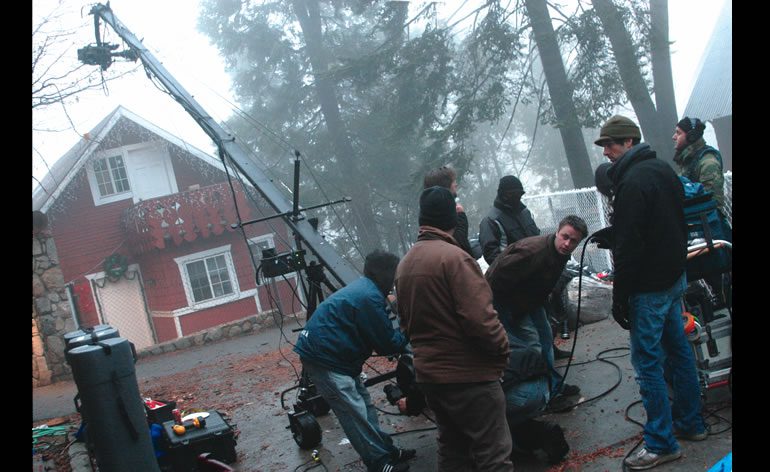
At the end of last year, I ventured for the first time into the genre I’ve long been most wary of shooting – Low Budget Horror! (The production’s budget was at least $300,000, approximately.) This to me has always seemed one of the most over saturated of markets with numerous projects generally underachieving. The main cause of this is scripts that rely far too heavily on post effects and bad blood gags. To do either of these to a believable audience standard is usually totally unrealistic in the low budget world. A knock on effect is sequences having to be lit way too dark or framed awkwardly to hide the cheese factor. Totally unrewarding.
Taking on Marked
So when I was given the script ‘Marked’ to read I was full of skepticism. About 112 pages later my mind had changed. This was a project that relied heavily on a visual mood to build tension and that challenge excited me. Next to meet the director, Dustin Voigt. He had also written the script and had a definite idea of what style of movie he wanted to finish with. I could tell from the very outset we were on the same page with both our expectations and concerns. We were in this together!
The production company Night Light Films had only recently been formed, and this was only their second feature. Their whole set up is based around shooting HD, so shooting any other format was never an option – and it had to be a Sony F900. Our only choice was lens type. Zoom or DigiPrimes – not both. Instinctively at first both Dustin and I wanted the primes, which are optically superb. But then when we started to get realistic about our shooting schedule of 15 days we realized compromises had to be made. A zoom is so much faster to work with. Constant recalibration checks when changing a Prime lens is a must by the 1st AC. That time spent would very quickly add up and cause us to start missing shots, something we didn’t want to do. The other problem with Primes is that to do a move you obviously need to track. Taking the time to block and lay a track properly in the low budget world is a luxury. But by having the zoom always on, I could at least add some movement to ‘quick’ cutaways then and there. We could therefore save our big tracking shots to key moments in the script and plan our days accordingly.
Free for members
Sign up free to keep reading
It’s free and takes less than 30 seconds. You’ll also get our Interstellar issue free, and a community of filmmakers sharing their work.
No credit card. Continue with Google or your email.