By George Avgerakis
George Avgerakis explains the four C’s of shooting effective B-roll for dramatic films: continuity, cutaway, client and creativity, with practical tips.
The key to shooting effective B-roll is to remember the “Four C’s” – Continuity, Cutaway, Client and Creativity.
Continuity is that cinematic discipline that attempts to make every take of a scene identical. Usually, continuity is maintained by the Script Person or Assistant Director. Their task is to make sure that the props, clothing, length of candles and cigarettes, consumption of food and drink, and dialogue remain exactly the same from take to take. If a variation occurs, the Script Person must take meticulous notes of how the take differs and report the same to the director before the next take is shot.
Sometimes, the Script Person will make a mistake, or other times, the director is enraptured by a great “keeper” take that happens to have continuity errors.
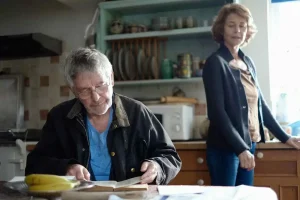
At such times, a B-roll cut is just what the doctor ordered to rescue both the editor and the director’s reputation. Here’s a common example. You’re shooting a two shot at a dinner table. The first shot is Joe seen from over Patricia’s shoulder as Joe sips a glass of wine, leaving the glass on the table, half empty. The second shot is Patricia, seen over Joe’s shoulder, as Patricia sips her wine, leaving her glass half empty. The third shot, shows Joe again, but the best take is from earlier in the day, when both glasses are full. Without a B-roll “cutaway,” the third shot will reveal an ugly continuity error.
What B-roll could the director shoot to “cover” every contingency of wine level? The answer is to shoot an extreme close-up shot of the wine bottle’s mouth as it pours wine into both Patricia’s and Joe’s glasses. Of course, the compliment of this B-roll coverage is to shoot shots of both Joe and Patricia sipping from a full glass until the glass is empty (Joe and Patricia will like this work, but wait until after you’ve shot the entire scene or until the end of the working day).
Now that you have the wine filling and emptying covered, think about other continuity issues. Cigarettes burn through an entire scene, then get crushed out and left in an ashtray. Cover this contingency by having actors light up in close-up and shoot a shot of each ashtray with various amounts of butts, while the actor crushes out a fag-end.
Of course, never forget to shoot lots of listening shots of actors who are not, at the moment, saying something. While never indicated in a script, a director cannot be satisfied with shooting only the person who has dialogue. If an actor is talking, most of the time, someone is listening. Shots of the other person are the most effective B-roll you can acquire. They allow the editor to build rhythm into the scene, avoiding monotony. They also allow the editor to shorten dialogue if you, the director, later decide to shorten the scene or to cut out some glaring error in the performance.
Traveling shots, where actors walk or drive in a scene, require a director to shoot passing scenery that can be used whenever the editor needs to get around a continuity or other editorial problem – like a director who “cut across the line”. The trick to making a scenery cut work is to always shoot the B-roll as if seen through the eyes of one of the actors. You can’t have two actors looking forward in a car and use a shot through a side window as a B-roll rescue.
We could go on and on, here, but you get the point. The only thing I haven’t figured out how to cover is the grave mistake of having a working clock in a scene. Clocks are so problematic that unless it is called for in the scene, I eliminate them entirely.
Cutaways, in a scripted film are shots that, while not specifically in the script, add dramatic or comic kicks to the rhythm of the edited scene. A bit of this is covered above under continuity, but also remember that B-roll of other actors allow the editor to create powerful dramatic effects that propel the story or create bellies full of laughter in the audience.
How many comedies have you seen where outrageous behavior of the main character is intercut with reaction shots of the Priest, Nun, Old Lady, Mother, Father, even the dog, staring in dumbfounded awe?
And how many Mafia or martial arts movies have we seen when a silent cut of the killer’s face reveals that someone elsewhere in the scene has gone one step too far and shortened his life expectancy?
Cutaways raise the common B-roll a quantum order of magnitude. They are essential.
B-roll is often shot purely to please a client. Clients are the people who pay for films to be made – such as TV commercials or sponsored corporate projects. The most common is the “pack shot,” a term coined during the days when cigarette commercials were legal. Every such commercial needed to have a closeup B-roll shot of the pack of coffin nails.
Today, a “pack-shot,” in fact a whole passel of pack shots, should be made whenever you are shooting a sponsored project. In fact, if a company has been kind enough to donate product placement benefits to your project, never forget to get plenty of B-roll coverage of the benefactor’s goods.
Client B-roll can require some bizarre efforts, so I try to have an extra monitor on the set, just for the client(s) to watch. During a critical surgical video, once, I assigned an extra cameraman to concentrate only on shooting the client’s product during the entire procedure. I ended up using only two cuts – but those cuts literally made the film for the two guys who were forking over 90 big ones for two days of work.
Whenever you are invited to a client’s facility, employ your courteous manner to try and film every employee and facility you can, without invading privacy or confidentiality. We carry an extra handheld DV camera or two on every shoot and encourage anyone on the crew who is not actively working to use the cameras to gather Client B-roll. At the very least, a sequence of smiling employees, split screened with the closing credits always gets us praise, but sometimes, the roving DVCams capture an essential shot that saves an entire production.
One client, who learned he didn’t have to pay for an extra pick-up shoot day because my electrician had shot two missing scenes of an assembly line, sent the electrician a case of wine the following day! I enjoyed exclusive contracts from that client for eight years until he retired.
And never forget to grab a shot of the client’s office exterior, with the lawn logo prominently in the foreground. Utterly boring, but so valuable as for both the client and your stock shot library.
I go to extreme lengths to please a client by using B-roll. If my client is a woman, I spring for a full manicure on the justification that the client can perform “hand modeling” B-roll shots. The grateful client will never question the logic of this, and I have never had to explain what “hand modeling” was!
Creativity is the final category of scripted B-roll necessities. It is difficult for me to give you any rules or guidelines about this category. Not only can you shoot B-roll on location, but you can also create B-roll using computer-generated imagery. The best way to learn how to produce Creative B-roll is to work as both the director and editor of your own projects. Once, I got myself into a new client, who was proud of directing his own training films. I put my foot through the client’s door by offering my services as an editor only.
On the first assignment, I found many instances where the client had not covered himself during the shoot. The most common way to save my client was to create a freeze frame just before the mistake, add a superimposed title that illustrated the current teaching point, and then dissolve to the next scene after the mistake. Essentially, I was creating B-roll out of thin air! The client was so pleased that he asked me to be his cameraman. Even though I had been doing camerawork, the client was pleased to pay me directorial rates to have me on the set and literally teach him how to direct effectively. This relationship lasted 12 years until the client retired, taking me across the US and to nearly every country in Europe and South America!
The trick to keeping this client was to continually come up with creative ways to make his shoots more interesting – usually by suggesting valuable B-roll shots – no kidding! In Rio de Janeiro, we tried to set up an interview with the Christ statue on Sugar Loaf Mountain in the background. The trouble was that the statue was shrouded in clouds. So I locked off the camera with a cloudy summit in the background. Then, just before we left Rio, I went back to the same location and shot the clear mountaintop from the same location. Later, in the edit room, I created a key-hole effect and electronically pasted the B-roll of the Christ statue over the interviewee’s shoulder. By feathering the edge of the key just enough, the effect was – well a miracle – at least for the grateful client.
Perfecting the technique of obtaining Creative B-roll takes experience in both directing and editing – of literally solving your own problems – and then having the presence of mind, during the shoot, to be constantly thinking how you can enhance a scene beyond the parameters of the script. To do this, always ask yourself, “What is this script’s bottom line? What are we trying to achieve?” And then look around you and try to answer the question with a B-roll shot.
George Avgerakis is VP Creative Director of Avekta Productions in Yonkers, New York, an e-media production company that produces video, CD-DVD, web content and print in English and all foreign languages. George’s email is [email protected].
Related filmmaking guides
- What does a cinematographer do?
- How to become a cinematographer
- Camera angles in film: a beginner’s guide
Keep learning filmmaking
Want more lessons like this? Join StudentFilmmakers free for live webinars with working pros, and stream on-demand filmmaking classes in cinematography, directing, screenwriting, sound and post.