Experiences and Techniques for Operating Handheld Film and Video Cameras
by Bill Zarchy
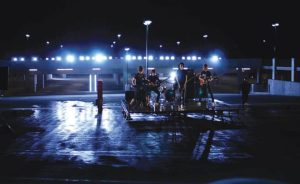
Deep in the second hour of the second set on the second night: Stay strong and focused, optically and mentally, concentrate on following the music. Check the earplugs. Avoid hearing loss. Onstage at the Warfield Theatre in San Francisco, right in front of me, Phil Lesh and Friends rock out.
Shooting handheld for documentary, commercial, musical, and even dramatic films can challenge, vex, frustrate, exhaust, and exhilarate – often all at once. Handholding the camera lets you improvise angles quickly, stick the camera in places a tripod can’t reach, or float with innovative, flowing moves difficult to duplicate from a dolly. And, if you’re tall like me, throwing the camera on your shoulder enables you to see over crowds at news events, rallies, shows, and parties.
The first movies were filmed from tripods and later from rolling dollies. Handheld shots appeared late in the silent film era, dependent on the invention of smaller, more portable cameras with spring windings to replace the original hand cranks. But these developments were quickly trumped and the camera immobilized again by the coming of “talkies” and massive, boxy, silenced cameras at the end of the 1920s. Not till after World War II did James Wong Howe shoot the boxing scenes in “Body and Soul” from roller skates with the camera on his shoulder – the same era as the release of the light 35mm camera, the Arriflex II, and the first 16mm cameras.
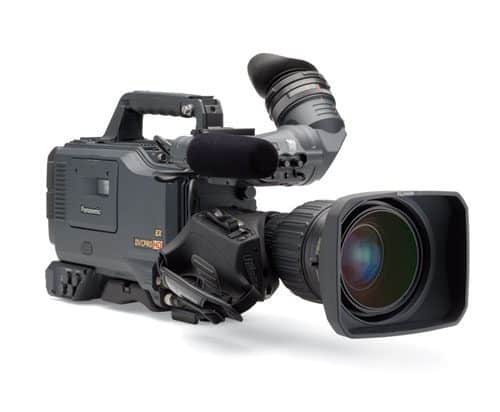
In the pit in front of the stage, I review my assignment from directors Jay Blakesberg and Bob Sarles, who will also be shooting the concert, not calling shots on a headset. I’m charged with keeping Phil Lesh in frame at all times, and to mix up the shots on my handheld Panasonic DVC Pro SDX-900, one of six cameras on this shoot. My starting game plan: Stay in tight during Phil’s vocal and bass solos, ease out to wider coverage when someone else is singing or playing lead.
Unskillful handheld work can look amateurish and undercut the effectiveness of the visual material. But a Levi’s 501 Blues campaign in the late 80s popularized the wobbly “shaky-cam” look as an edgy, urban, hyper-authentic imitation of life. Suddenly steadiness seemed old school. This aesthetic (where looking more amateurish is more … real) lives on today in directors who occasionally create more shake by slamming me in the shoulder at irregular intervals during takes.
Freeing the camera from its ground mooring provides excitement but can allow the operator to wander into awkward or dangerous positions. While shooting in the control room of a milk plant once for Safeway, I inadvertently brushed against a panel of switches, which controlled the plant’s processing paraphernalia. My left shoulder flicked a switch that shut down a huge bottling machine, but the incoming flood of milk continued unabated. In seconds, hundreds of gallons of milk had filled the processing room. Alarms squawked indignantly, and we left quickly.
Before a concert shoot with The Jacksons (when Michael was still a teenager), I was warned, without elaboration, to “watch out for the pyro.” During the set, I roamed too far onto the stage and was saved by a roadie, who grabbed my collar and pulled me back to safety just as a glitter-rock flash-pot explosion erupted where I had been standing.
Stay wide, stay wide, show the whole stage, wait for the solo … Now zoom in slowly on Phil as he picks up the riff from the lead guitar and takes it to a higher plane. Stop in a medium shot, showing his face and six-string bass guitar, hold that for one chorus, then push in all the way to the strings, showing both hands. Wait one more chorus, then push into the left hand, follow it up and down the strings, try to keep the movement as lyrical as the groove of the music. Wait for the end of the verse, then follow the flat pick in the right hand plucking the thick metal strings.
In film school at Stanford, I learned two techniques for shooting handheld walking shots, and I pass them along to my students at San Francisco State:
(1) Keep the knees bent. The “duck walk” enables an operator to reduce the side-to-side, stepping movement which is unavoidable when you walk normally with the camera on your shoulder. This awkward-looking semi-squat step with bent legs can smooth walking shots.
(2) When walking with an actor or narrator or reporter, try to match the rhythm of your gait to your subject’s. If following, walk in step with the subject. If the camera is pointed backwards and leading the subject, as he/she steps left-right-left, the operator steps right-left-right at the same cadence. Even though the shot will still include the telltale stepping motion, matching steps makes the picture appear smoother.
Oops, Phil has moved, and an LCD screen on a low stand – one that many musicians use for song lyrics – is blocking my best shot between the audio monitors. Quick! Scurry to the other end of the stage, wink at the security guard who shifts position to let me slip past him, find a clean angle. Behind me, a thousand paying customers are mellowing to the music. Earlier tonight, a young man launched himself from the balcony in misguided exhilaration, breaking the collarbone of an unsuspecting music lover in the orchestra below. “I hate it when they do that,” said the security guy. Sniff the air, absorb the vibe, enjoy this privileged position so close to the players. Above all, transcend the shoulder pain and take pleasure in the music.
After film school, a good friend who found work shooting racing and other sports told me his cardinal rule: when you pop the camera off the tripod, zoom out and walk in. Get close to the action and shoot on the wide end of the lens. Wide-angle shots provide dramatic perspective and nearly endless depth of field, lend themselves to interesting compositions and flowing, dramatic movement, and are easiest to handhold smoothly. Telephoto shots, obviously, are more difficult to keep steady and in focus.
Early in my career, I met a cameraman in his 50s who specialized in documentary work. After decades of shooting handheld, the shoulder muscles on his right side were noticeably more developed than on the left. When I first experienced back pain from schlepping gear and shooting in my 20s, a chiropractor advised me to use the camera on my left shoulder half the time. I laughed and explained that most viewfinders only allowed for right-shoulder shooting. She thought for a moment, then asked, “Well, when you’re running around with the camera, are you actually shooting all the time? If not, why don’t you carry it on your left shoulder in between shots?” To this day, I’ll sling the camera up on my left side from time to time when I’m relocating or not rolling, in order to balance the load on my back, shoulders and neck.
There’s nothing natural about running around with a 15-25 pound machine on one shoulder, struggling for hours to keep it pressed to your eye and perfectly steady, to freeze in a relaxed posture, to avoid sweating and fogging up the eyepiece. On concert shoots, the cameras – even the handhelds – are often kept far back from the musicians. I am 15-20 feet away from Phil, but fortunately, I can lean my elbows on the lip of the stage for steadiness. Oh, and since I’m also the D. P., I try to keep an eye on the color and intensity of the lighting, despite the fact that the viewfinder is black-and-white.
Camera design has always had a major influence on the ergonomics and aesthetics of handholding. On my first shoot abroad, about a year out of school, we followed a group of tourists on an eight-country Asian tour called “Orient Escapade.” I brought a 16mm Éclair NPR and, at the director’s insistence, a shoulder brace. I tested and quickly discarded the brace as too limiting and confining. If all my shots had been from a standing position with the NPR on my shoulder, it would have made sense, but I found it impossible to kneel while wearing the rig and cumbersome to pull the camera off for low angle shots.
This Éclair had a pistol-grip handle and custom bracket on the front right side for handheld shots – remarkably, an aftermarket item never sold by Éclair. The grip enabled the operator to rest the camera on the shoulder and steer with the right hand in an upright position, rather than cradled under the camera, which put all the weight on the bicep. But on long days following the tourist “geese” on and off the bus and bullet train, my hands got sore. So I cut chunks of foam from one of our cases and fastened them crudely with white tape to that handle and the one on top of the camera. The result looked like bandages and elicited odd responses from people who thought the camera had been injured. I considered adding red dye to the “bandages” to simulate blood, but no one else thought that idea was funny.
Looking up at Smokey the Elephant at the Oakland Zoo. Several months later Smokey turned on and killed the trainer on the right. Oakland Zoo, 1990.
On that trip we also traveled with a wheelchair, to provide an easy platform for rolling handheld shots and to facilitate baggage handling. Inevitably, as we checked into hotel after hotel in Japan, Taiwan, Hong Kong, Singapore, Malaysia, Thailand, Bali, and Hawaii, the bellhops would stack our gear on one of their own carts, then look around for the sick person in our group, shrug, and throw the chair on top of the pile. But we filmed gorgeous moving shots with the wheelchair and the “injured” camera at every stop.
After more than seven hours of performance over two nights, even as my soul is soaring with the exhilaration of the music, my muscles are starting to tire. Under my shirt, on the right side, I wear a slice of dense foam, cut from a camping pad in the shape of a fat figure-eight, to prevent chafing as the camera’s bottom slides forward and back on my shoulder with each change of shot. Handheld shots often involve squeezing the camera in odd positions off the shoulder, shooting from the hip or cradled in the lap. Fingerless gloves pad my palms from sharp metal and plastic edges, and they improve my traction, so I don’t need to clutch the camera as hard for hours at a time. Tonight I’m wearing neoprene elbow and kneepads for support as I lean or kneel on the stage. I feel like the Bionic Man, but if Barry Bonds can wear a small shed as a protective device on his elbow, why can’t I use my little tricks to attenuate the discomfort?
Smaller prosumer video cameras present a new challenge. Built-in electronic image stabilization on many cameras in this market does help with steadiness. But ever since Sony released the Handicam in the 80s, camera designers seem to think that handholding means just that – holding the video camera in your hands like a still camera, not leaning it on the shoulder in the professional manner. Since many cameras in this market have swing-out video screens, crappy electronic viewfinders, and ubiquitous, bumpable buttons, I often find myself shooting with shoulders hunched, the camera held in both hands, palms up, at chest height, and 8 to 12 inches in front of my body, as if I’m timidly offering a plate of cookies to a pack of hungry eighth-graders.
This non-ergonomic position concentrates the stress and weight on the wrists and makes it challenging to hold for long periods or to blend smoothly the flow of the camera and the body. Fortunately, the newer JVC ProHD camera series, the GY-HD110U, 200U and 250U, and Canon’s XL-H1, have begun to stretch the form factor in camera design from short-and-compact to long-and-narrow. In some cases, a small adjustable shoulder mount allows the operator, once again, to handhold the camera in the usual way.
For years I owned a CP-16 reflex camera, the first camera with a slot for the battery right on the body. It was a wonderful machine originally made for news shooters – easy to handhold, with a built-in, adjustable handgrip and trigger up front, and cheap, lightweight plastic film magazines.
I shot a lot of Grateful Dead concerts with the HL-79, Ikegami’s workhorse video camera of the 80s, and tonight’s long-set jam-band show with Dead alum Lesh takes me back to those shows. The product manuals for the HL-79, I recall, specified that “HL” stood for “Handy-Looky” (the same branding universe as “Walky-Talky,” I suppose), and first used the name for Ikey’s earliest portable cameras built for CBS in the 60s. Next to me in the pit, operator Steve Davy raises his smaller DV camera on a monopod to see back over the crowd.
Using a monopod on the ground, or leaning or bracing against a wall, post, stage monitor, or table can help with steadiness and avoid fatigue. For low-angle shots, a sandbag or bean bag under the camera provides a simple platform near the ground. It’s cleaner and easier to maneuver a handheld camera resting on a bag, rather than groveling directly on dirt, carpet, grass, or concrete.
Heavier cameras are obviously more tiring to handhold, but more mass on the shoulder does make telephoto shots steadier. Finding a restful posture for shooting from the shoulder is a must. A separate monitor, such as an LCD screen mounted on the camera, is useful for viewing a shot when access to the viewfinder proves tricky or impossible, or for walking shots where the camera is carried by the top handle, low to the ground.
Between sets, I joke about the pain with Jarid Johnson, the technical line producer for our video production and the other camera operator toting an SDX-900. When I shoot stories or commercials with actors, handheld shots are typically short, no more than a few minutes long at most, and assistants stand poised to fling a furniture pad down if I start to kneel, and to snatch the camera off my shoulder when the director calls “Cut!” Here at the Warfield, each take lasts an hour and leads directly into another. I find myself wondering if the security guard now ten feet from me would notice if I fell over during the show, or if he’d mutter “Far out!” and assume I’d inhaled too much of the interior smog.
I’ve shot handheld in Costa Rican coffee fields and on Bombay streets, under elephants and bulldozers, perched on rickshaws, cherry pickers and forklifts, leaning from helicopters and planes, the front ends of locomotives and subway trains, the rear ends of trucks and vans, and the hoods and interiors of cars. Often a small down vest stuffed into a nylon sack has helped to cushion shocks between the camera and my shoulder on moving vehicles.
My oddest angle ever was a fromunda shot during a Buddy Rich shoot. The band performed on a stage constructed for the show in a studio in San Francisco, and the director, with startling creativity, had Buddy’s drum kit placed over a 4×4-foot sheet of clear Plexiglas built into the stage floor. Several times during the show, on cue, I abandoned my normal position on stage right near the keyboards and bass, ran to the back, waited while a stagehand removed a wooden brace under the Plexi, then crawled through a tunnel under the stage and shot straight up at Buddy playing the drums. I started in tight with a low-angle shot of his sticks on the snares, cymbals, and tom-toms, then pulled back to see his feet in my foreground working the bass drum and high-hat pedals, and his head moving to the beat. An angle no one had ever seen, fromunda Buddy.
During the first set, the director noticed blurry splotches on the Plexi, which puzzled us all for a while. But later in the show, we discovered the source: on one of my close-ups during an intense drum solo, we saw a big droplet of sweat form on Buddy’s nose, work its way to the tip, and fall to the clear surface between Buddy and me, in hypnotic slow motion. Fortunately we were able to clean the Plexi between sets!
Camera technology has evolved over the decades, but the principles of handheld shooting are eternal. Choices about shaky-or-steady handheld movement, scene coverage, and camera obtrusiveness must always be made in the interest of serving the material and illuminating the story. The tricks of wide-angle movement and telephoto steadiness, zooming out and walking in, duck-walking and matching steps, finding restful ways to freeze the body or support a handheld camera, innovating angles and grooving to the music, all still apply, no matter what machine sits on your shoulder – or at your hip.
Bill Zarchy (www.billzarchy.com) is a freelance director of photography, writer, and teacher based in San Francisco. His credits include the Emmy-winning “West Wing Documentary Special,” the Grammy-winning “Please Hammer, Don’t Hurt ‘Em,” and the feature films “Conceiving Ada” and “Read You Like A Book.” He has published numerous personal essays, tales from the road, and technical articles. He is working on a book about his work and travels, and he teaches Advanced Cinematography and Lighting at San Francisco State University and De Anza College.
-
- Click here to sign up for the Print Subscription.
- Click here to sign up for the Digital Subscription.
- Click here to sign up for the Bulk Subscription for Your School or Business.