

Today’s DSLR and mirrorless cameras are capable of taking high resolution video. Unfortunately, the microphones built into these cameras are woefully inadequate, and there is little question that the audio quality can’t keep pace with the video. A simple way to upgrade your audio is with an external microphone. First, you’ll want to make sure that your camera has an external microphone jack. This jack is typically an 1/8″ (3.5 mm) mini-plug and will usually be marked as “MIC” on the camera.
When shopping for a microphone you’ll notice there are basically two types: monaural (often shortened as “mono”) which has one audio track, and stereo which has two. You might think that stereo is the better choice, but there are many instances where a mono microphone will be the best option.
Mono Microphones
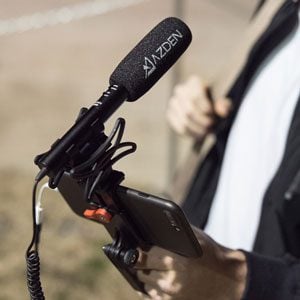
Directional mono microphones, often called shotguns, have a single microphone element. The microphone element is normally placed at the back end of a barrel, which has cancellation vents on both sides. This gives the microphone a narrow pickup pattern that is called super-cardioid. The result is a microphone that is most sensitive to sound coming from the direction it is pointed, while being less sensitive to sounds from the sides and rear. This directional type pickup is preferable for most dialogue and voice over applications. For example, when recording dialogue, you want the sound pickup focused on your subject, and all extraneous sounds to be reduced. This will make your subject’s voice and your recording more intelligible. Mono microphones can also pick up sounds at a greater distance than stereo microphones, again because their pickup pattern is more focused and extraneous noise is reduced.
Stereo Microphones
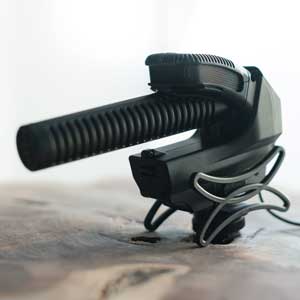
Stereo microphones have two microphone elements, and are designed to give you a wider, more immersive sound field than mono microphones. A wide pickup pattern is preferable for most live events and when shooting outdoors. For example, if you’re recording a band with a stereo microphone, the individual musicians will be positioned in your recording as they were on the stage. With a mono microphone, all the musicians would be centered in the sound field, as if they were all playing on stage in the same exact spot. Any type of outdoor video, from a city street to a beach setting, would be enhanced with a stereo microphone. The large sound field will replicate what is being seen and heard in the video where all directional clues would be lost with a mono microphone.
When To Use Stereo Vs. Mono
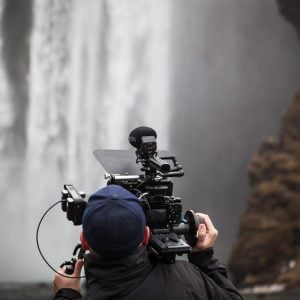
To illustrate the difference between mono and stereo microphones you could use the analogy of a wide angle or zoom lens. If a park is our setting, a wide-angle lens lets us see children playing to the left and a bird in a tree to the right. Similarly, stereo mic lets us hear the children playing on the left and the bird chirping on the right, and all the other sounds in the park. But what if we want a closeup image of the bird and to better hear its song? Then a zoom lens will give us a detailed closeup image, and a mono shotgun microphone will do the same for its song.
Another way to look at it is with the example of a wedding. You would want a mono shotgun microphone to capture the couple exchanging their vows while a stereo mic would be more suitable for the reception scenes.
Choosing a Microphone
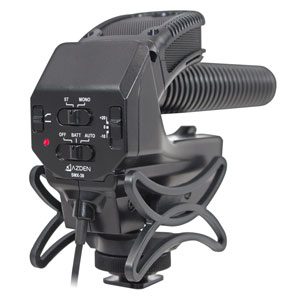
So, which should you choose: a mono or stereo microphone? If your budget allows, you may want to consider both, or you may want to consider the Azden SMX-30 Stereo/Mono Switchable Microphone. It combines the best that a mono and stereo microphone have to offer. Since the SMX-30 is really two microphones in one it can satisfy most of your on-camera audio needs.
Frequently Asked Questions
Stereo vs mono microphone: what is the difference?
A mono microphone records one audio track from a single microphone element. A stereo microphone has two elements and records two tracks, creating a wider sound field where sounds keep their left and right positions. Mono shotgun mics focus on what they are pointed at, while stereo mics capture the whole space around the camera.
Is mono or stereo better for recording dialogue?
Mono is usually better for dialogue. A directional mono shotgun microphone is most sensitive to sound from the direction it is pointed and less sensitive to sound from the sides and rear. That focus reduces extraneous noise and makes your subject's voice clearer and more intelligible. Mono mics can also pick up sound from a greater distance.
When should I use a stereo microphone for video?
Use stereo when you want to capture the feel of a whole space, such as live events, a band performance, or outdoor scenes like a city street or a beach. Stereo keeps sounds positioned as they were in real life, so musicians on stage stay in their places and the audio matches the wide picture.
What is a shotgun microphone?
A shotgun microphone is a directional mono mic. Its single element sits at the back of a barrel with cancellation vents on the sides, which gives it a narrow pickup pattern called super-cardioid. It hears best in the direction it is pointed and rejects much of the sound from the sides and rear, which makes it popular for dialogue.
Do I need an external microphone for my camera?
The microphones built into most DSLR and mirrorless cameras are not good enough to match their video quality, so an external microphone is a simple upgrade. First check that your camera has an external mic jack. It is typically a 1/8 inch (3.5 mm) mini-plug input, usually marked MIC on the camera body.
Can one microphone record both stereo and mono?
Yes. Some on-camera microphones are switchable between stereo and mono, essentially two microphones in one. That lets you switch to mono for focused dialogue, such as a couple exchanging wedding vows, and to stereo for a wider scene like the reception. If your budget allows, owning both a mono and a stereo mic is another option.