By Dean Yamada
Coppola said cheap cameras could let anyone make a great film. Director Dean Yamada explains how to tell an authentic story and shoot it with heart.
There’s a quote that I love from Francis Ford Coppola in which he talks about the prevalence of video cameras and how it opens up the possibility for a little fat girl in Ohio to pick up her father’s camcorder and become the next Mozart. Her brilliance breaks down the whole professionalism of moviemaking and returns cinema to an art form.
With the boom of affordable HD cameras, this is now happening around the world. Ten years ago, I believe it would have been nearly impossible for a digitally shot short film to compete for slots at the biggest film festivals around the world. Now it is commonplace.
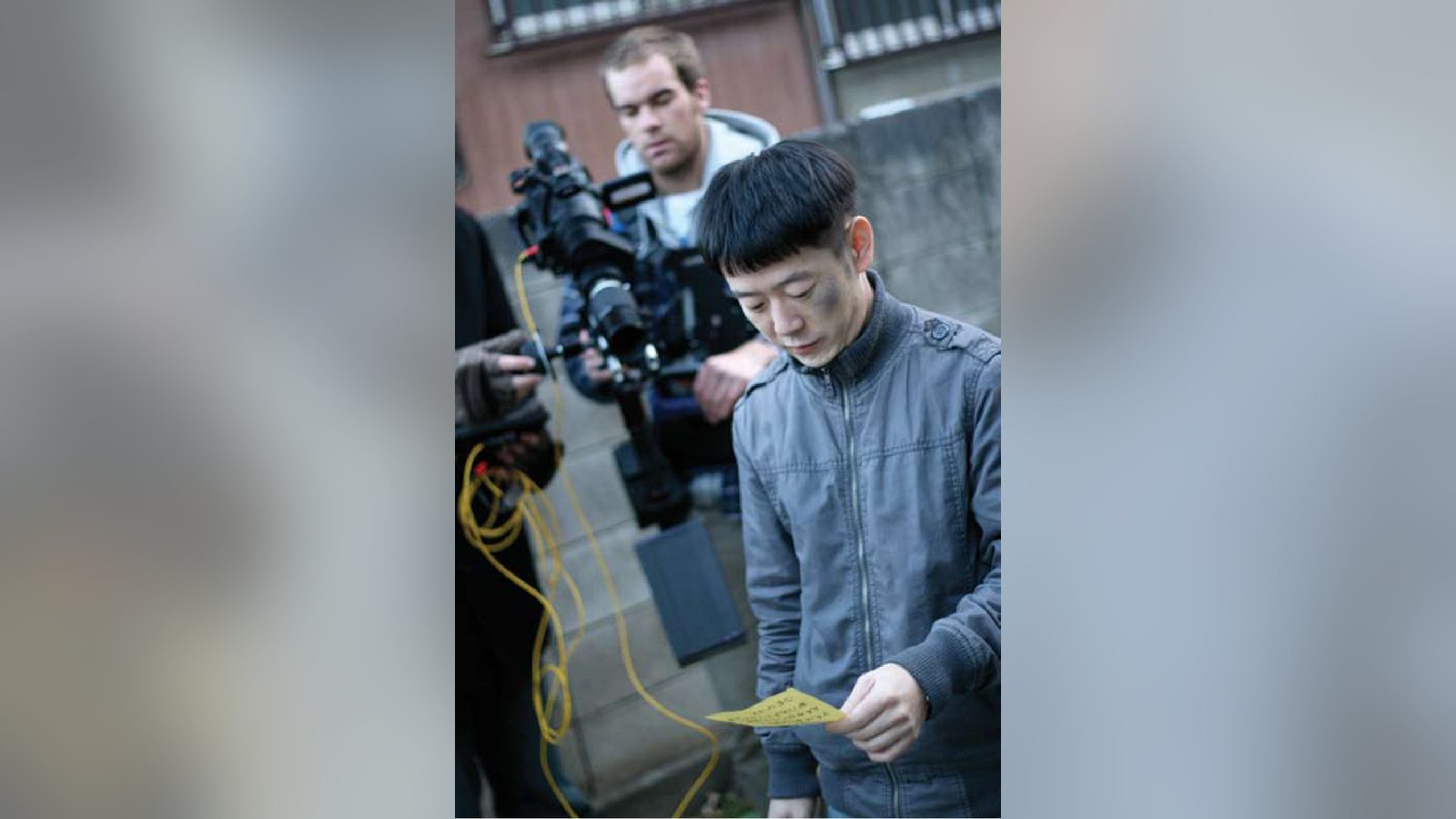
I teach film at a little school in Southern California called Biola University, and one of the benefits of teaching at this school is that I get to bring a class of students to Tokyo every two years to make a short film. Our latest venture is called Jitensha, which means “bicycle” in Japanese. It’s the story of a lonely man whose bicycle gets stolen piece by piece; when only the bell is left, he receives a letter in the mail with a list of addresses where he can retrieve the parts of his bike. It’s a redemptive tale of how a man pieces his life back together.
A Japanese writer named Yu Shibuya penned the script and a small production company called Studio Re: collaborated with us on the production. Our lead actor, Yugo Saso, starred alongside Kiefer Sutherland in the 2001 indie film, To End All Wars, which was produced by the chair of our film department.
Apart from a couple of C-stands, we shot Jitensha using only equipment we could carry with us on the plane. This included a Panasonic HVX-200A, a Letus adapter, a 35mm lens package, a Steadicam, an Arri light kit, sound equipment and a few other small items.
Here’s why and how we used the bare minimum HD filmmaking tools to tell the story, increase production value, and achieve our objectives.
The Look and Feel of the Film, “Jitensha”
The first half of Jitensha has a cooler color palette and uses a lot of flat space. As the protagonist sets off on a journey of self-discovery in the second half, the colors become warmer and more saturated, the space becomes deeper, and we begin to use a lot of vertical lines.
Capturing the Look
To attain the look we were going for, we needed to be aware of our surroundings and what they had to offer visually. The film is a mix of deep and flat space, warm and cool colors, and uses strong vertical lines. When we arrived at each location, we had to look at the linear motif inherent to the surroundings and what kind of space we could achieve.
Using the example of vertical lines, when we’d compose a shot, we had to be conscious of how to maximize this visual component. If there were only vertical lines on one side of the building, this is where we would place the actor. The whole film was shot on location, so it wasn’t a matter of production design, rather where we place the camera.
Camera Selection
Panasonic HVX-200A
Our department owns 2 HVX-200As and 1 RED. For traveling overseas, the HVX is much more portable. The image quality looks good, the lenses can be changed, and we shoot with P2 cards so the workflow is easy.
Lens and Lens Adapter Selection
35mm Lens Package and Letus Adapter
To tell a story in the best possible way, a filmmaker needs to know how long and short focal lengths affect each composition. Extremely long focal lengths tend to compress the space in a shot, but have a shallow depth of field, which can look visually appealing. Extremely short focal lengths expand the space, often making it look more dynamic.
The Letus adapter was the most accessible lens adapter. This was an absolute must because we needed to be able to switch out the lenses so that we could control the look of the film. Being able to switch out the lenses allowed us to achieve different looks, such as using a longer lens to attain a shallow depth of field. For some shots, a shallower depth of field can have more of a filmic quality. We used focal lengths to control our shots and give us the look that was appropriate for the scene.
Without the lens adapter and the 35mm lens package, the film would have lacked texture. We wouldn’t have been able to achieve a look that would make people forget that this film was shot on video and not film.
Camera Support Systems
Steadicam
Because we were shooting a film about a bicycle, we knew we were going to have moving shots. We wanted these shots to look fluid, whether we were tracking with the bicycle in a car or following the protagonist on his journey. We also wanted to keep the film dynamic by moving the camera. With that said, we didn’t use tracking shots just for the sake of moving the camera; they had to be organic and work with the story.
We used the Steadicam inside of a car while we were tracking with the bicycle. The last shot of the film was shot guerilla with the hatch of a minivan open and the camera op shooting from the back as the actor followed us on his bicycle. All of our tracking shots were done with the Steadicam, which freed us of having to use a dolly, thus saving more time.
The Steadicam is a substantial weight to be carrying around all day. It helped us to have two camera operators, who would switch off to lighten the load. To use a Steadicam well, one has to learn how to balance it and control it. It’s not easy to get fluid moves, so our camera ops made sure to practice with it before leaving for Japan.
Arri Light Kit
The Arri light kit was the only portable light kit that we felt we could check onto an airplane. It contains three small lights that we used to shoot most of the interiors. We made this decision because it was easier to bring our own lights on the plane than to rent in Japan.
One Arri light kit is not enough to fully light a scene well, so that was the biggest disadvantage with not having bigger lights. However, it was small enough for us to use surreptitiously when we had to light a couple of outdoor scenes.
Audio Gear and Setup
We recorded our sound directly into ProTools using a MacBook Pro.
We used a boom most of the time along with ProTools. Having the sound recorded digitally gave us good sound quality and allowed us to easily sync it to the picture in Final Cut Pro.
Would it surprise you if I told you that this little film, created by a fledgling film program, shot with limited resources, premiered internationally at the oldest film festival in the world, the 66th Venice Film Festival? How about if I told you that it screened in competition at the Clermont-Ferrand Short Film Festival, the most important event for short films in the world?
This proves to me that the playing field has officially been leveled. For films to screen on some of the largest stages in the world, they do not need to come out of the big name film schools, nor do they need to be shot on film stock.
For Jitensha, all of the necessary elements fell into place – an original, unique story; a great actor who filled in the gaps; strong aesthetic choices that dictated the look of the film; and lastly, an affordable shooting format that would allow us to make a beautiful film on a shoestring budget.
Apart from me being the director/ professor, I wanted to try to erase the hierarchy of the crew. Each student had a job to fulfill, whether as the producer or best boy. Just as in the human body each part serves a purpose and is no less important than any other part, so it was on our shoot. If the 1st AD does just as much work as the producer, why should the producer be seen as any more important? This is just a Hollywood convention that exists only because of money. On our films, money does not dictate the importance of the position.
My students poured their hearts into this film and brought their A-Games to the set. This made all the difference as we set out to tell this story in the best way we knew how.
Anyone can pick up a camera nowadays and make a great film without following Hollywood rules. One has only to tell an authentic story and shoot it with great heart. At the end of the day, it is the emotional resonance of the film that will connect with audiences around the world.
Dean Yamada received his MFA from USC and is an associate professor at Biola University, where he specializes in production and post-production classes. Jitensha (www.jitenshamovie.com) also won best short film at the Heartland Film Festival and the Best of Fest award at the Broadcast Educators Association Festival of Media Arts. Next up, Dean will be bringing a class of students to Berlin to shoot another short film.
Keep learning filmmaking
Want more lessons like this? Join StudentFilmmakers free for live webinars with working pros, and stream on-demand filmmaking classes in cinematography, directing, screenwriting, sound and post.