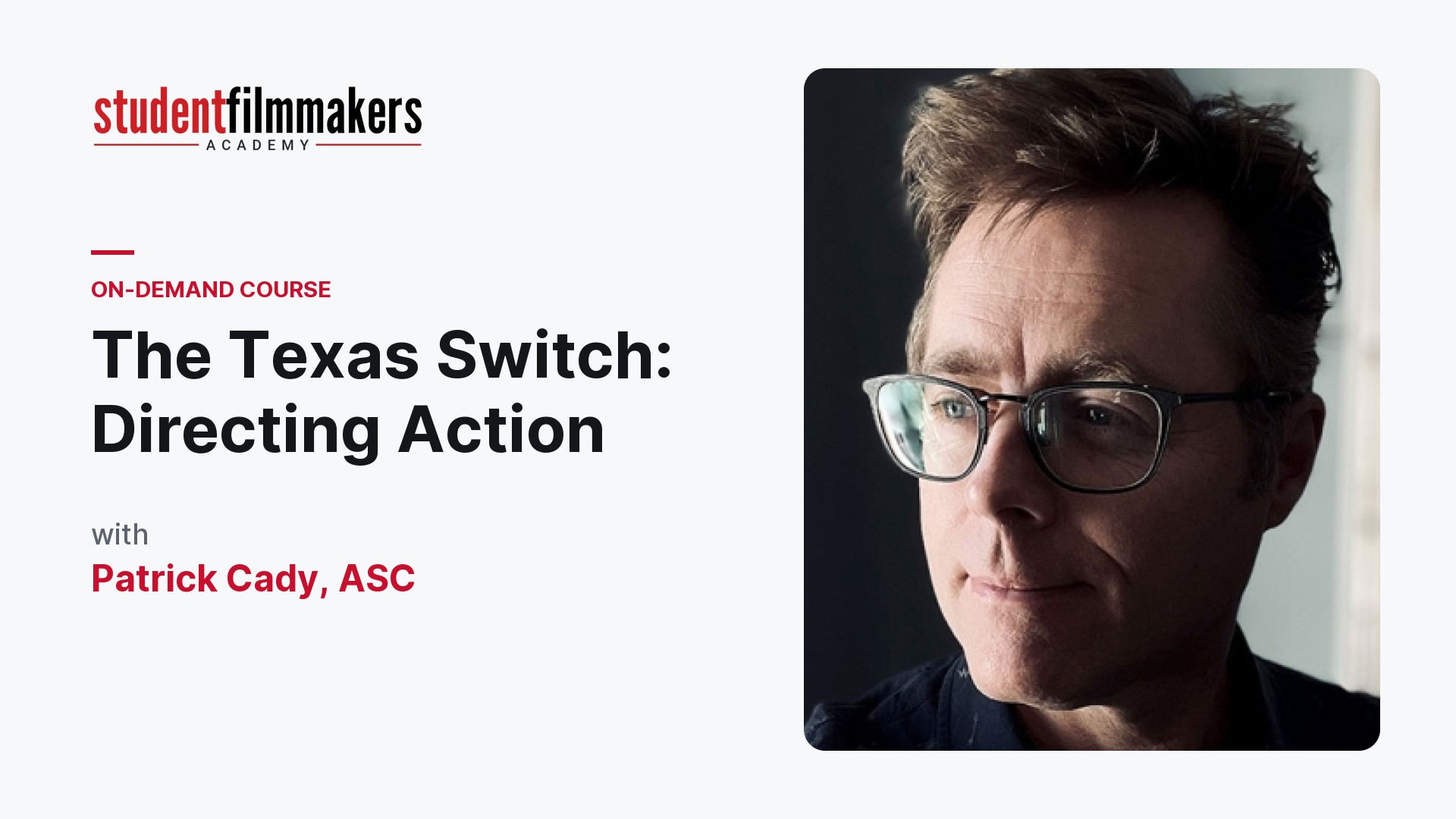
A Texas switch trades an actor for a stunt double inside a single shot, and the audience never sees the trade happen. Patrick Cady, ASC, an Emmy-nominated cinematographer (Insecure) who shot Girlfight and went on to direct episodes of Bosch, pulled off two of them in one take on a steep hillside chase. His lesson: plan the switch with your DP, shoot it once, and if it works, move on.
Cady opened his live class with StudentFilmmakers by playing raw dailies from that Bosch chase, still far from final color, and then pulling up the shot list from the shooting day. Most of what follows comes from those two documents and the questions filmmakers asked about them.
What is a Texas switch?
It is a swap. A performer leaves the frame for a moment, behind a pan, a bush, a pillar or the camera itself, and someone else enters in the same costume and keeps going. Done well, the shot plays as one unbroken action by one person. Cady suggests watching old Westerns to see where the trick comes from, and then looking up modern examples, which are easy to find.
On Bosch, the chase sent a suspect in a red vest down a hill with the detectives behind him. As the man in the vest runs off screen, the actor ducks around the right side of the Steadicam operator and hides behind the crew. A stunt performer who had been crouched behind a shrub takes his place and heads down the slope.
The second switch is faster. When the Steadicam moves off actor Jamie Hector, who plays J. Edgar, a stunt double runs into his exact position. Cady admits he has never counted the frames.
Why use doubles for running down a hill?
Students tend to underrate it. A run down dirt does not look like a stunt, but Cady was blunt about the risk:
“It’s a huge stunt. All you need is someone to trip.”
Before the take, the stunt coordinator and stunt team went over the hill with rakes, cleared out large rocks and softened the dirt. The aim was to keep any actor from face-planting or twisting an ankle with a large action scene still ahead on the schedule. An injured lead on day one of a chase is a problem for every day after it.
How do you plan a Texas switch on a shot list?
Cady writes his shot lists with his cinematographer, not alone. On this episode that was Paul Summers, and the two of them walked the location several times. On the list, the hillside was shot 7, which Cady first planned as its own setup followed by a separate pass of several point-of-view angles.
Walking it again, they saw that a wide shot plus one long-lens POV would cover the action. With three cameras rolling, they folded everything into a single setup. That cut the stunt team’s work to one pass. Here is how the cameras split the job:
| Camera | What it did |
|---|---|
| Steadicam | Led Edgar, then hinged around behind him as he closed on the suspect. This is where the switches happen. |
| Wide shot | Showed how steep the hill really was, with the highway view in the background. |
| Long-lens POV | A tight angle on the runners through foreground plants, used to carry the chase down to the bottom of the hill. |
“Hinge” is Cady’s own shorthand. A filmmaker asked whether it meant the switch. It doesn’t: it means the operator pans around the actor like a door swinging open.
Two details are worth stealing. First, while scouting, the team added a small cluster of shrubs near the top of the hill. They hid the Steadicam work and gave the stunt performer a place to wait. Second, the long-lens POV exists to move the story to a much larger stand of plants at the bottom, where the rest of the scene plays. Because the greenery looks alike, a whip into leaves lets the editor cut from the hill to the hiding spot even if a little time has jumped.
The switch on Edgar was not on the paper at all. The Steadicam operator suggested it on the day, since a stunt double was standing right there, and the stunt coordinator agreed. Cady said yes.
For more on building a list like this, see How to Make a Shot List.
When should a director say “check the gate”?
The crew rehearsed the move several times without people, perhaps once with runners, then rolled. Cady watched from a van parked beside the hill. The first take was the one. He threw open the van door and called it, and the crew turned to stare. The first assistant director asked if he was sure.
He was. His advice to any director who has the shot:
“If you’re excited about it, check the gate and move on.”
Kim Welch, our publisher, asked what happens if something was missed. Cady pointed out that he is not the only one watching. The cinematographer, who is not operating, the script supervisor and the camera assistants on their focus monitors are all checking too, and calling “check the gate” is an open invitation for any of them to speak up. If nobody does and it still turns out wrong, he lives with it.
Another filmmaker asked if he played back every camera before moving on. No:
“If you have doubt, just do it again. It’s going to be faster. Just do it again. Don’t get hung up on playback. Nothing will slow the pace of a set down faster.”
In the film days, the phrase meant an assistant checking the camera gate for a “hair,” a buildup of emulsion that would cast a shadow on the image. Now Cady uses it to mean the take was truly recorded. On an episode of The Rookie: Feds with Nancy Schreiber, ASC as his DP, the two of them traded bicycle bells: he rang his to call it, and she rang hers when the take was technically good.
How can you fake a fall without a switch?
When cinematographer Michael Goy asked how a director without camera experience can learn to think this way, Cady went back to grad school in New York in the ’90s. He and a friend watched the action movies they loved on Laserdisc, shot by shot, with the sound off. Scenes that had seemed impossible started to look buildable.
One pattern he picked up is a two-shot cheat. Shoot the actor running across frame and whip the camera with them, but they don’t fall. Then repeat the move with a stunt performer, start on their face, whip with them as they’re thrown, and follow them to the ground while they hide their face. Cut the two together:
“No one doubts that the actor just got thrown to the ground.”
On bigger stunt days he maps moves with Hot Wheels cars on the hood of the real car, or with Lego figures, as one viewer suggested.
Did the one-take version make the episode?
Not as shot. On a TV series, the director turns in a cut and the producers finish it their way. That is why Cady shot coverage too, so the bosses could tighten the chase. The oner was cut up in the final episode. He even planned a beat where Edgar pauses at the top, annoyed that he has to ruin his good clothes, before going after the suspect, the kind of human moment he loves in Raiders of the Lost Ark.
What else to take into your next action day
- Plan the shot list with your DP at the location, then look for setups you can combine.
- Give doubles somewhere to hide: a shrub, a pillar, the back of the crew.
- Keep one pace all day. Cady doesn’t want Gone with the Wind in the morning and The Dukes of Hazzard after lunch.
- Check your progress halfway to lunch, at lunch, and halfway to wrap, and compromise early.
- Make a beat sheet for the cast when the writer can’t scout, so actors know what the day holds.
He also shared how he and Karyn Kusama planned Girlfight around 24 shooting days and an estimate of 18 shots a day, and why his main test for any angle is simple: “Every shot should answer a storytelling question.” If you are a new director paired with a seasoned DP, this piece on working together is a good next read.
The full class also covers scouting with Ernest Dickerson’s photo trick, a Bosch camera car that caught fire, tension versus surprise in long takes, and bounce light for multi-camera scenes.