Reference: StudentFilmmakers Magazine, 2015. February 2008. The Interview Process: Guide Your Subjects through to Get the Best Responses: A Few Helpful and Often Overlooked Elements by Matthew Marshall. Pages 34 & 36.
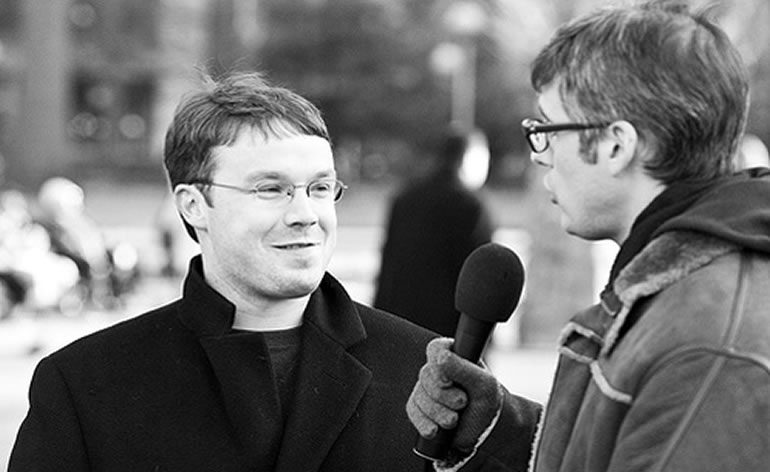
Interviews are usually conducted for corporate, documentary and event productions. As videographers, we often find ourselves in the position of conducting the interview ourselves. This is especially true on projects such as documentaries, which often have very small crews of two or three.
Over the years, I have shot and interviewed people ranging from the CEO of Citigroup to members of Native American communities, and in that time, have developed methods I have found helpful in getting the most from those being interviewed. This article does not address the lighting or technical aspects of the interview procedure, which are obviously essential. It will focus on the more overlooked area of how to work effectively with your subject.
It is important to first define what exactly makes a successful interview. I believe an interview is successful only when audience members have a true connection with the interviewee. This happens when we, as audience members, know the interviewee is speaking honestly and passionately about their subject. Someone can only speak from this place when they are in an environment that is somewhat safe and comfortable to them.
Herein lies the challenge – how you create a comfortable, safe environment in a situation that is inherently stressful and intimidating to the subject: the interview process. Being on camera for a novice – and most subjects will be novices – can be an extremely intimidating experience, where the interviewee is seated in a chair under bright lights with a camera bearing down on him/her. It is imperative to keep in mind that nearly every step of the interview process is completely foreign to your subject.
It is your responsibility to guide them through this process. The most destructive error you can make when interviewing someone is to stick him or her in the “interview chair” and ask about some incredibly intimate detail of his/her life. It will not work, and the remainder of the interview will be lost.
In order to get dynamic interviews, I have found a few helpful and often overlooked elements:
Start by developing a rapport with your subjects before the interview begins. Be certain to introduce them to all of the crewmembers. Try to engage with them as much as possible. The idea is to cultivate a feeling that they are not there to be examined, but they are a part of the procedure.
Before the camera rolls, it is imperative to walk your subjects through the entire process of what is about to take place. Let them know that they will be miked, they will be asked to speak for an audio level check, and they will be sitting in front of lights. Also, let them know they can start and stop at any time. This takes the pressure off of having to do it perfect. The more your subjects are oriented to the process, the more comfortable they will be. I have found it best to explain all of this before they are seated for the interview.
Explain the procedure of answering your responses in full statements. This part always seems to be the most difficult concept for subjects to grasp. The key to them understanding is to actually practice this with them before shooting.
For example, if you ask, “How long have you worked at the day care center?” Explain to them that the audience will not be hearing the interviewer’s voice in the final edit, and it would be more effective to respond with, “I have been working at the day care center for five years”, instead of merely saying, “five years”. Although most interviewers are very familiar with this type of response, they do not practice it beforehand with subjects. Ask your subjects the questions, and then, have your subjects repeat back to you using full statements with their answers. I can guarantee if it is not practiced at least one time, they will completely forget the concept when the camera starts to roll.
Once they are seated in front of the camera, don’t begin the interview immediately. Take some time to chat casually with them in this setting, while they are being miked. Allow them time to get comfortable with the environment of being in front of the camera and lights.
When the interview does begin, it is best not to start abruptly by announcing, “Action!” or, “We’re rolling!” I find a more effective way is to casually let your subjects know the camera is rolling and ease into the first question from the conversation you are already having with them. When your subjects are engaged in actual conversations, they will be less focused on the camera and more focused on the discussion. This goal is to keep the interview from being staccato.
Before concluding any interview, always ask if there is anything that they feel was not included that they would like to add.
In order to move audiences and have them connect to your subjects, you must work with your subjects, not just the lights!
Matthew Marshall’s short narrative films have been nominated for the Academy Award in the student category and have won in festivals such as the Avignon Festival, Hampton Film Festival, and International Short Film Festival. His film awards include the Martin Scorcesse, Warner Brothers and Lew Wasserman Awards. His documentary work can be seen at the Smithsonian National Museum of the American Indian. Matthew currently works as a videographer and editor in New York City. His website is www.tenacityfilms.net.