Tomas Salles directed, edited, produced and animated the award-winning short Equilibrio. He explains how he shot, animated and cut the dark comedy.
Equilibrio, directed, edited, produced, and animated by Tomas Salles, becomes one of the top award-winning films of the 2007 Annual Summer Shorts Film and Video Awards receiving third-place grand prize and recognition. A one-minute yet impactful, digital effect heavy, dark humor short, Equilibrio is Salles’ first short film, and his thesis for his Master of Science degree in Computer Graphics Animation at NYU.
With an extensive work background as a Digital Effects Artist in Brazil since 2001, the New York-based 3D artist and NYU graduate begins his film directing career with his award-winning Equilibrio, and details his experience making his film, while sharing a few digital effects techniques and tips.
While conceptualizing your story for Equilibrio, did you approach ideas keeping View the movie and post a comment at: http://www.studentfilmmakers.com/movies/2007/08/24/equilibrio/ in mind you’ll be implementing a lot of digital effects for this project?
Tomas Salles: Yes, my idea was to try to come up with an original film, by using the tools and techniques that I’ve learned in school and at work. Since I have a background in post production, I started to think on the possibilities that the digital technology available at the time could provide, letting my mind free of limitations and worrying about the techniques later.
What inspired your story for Tomas Salles: The idea for the story came in part from a dream. I was sitting at home watching a comical music video on TV with a skinny guy working out in a gym and having his muscles grow. While I was dreaming, I thought to myself, ‘Wow, what a nice idea for a music video. I wish I had thought of that.’ And then I woke up and realized the idea was in my head! After that, I went on to develop a better story with a close friend [Rodrigo Carvalho]. And, we came up with the dark and humorous short.
Could you share the message or metaphor behind Equilibrio?
Tomas Salles: My intention was to be open to any interpretation of the viewer surrounding the theme of being balanced, which is essential to life. But I usually like to point out the short’s metaphorical comment on our culture of excesses. A culture that encourages us to be better, more competitive and more impulsive to grow (in any sense), but that also make us consume too much, profit too much, consequently, pollute, destroy, and waste.
Equilibrio means balance in Portuguese because my generation is challenged to find the balance between growth and sustainability to avoid an ‘unexpected fall’. I think some of the questions behind the short are – how can a limit to growth and expansion be determined? And are limits bad to human potential?
What kinds of things did you discuss with your cinematographer, Chris Freilich, in regards to the look and feel of Tomas Salles: We discussed a lot about mood, timing and color palettes. I imagined a dark environment, with very little saturation and a very diffused light. So early in pre-production, I showed him some visual references of what I liked. He explained to me that they where very expensive light setups and that they were very hard to achieve, especially with our budget [$5,000]. But when we got to the time of the shoot, he accepted the challenge and ended up using very smart and cheap solutions to achieve the desired look. I was really impressed with his work.
What cameras did you use to shoot Tomas Salles: We shot the film in 35mm using an Arriflex 35 III Camera with a set of Cooke lenses (18mm, 25mm, 50mm, and 75mm T2.0 S4 Prime Lens).
What tools did you use to animate and edit Equilibrio?
Tomas Salles: For editing and creating all the digital effects for the film, I used the computers at NYU’s CADA (Center for Advanced Digital Applications). Most of the time, I worked with an AMD Athlon 64X2 dual core processor computer with 2 gigs of memory. The software used to create the CG elements and to composite everything was Autodesk Maya Unlimited 7.0, Michael B. Comet’s Pose Deformer, Pixologic Zbrush 2.0, Boujou and After Effects.
For the editing, I used Adobe Premiere 2.
Did any surprises come up while shooting Equilibrio?
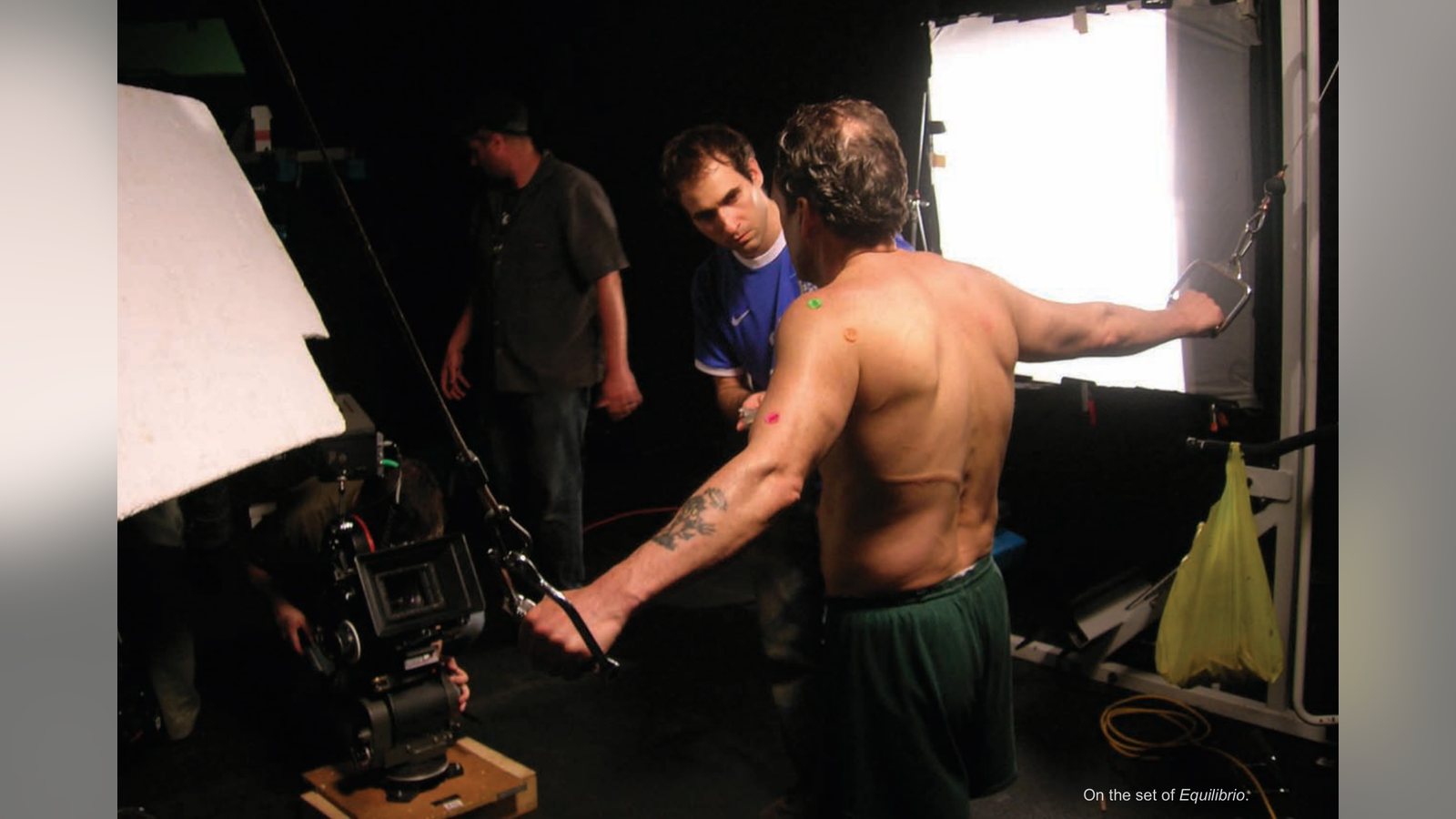
Tomas Salles: Yes, we had a couple of problems. The place where we rented our gear from forgot to include a dolly we asked for, which almost spoiled our plans. Also, we planned to shoot overnight at a location in Queens, New York – a gym called Fitness Point. The shoot was supposed to last 11 to 12 hours, but since it was a Friday, the gym would close two hours later than we thought, totaling 9 hours. We only had from 9pm to 6am, so we started setting the light rigs at 9pm sharp, and started shooting one and a half hours later. We shot in 7 and a half hours, it was very tight.
How did you work around not having the gear you expected, and then, having to work with a tighter schedule?
Tomas Salles: Chris had brought his own gear, and he had a homemade dolly that got the job done. And, thanks to our well thought-out shot list, we managed to shoot 13 out of 14 scenes with an average of three tries and one rehearsal on each light set-up. Everything ran as planned and with a very pleasant mood on the set. This certainly wouldn’t be possible if weren’t for the experienced crew that helped me. Also, we devoted quite some time on pre-production developing the storyboards and pre-visualizations that were later organized as an on-set schedule by Bobby, me and Chris.
How did you put together your crew?
Tomas Salles: My wife, Natasha Novis, had experience as a production and costume designer in Brazil, so she helped me with the casting. The co-producer/ assistant-director Bobby Yan, whom I met at NYU, introduced me to the DP Chris Freilich.
And how did you cast your lead role?
Tomas Salles: My wife Natasha and I organized two casting tests at one of NYU’s rooms with actors from the NYC area. We posted some ads online and selected 9 people out of 35 to be shot on DV. When I saw Mick Diflo’s pictures, I knew he was a strong candidate because he had the exact look I was aiming for. And on his casting test, I learned that he was a stand up comedy artist, that he used to be a boxer and could jump rope like a pro, which together with his acting skills convinced me straight away.
Altogether how long did it take for you to shoot and edit Equilibrio?
Tomas Salles: It took me 4 and a half months in pre-production while studying at NYU, one night of shooting, and six months of post production.
For those who don’t necessary work in digital effects, could you tell us how you made your favorite parts work with your story, as well as come to life?
Tomas Salles: The main technical challenge was to manipulate the live action footage to achieve the desired visual effect convincingly.
First, I had to digitally track the movement that the real camera did on set so that my digital camera could match the movement of the environment. For that I used two softwares, Boujou and Maya Live. After that, I had to ‘rotoscope,’ animate frame by frame, the digital torso to match the actor’s body and finally animate the muscle growth and add a dynamic physics simulation on top of everything to re-create the natural jiggle of our muscle mass. The last step was to digitally match Chris’s cinematography and make the light behave accordingly on digital torso simulating a realistic digital skin.
Could you share with us an indie filmmaking tip in regards to implementing digital effects in short films?
Tomas Salles: I would suggest to any filmmaker that wishes to use digital effect to include the digital artist in every stage of the production. I don’t think digital effects should be a part of the post-production stage only, because the shoot will always have a huge impact on the desired effect and consequently on the budget. So it is crucial to have the digital artist’s opinion before taking the important decisions. I even think the digital artist could help with story ideas since he understands the possibilities and limitations of the digital field.
What advice would you share to aspiring filmmakers around the globe?
I would love to encourage any filmmaker to use digital effects as a tool to make better, more creative and touching movies and not only technological spectacles which are so common these days.
Related filmmaking guides
- Top video editing software for students
- ADR: automated dialogue replacement explained
- The power of sound in film
Keep learning filmmaking
Want more lessons like this? Join StudentFilmmakers free for live webinars with working pros, and stream on-demand filmmaking classes in cinematography, directing, screenwriting, sound and post.