Filmmaker Travis Walton Waugh talks about the human characters and mystical creatures in his film, and how he designed and brought them to life.
What inspired these characters, both the human characters and the mystical creatures?
Travis: The creatures came about through the desire to have eccentric and puppet-esque beasts in a no-budget student film. Amy Novinski, the costume designer, was the brains behind the operation from that point on. We sat down and looked at where each character was, and visually, what they were doing to more fully design the creatures. For instance, the yarn wolf obviously stems from the knitting of the little old woman, “Blue”.
As far as the human characters are concerned, there wasn’t much acting required through the script, so I was more interested in the aesthetic look of the actors than their emotive potential.
Did you conceptualize and sketch creatures for your designer? Tell us more about how you brought your mystical characters to life.
Travis: I think it was a combination of both of our own imaginations. I did sketch some stuff and talk about it with her, but she would usually become the voice of reason. Amy would remind me that all of the materials we were creating with were household objects. The entire wolf was made from a blanket and a lot of yarn. The stone golem was made out of a mattress and memory foam. The bird was literally comprised entirely of found sticks from scavenging the woods. I hope telling you all this doesn’t dispel the mystical aspects of the three creatures. Regardless, Amy did an absolutely beautiful job with little resources.
What is the significance of “Yellow,” “Blue,” and “Red”?
Travis: The primary color stuff was more or less a requirement of this project for the class and professor I was making it for. It turned out to give the movie a new aspect, but I think it’s overdone. The stories are visually different enough to not require additional color separations. What’s done is done though, and apparently, it’s quote, “a nice effect” for some audience members.
Tell us about the cameras you used to shoot your film, Fairytales.
Travis: We shot it on the Panasonic DVX-100 [24p]. I hadn’t used the camera before and learned a hard lesson on some simple concepts. The red is uncomfortably grainy, and it’s my fault for not lighting the scenes enough, and instead, using the gain function. A word to the wise, never ever use gain.
Did you use filter effects?
Travis: Most all of the color correction was done live on set with gels or white balancing on something other than, well, white.
What shooting, lighting, and editing techniques did you use to create the look for the Yellow, Blue, and Red characters and scenes?
Travis: At first, the idea was to subtly insert the colors for each section through obvious and not so obvious wardrobes and props. Before finishing the last of the costumes though, I didn’t feel it appropriately met the requirements of the assignment that were focusing on color and the possibilities that it can produce in a film.
What was your most favorite scene to shoot and why?
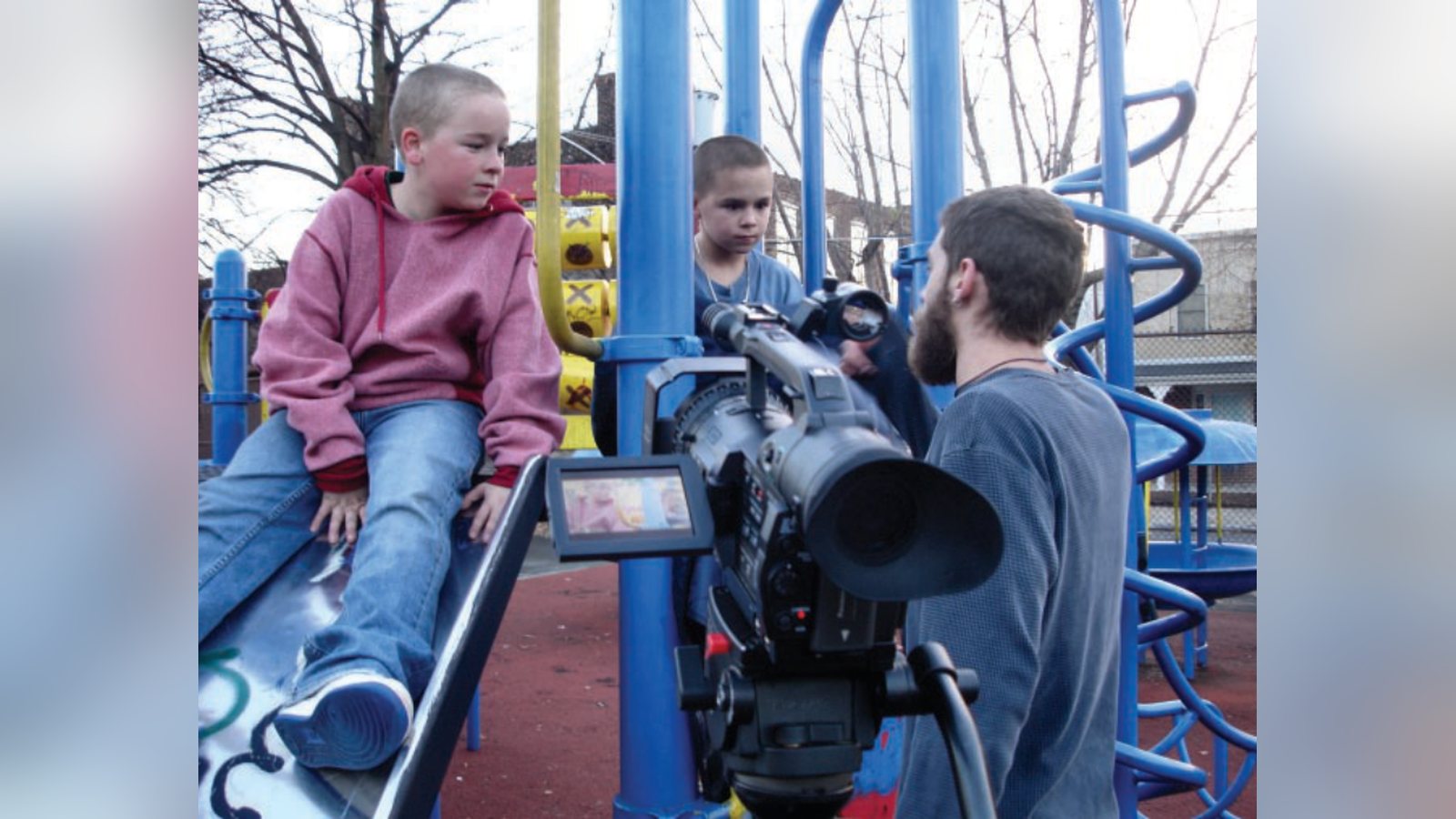
Travis: It was way fun to hang out with the kids, Rocky and Vinny. They live in a neighborhood in North Philadelphia that is not so supportive of “playtime”. I used to work with them in a couple of afterschool programs, and at times, I felt like I neglected the kids – not just those two – who I used to be so closely connected with. It was a relaxing afternoon to fool around while filming. Who does it hurt to climb a monkey bar for an hour or so with them instead of always being behind a camera…
Did you use storyboards?
Travis: I did do storyboards, but it was more for filling out the requirements of the class than anything practical. Even with that said, I didn’t actually storyboard each shot. Personally, I think if I’m using digital footage anyways, just shoot more than could ever be considered useful and spend extra time in editing.
There are also day and night scenes in Fairytales. Could you describe your lighting setups for the day and night scenes?
Travis: Lighting was absolutely a disaster for this project. The locations required extension cables to stretch into the middle of a wheat field. We were blocking neighborhood streets illegally with our cars to set up lights for shots. Many times, we would have to leave some equipment at the school because we had too packed a car with cast, crew, costumes, and camera junk. The positioning itself was nothing special, often literally just trying to expose enough. I’m no good with lighting. I don’t understand it enough and still feel that way. But I guess that’s why I’m in school.
There was a machine operator and stilt consultant in your crew. Could you talk a little bit about this? Was your stone golem on stilts?
Travis: The stilts were a long and painful experience. If we would have had more time, maybe we could have pulled it off, and we’d be talking about a completely different film. Since the film was written, shot and edited within one month, there were a lot of little things that had to be put on the backburners, so as not to shut down the entire project. The stilts were one of these things.
The original concept was to have the stick bird walking around the woods and interacting with “Yellow” more. The stilts were supposed to support my weight while in the crouched position. Needless to say, they didn’t. The yarn wolf also was drafted to have both front and hind legs of yarn-covered stilts. This didn’t work either. As a result, we had to put the bird in a tree and have primarily tighter shots of the wolf.
Frank, Derek and some of the other credits were in there because I felt bad for having people do work for me that wasn’t in the final film.
So the film was written, shot, and edited within one month… Travis: It took a little under one month to complete the entire project. About two weeks of that was in pre-production with long nights of costume manual labor. Then, two weeks of filming. When we would finish shooting a color, I would immediately, sometimes the same night, go into editing. Don’t get me wrong – that is entirely not enough time to properly edit a piece, but what can I say? It was due for credits and grades. I never really went back and touched up any of the areas that seem lacking.
You used original music in Fairytales. What was it like working with your composer? Could you describe your collaboration?
Travis: Chris is a just friend who I don’t really know all that well. He’s been doing his own music for a couple of years now, and I’ve been really into it. He’s from Illinois and was actually on tour while I was editing. When he came through Philly, I got a chance to do a video interview of him while we drove around. There’s not too much to say there, other than we both thought the main song was good for the film. It’s definitely a great musical build-up of anxiety to the point when you first see the tree bird and other creatures.
The sound effects in the opening scene gave a hint there might be some kind of creature beyond waiting to be discovered. Did you do foley work?
Travis: There was a significant amount of foley to be done. Most of which I realize now I made so entirely subtle that no one will ever realize, and most will never hear. Important examples are the opening as you mentioned and my favorite sound right before “Yellow” turns and realizes something is with her, a mixed stick-leaf crackle and bird sound is heard.
What would you say was the biggest challenge with this project?
Travis: There were a lot of challenges. The biggest and most frustrating was the amount of downsizing of ideas which had to be done. The most disheartening thing is to have a really great plan or scene and have to either omit or change the essence of it. I would figure this whole scenario out with tons of shots and movement, and then, look at a calendar and say, “Hey, this has to be finished by next Friday.” The only solution I came up with is to continue to incorporate my grandiose ideas into later films with budgets and time.
The only other important comment I can make on “challenges” is to be aware of your actors. Acting sucks sometimes, and it’s important as a director to be aware of that. I’m a pretty excitable guy with a lot of energy, and I’ve come to realize most of that needs to be addressed to my actors. Constantly aware of their situation and remembering to be in solidarity with them through everything I ask of them.
If you could share a piece of advice to new filmmakers around the globe, what would it be?
Travis: A lot of people don’t like this movie.
So the fact that you’re ‘reading this right now’ and I’ve probably never met you is a really great encouragement. I guess the best thing I can do is turn that encouragement into advice. Who cares if some or even most people don’t like your work? I can almost guarantee it’s still worth doing. In school, students practically never like another student’s work, and your teachers will get paid to tell you what is wrong with your film. I’m not telling you to ignore any criticism that is ever given to you, but at the same time, it’s not worth it to let someone else’s subjective opinion influence you enough to dislike what you do and create.
What are you working on next?
Travis: I’ve actually finished three or four short films since working on Fairytales. One of those projects, East City, Badlands incorporates Amy’s wonderful costume design again and shares some resemblance to Fairytales. The difference being every character [20+] has a unique costume or prosthetic.
Currently, I am in the pre-production stages of an interactive narrative piece. It’s kind of like a “choose your own adventure” DVD. There are five characters to select from; a wolf, an old blind woman, a long-armed character named Bankshot, the Frog Prince, and a homeless kid. The system is simple – you watch a scene, and through menus, determine what your character does. The paths cross in different ways as you dictate your character’s decisions. There are other creatures and mystical beasts you can avoid or encounter. It’s a fun project but a lot of work since I’m kind of making five movies and condensing them into one format. There will be a webpage soon, which will set up the initial storyline and also have animated prologues for each character.
Related filmmaking guides
Keep learning filmmaking
Want more lessons like this? Join StudentFilmmakers free for live webinars with working pros, and stream on-demand filmmaking classes in cinematography, directing, screenwriting, sound and post.