In the world of music videos cinematographers are often faced with very limited budgets and even more limited time to get good looking material. At the same time, however, cinematographers are given almost free rein to follow their instincts creatively. More often than not, a cinematographer can ignore the notion of naturalism and completely motivated light.
We can use the fact that we are not constrained by naturalism to come up with different kinds of creative solutions to common problems that can arise when shooting music videos.
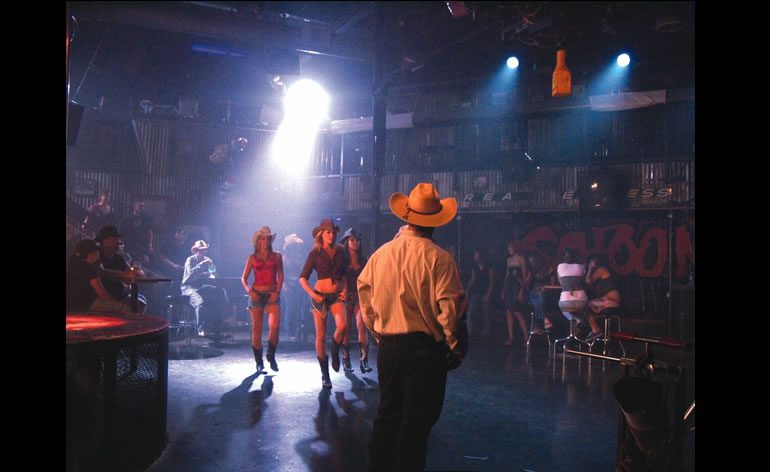
For example, on a recent music video project, I’m faced with shooting a club scene in a location which only looks good when the camera is looking in only a few directions. I have a shot that has to look in one of the “bad” directions, with an ugly, undressed white wall in the background. This wall will kill a lot of the mood and drama of the imagery.
What I decide to do is fill the room up with haze (which is different than the smoke produced by a conventional fog machine) and use several large focused lights in the background. With the haze in the location, the light projects a very distinct shaft of light which essentially covers up anything behind it. I project this light in the background and thus camouflage the ugly white wall with an interesting blue shaft of light. It would be hard to justify this solution for a project where naturalism is important.
Another problem that can arise when shooting music videos is because of their quick-paced cutting, it is easy for a viewer to lose a sense of location and the layout of the location. For example, in this same club scene, we shoot small vignettes in different parts of the club, and there is little to tie these different places together as one location. I decide to create a motif of blue light in all the club scenes so that the viewer would immediately associate blue light with the club subconsciously.
There are endless “quick” solutions like the ones above which cinematographers could work into their arsenals for different circumstances. Color, for me, is a powerful tool that should be used sparingly to maintain its maximum effect. Too many colors going on at once can often just look muddy and unattractive. Using a limited palette of colors can help maintain the impact. Blue backgrounds can look quite nice with warm skin tones in the foreground. Experimentation is key to figuring out what you like and don’t like.
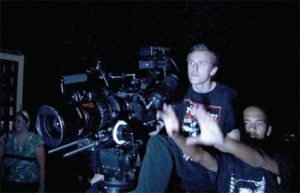
Images courtesy of Kevin Zanit.
Kevin Zanit is a California-based cinematographer who has worked on numerous commercials and music videos. His filmography includes Room Service (2006), These Days (2006), Inner Prison (2005), and Passing Moments (2003). Kevin and his partner, Elhanan Matos, recently launched a production and consulting company specializing in high-speed photography (www.studiobattlerattle.com).