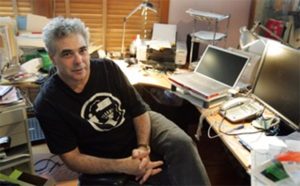
VFX supervisor Wayne Brinton talks about discovering computer animation, learning compositing on the job and making visual effects look real on screen.
When did you start working with visual effects, and what led you to make to make it a career?
Wayne Brinton: I was going to school for graphic design when I discovered computer animation. After taking the program at Seneca College in Toronto I was offered to learn compositing by a company called GVFX. Since there was no school at the time that taught this, I had no idea what it was so I figured I’d give it a try.
How did you land the job for “Now You See Me”?
Wayne Brinton: We were approached by Nick Brooks, the
VFX Supervisor on the show, to do some tests on the mirror shattering. We worked for a few weeks on this before getting our full workload.
How would you describe your position as VFX supervisor for the film, and what was your role in the daily workflow?
Wayne Brinton: I was tasked with supervising the 220+ shots that Modus worked on. I oversaw the entire process and worked directly with the movie’s VFX supervisor to bring the director’s ideas to final cut.
What was the pre-production and development process like?
Wayne Brinton: We did a lot of Look Dev on our sequences. Since there was a lot of SFX in our shots including shattering mirrors, fires and flash paper, we had to spend lots of time of simulations.
Being that “Now You See Me” is a heavily magic-based movie, what tools did you use to make the illusions real on-screen?
Wayne Brinton: We used everything from filming real flashpaper in a darkened room to using in house motion control to simulate thousands of people in a crowd. In a case like the vault flash back scene where a pile of money is suppose to burn, we ended up using three different software for simulation (Maya, XSI, Houdini), two for compositing (Nuke and Flame) and a bank of practical lens flares that were shot with anamorphic lenses.
Could you share with us a little bit about workflow?
Wayne Brinton: I always try to work backwards when starting a show. What does the director want? He wants a perfect final image. Who gives the director the final image? The compositor. And what does the compositor need to make this image? They need descent plates and nice CG renders from the lighters. What do the lighters need?… And so on. This way you are starting with what you need to deliver for final and always have that result in mind.
What’s one of your favorite scenes?
Wayne Brinton: One of my favorites was the apartment fight. It was small but most of the effects were invisible. I remember reading about how many hours the actor spent throw cards and how important it was to have little VFX in the movie. And in the end all the cards thrown in the apartment were hand animated in Nuke.
What would you say was an interesting challenge on this project?
Wayne Brinton: That would be the giant 5 pointz sequence at the end. We had aerial plates with nothing in them and need to add crowds of thousands with bumper to bumper traffic, helicopters and lights. And since it wasn’t the focal point of the sequence it all need to blend seamlessly.
If you could share a quick tip related to working in VFX, what would it be?
Wayne Brinton: The director is always right. The supervisor is always right. The artist is always right.
Related filmmaking guides
Keep learning filmmaking
Want more lessons like this? Join StudentFilmmakers free for live webinars with working pros, and stream on-demand filmmaking classes in cinematography, directing, screenwriting, sound and post.