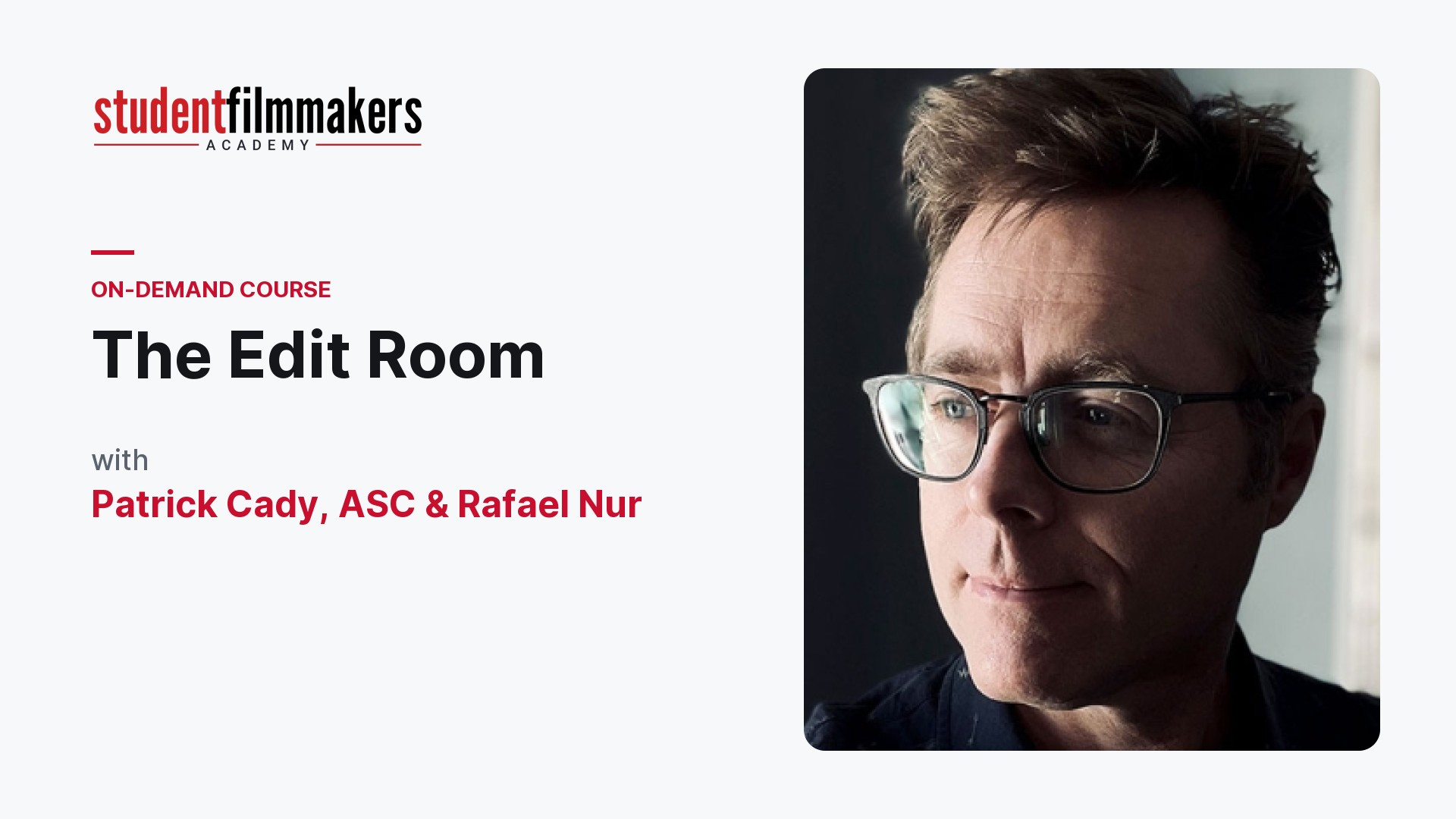
On a TV series, the director hands footage to an editor and then gets only a few days to shape the cut. For a StudentFilmmakers webinar, Patrick Cady, ASC, the longtime Bosch cinematographer who now directs episodes of Bosch: Legacy and NCIS: Origins, walked through that process with Rafael “Rafi” Nur, who edited his Bosch: Legacy episode 308. The big lesson: give your editor clear intentions, then let them surprise you.
What does the director send the editor during the shoot?
Cady starts with his shot list, sorted in story order and then broken down by shoot day. Episode 308 had a large sequence scheduled for a day and two-thirds. With three cameras running, the script supervisor credits each camera angle as its own setup, so the paperwork looked frightening. Cady adds a line at the bottom that counts “true setups” instead, 41 of them, so the crew doesn’t panic.
After each day he sends a cleaned-up summary of what they actually got: which take of a profile shot he liked best, a reminder not to use a resize he’d asked a camera to try, and what got dropped. A close-up of handcuffs going on, for example. Everyone pictures a perfect cuffs shot from some movie, he said, without knowing how much it hurts the actor’s wrist. He’ll try it briefly and then let it go.
Nur says those notes matter, along with the script supervisor’s. But much of his job is reading the footage itself:
“You’re almost trying to read the footage as if you’re trying to read a language in terms of how the director is speaking to you.”
Seven takes of one shot tell him something. So does Cady’s voice off camera between resets, which often explains what he was after.
How fast is the editor’s cut?
Fast. Bosch usually shot an episode in eight days, and a full day of dailies is a full day of work for the editor. Nur cuts each scene as it arrives, sometimes loosely on heavy days, and only sees the whole episode a day after the last footage lands. Then he has two or three days to finish the editor’s cut.
That cut is far from rough. It has music and sound so it feels like the show, but it is still built as scripted. Lines don’t come out yet and scenes don’t move. “It’s the best version you can come up with of the show as scripted,” Nur said.
| Stage | Who leads | Time on Bosch: Legacy |
|---|---|---|
| Editor’s cut | Editor | During the shoot, plus 2 to 3 days |
| Director’s cut | Director with editor | 4 days |
| Producer’s cut | Showrunner with editor | About a week, less fixed |
| Studio and network notes | Showrunner | While the editor starts the next episode |
Run time was loose on a streaming show. Episodes landed between 40 and 50 minutes, and a big director’s cut could run near 55. On the network show NCIS: Origins, Cady said, the cut has to land within seconds of a set length.
What happens in the director’s four days?
Cady watches the editor’s cut from a link and brings notes to day one. For 308, he warned Nur that just over two pages of notes was actually few. Nur had seen four-page lists as an assistant, and Cady knew most were small fixes they could finish in a day. One note suggested moving a scene earlier than scripted, because as scripted it played like a continuity error.
Other directors work differently, Nur said. Some watch with him, some send notes and let him do a pass alone, and some only trade cuts by email, which he finds less productive. Cady prefers the room, partly because it’s humbling in a good way: you see the material come together smarter than you planned.
Then the episode leaves his hands. “Television is really a writer’s medium. So the showrunner is getting the last word,” Cady said. He sees the final version when it airs.
How much can a guest director push?
It depends on the show, so ask. On his first Bosch episode as a director, Cady went to Steve Cohen, the editor who had cut the most episodes, and asked what directors always add that the showrunner, Eric Overmyer, takes out. Cohen knew at once: cutting out to wide shots in the middle of scenes. That told Cady which coverage he didn’t need to fuss over.
On the other hand, when Cady directed his first episode ever, on Rectify, he asked the showrunner whether he could show a reordered opening. The showrunner expected to scrap it and ended up using about 90 percent.
His rule for creative disagreement came out of an early clash with a Bosch producer over a lighting choice, using an idea from a friend:
“You’re a creative person, I’m a creative person. If we agree like 85 percent of the time, we’re in great shape.”
Try to guess what the boss wants all the time, and that number drops. Nur agreed, adding that his own favorite ideas often land in that other 15 percent.
Why do pauses matter so much in the edit?
Because time feels different in the cutting room. On set, a pause seems tiny after an hour of lighting. In a fast dialogue scene, one look or one held beat can tilt the whole scene, which is why Cady now thinks more about performance notes, not just transitions. But each scene cut alone collects pauses that feel meaningful, and strung together they slow the episode down. Nur explained what happens next:
“This pause right here means more, and it means more because you got rid of the other pauses. If you had all the other pauses in there, then none of them would mean anything.”
Screen size changes things too. Cady watches on set on a deliberately tiny monitor, and some moments that looked weak there played fine on the big screen in the edit bay.
Should editors visit the set?
Rarely, for Nur. He tries to visit once an episode, but he guards his outside view:
“It really helps as an editor to only see what’s in the frame, because that’s what the audience sees.”
If you know the room’s geography from being there, you may skip a wider shot the audience needs to follow who crossed where. During the shoot, he only contacts the director for real problems: a missing insert, a continuity gap, a needed pickup while the actor is still on set. Cady added a set habit that helps editors too. Lead actors often let a guest actor go first in coverage, so their reactions match whatever the guest chooses to do.
How do you become an assistant editor?
Nur and Brianna, Cady’s assistant editor on NCIS: Origins, both went through the American Film Institute. Union scripted shows need Editors Guild members, and the usual route in is 100 days of non-union work, often in reality TV, documentaries or trailer houses. Nur got his days on an unscripted documentary series, then joined Bosch. Brianna found a reality company through the credits of a show she liked and was bumped from intern to post PA within a week.
Their tips from the assistant’s chair:
- Offer story ideas, not just organization. You are the first fresh eyes on the editor’s cut.
- Ask to cut a standalone scene, and pick ones that stretch you, such as new actors or heavy blocking.
- Be ready to voice temp ADR. Brianna, often the only woman in post, has voiced every female character.
- Reach out. People in post rarely get asked, and most are happy to talk.
More on this craft: collaborating with your editor, episodic TV editing with Janet Weinberg, ACE, and how an editor should cut an actor’s performance.