By Jake Lovell
Adam Schlachter talks about his Oscar-qualified thesis short My Backyard Was a Mountain, set in 1950s Puerto Rico but filmed in California in seven days.
There is a new breed of filmmakers graduating from film school this year. These filmmakers are creating passionate, human stories that hold your attention. Latin filmmaker Adam Schlachter is one of these new graduates. His thesis short, My Backyard Was A Mountain, has qualified for the Academy Awards Live Action Short category, after winning the grand prize in the Rhode Island Film Festival. The 20-minute short is set in Puerto Rico, in the fifties. It has screened in numerous festivals including Cannes International Film Festival, Newport Beach Film Festival, and recently at the Australian International Film Festival.
I talked with Schlachter about My Backyard Was A Mountain on how he approached creating the illusion of a different time and place, and on finding the perfect actors. Born in Puerto Rico, Schlachter and his family moved to America when he was seven. He explains, “The movie is about a memory…90% is a memory.” Based on his previously written black and white short (Palmarenjo), Schlachter went on to develop My Backyard for his thesis project, which is set in Puerto Rico but filmed in California. To create the illusion of Puerto Rico, Adam and his DP (Matyas Erdely) decided to create a very grainy look to the film.
Schlachter says, “The original concept for the memory section of the film is that it would be like a discovered film from the time period, once lost, that was found and re-screened. Older films tend to have larger grain. We wanted to use Super 8, and then blow it up to 35 mm to get the grainy effects. However, Super 8 film cartridges only run three minutes as opposed to 16 mm for 15 minutes.” This would have caused a filming nightmare. In the end, they had to work in 16 mm, and then blow that up to 35 mm when they edited. Erdely used an Arriflex SR, Super-16mm camera, plus a Kodak 250 T for exteriors, and a 500 T for interiors. Adam credits his DP with helping to create the style and colors of the piece. “Matyas is a Hungarian. I always wanted to work with an Eastern European. He was in my class at AFI, and I loved what he had shot, and never got to use him in school. I like his premise that can you tell a scene with one shot. He is interested in telling the story with the shot, and not in making the shot just look good.”
The characters in My Backyard are rich and full, from the rugged father figure Pablo (Johnny Ray Rodriguez) to the innocence of Adan (Andrew Aguilar). In My Backyard, Adan (Andrew Aguilar) has one day to find a home for his beloved pet goat, Chivo, before his family leaves Puerto Rico. He enlists the help of his childhood friend, Denise (Leily Sanchez) to find a safe home for the goat. As the day unfolds, we see Adan’s realization of first love tempered with the bittersweet knowledge that he may never see Denise again. His first kiss is with Denise, and sadly it is also the last one. Through Adan’s eyes we see, and empathize with Adan’s predicament. Luckily for us, Schlachter ends the film by completing the journey full circle, in a very fulfilling way.
I wondered how much the original script had changed from the $1000 Palmarenjo project. “There were 19 new drafts of the script after the original was made. Most of the changes were minor, but the biggest change was the ending. In the original, the older Adan was younger and was looking out to the ocean. He never revisits his homeland. Backyard was the opposite,” says Schlachter.
The casting in such a visual film was of great importance to the filmmaker. Schlachter had specific traits he did not want his young actors to possess. He confides, “The challenge was in finding kids that were not trained to do commercials. Commercial actors sell the project. My film was subtler than that. Everything is done in the eyes. I chose kids that were kids, not actors.” In Andrew and Leily, he found the naturalness he wanted. “Andy had very little training and liked to climb trees all the time, even while we were shooting. Leily was the first choice for the part of Denise. No one else could play her. Leily had a musical background, and her music helped her in her part. Andy is a very subtle actor, and Leily played down to his subtle acting, herself.” These talented child actors were a godsend, as Schlachter had to abide by child labor laws that allowed the children only one or two takes per shot.
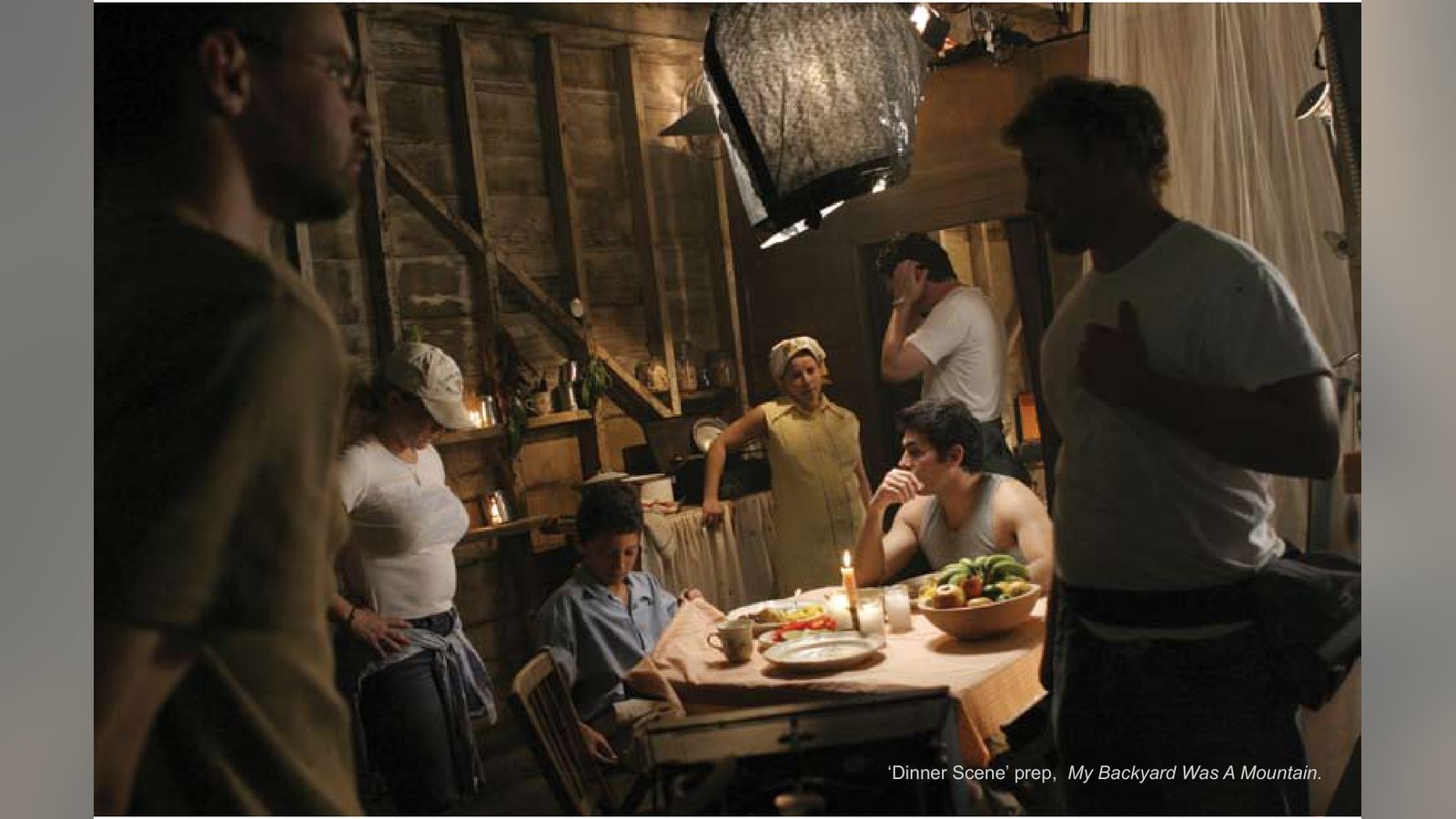
Schlachter managed to break the rule of never working with children and animals in one film. In My Backyard, the goat, Chivo, is pivotal to the story. I wondered how difficult it had been filming with a goat. “We were all so afraid that it would not behave, so that when it did, it was like a miracle. Only when it was under the dinner table did it start trying to wander about. The scene in the bed and the back of the truck made me realize that I must have had a guardian angel looking over my shoulder,” says Schlachter. With a budget of $36,000, My Backyard was a Mountain was filmed in seven days. The scenery is an intricate part of the film. Adam felt that the greenery of the California Mountains, in the rainy season, would serve as a substitute for the rich lushness of Puerto Rico. The stunning landscapes come courtesy of the Los Angeles National Forest, the Malibu Creek State Park, and Placerita Canyon. Unfortunately, March 2005 had been preceded by the wettest winter in fifty years. There were flash floods during filming. A lot of locations that Adam had previously scouted were now flooded. Schlachter jokes, “If you looked behind the camera, and turned it around …you would see rapids.” Luckily, they had enough dry landscape left to finish the shoot. Adan’s home was shot at a very small warehouse in Glendale, near Los Angeles.
Schlachter made sure he hired professional sound technicians. “In most student films the sound quality is awful. I told my producer to budget for the high end of professional sound technicians, so that I would have fewer problems in post.” This planning paid off. Schlachter had such a limited budget for post that he was calling in favors for the editing. “I didn’t want these people who were offering their services to spent time on solving sound problems, when they could be working on the aesthetics of the film.” The editing took approximately six weeks after principal photography.
Had everything gone as he had planned with filming?
“Everything in this film was planned with one exception: The scene on the hill where Adan throws the knife. I had to rewrite the scene on set because it was raining, and we could not come back to the location later, so I only had one take for each shot. The knife being thrown I believe was the actor’s idea.”
I wondered what Schlachter learned from filming My Backyard, and how it had changed him as a director. Schlachter comments, “Murphy’s law will always be there. As a director, you must trust your instincts. It is the sole characteristic that separates one director from another….that and their personality on set.”
One week before he graduated from AFI (with a MFI in directing) Adam was offered the director’s job on the horror feature, Oakley Seven. The producers had got their hands on a copy of My Backyard. Schlachter remembers, “They were looking for a fresh director out of film school who was energetic, passionate, and hungry – I was all of those things!” Oakley Seven is currently in post. Schlachter confides that the most important thing he learned from film school is that “… It is what you make of it for yourself, for your colleagues, and for your career. It is a place to take risks, to make mistakes, and to learn from your experiences. No film school can guarantee success just by completing it.”
I wondered what expectations and concerns he had leaving film school for an unknown future. Schlachter comments, “There were a lot of wants and notions of what I am worthy of, but at the same time, there is a lot of talent out there in the world, and competition can be fierce. In reality, a short is a showcase. It is your calling card. There is not much else you can do with it. Put yourself out there… You have got to self promote yourself.”
Apart from keeping his fingers crossed about the possibility of an Academy nomination, Schlachter is pleased that My Backyard Was a Mountain has recently obtained DVD distribution. His future plans include a sequel feature to My Backyard, and directing two of his screenplays (1986, and Stray Bullet).
So far Schlachter has never returned to Puerto Rico, since he left as a seven-year-old. I wondered… was there a ‘real’ Denise? Adam replies, “Ah,… I will keep that to myself.” Jake Lovell is a freelance writer based in Houston. With a background in theater arts and science, her articles offer a unique perspective on her subjects. She can be contacted at www.jacquelinelovell.biz.
Keep learning filmmaking
Want more lessons like this? Join StudentFilmmakers free for live webinars with working pros, and stream on-demand filmmaking classes in cinematography, directing, screenwriting, sound and post.