
By H.R. McDonald
H.R. McDonald won the 2012 ASC Andrew Laszlo Student Heritage Award in the undergraduate category. He explains the cinematography of his film Aexis.
Lighting and Composition Methods for Sci-Fi Thriller
The American Society of Cinematographers (ASC) has chosen H.R. McDonald as the winner of the 2012 ASC Andrew Laszlo Student Heritage Award in the undergraduate category for sci-fi thriller, “Aexis.” McDonald discusses cameras, lighting and composition, and his collaboration with director Eric Chang.
In your own words, could you tell us about the “story,” and what kinds of ideas came to your mind while reading the script?
H.R. McDonald: The film is a brief glimpse into the life of a man who seems to be living separate lives. In one life he’s an artist, in another he’s a scientist who is killed for his discoveries. The film goes back and forward in time, and at its most present time, it seems like it’s taking place in the future. I decided that it would be good to shoot the film in a way to make it seem like it came from the future.
Could you tell us a little bit about your collaboration with the director, Eric Chang, during the pre-production, production, and post production stages for “Aexis”?
H.R. McDonald: I worked closely with Eric to find the best locations in pre-production. We ended up finding a house that served a majority of our locations. This was a big part of being able to maintain a unified look throughout the film. I liked working with Eric because he gave me a lot of freedom, which I was surprised since he is a photographer himself, but he had enough other problems to worry about; it’s nice when a director puts that much faith in the photographer. I also graded the film.
What were some of your lighting and composition methods for conveying moods for scenes in “Aexis” and giving the film the science fiction / thriller feel that it has?
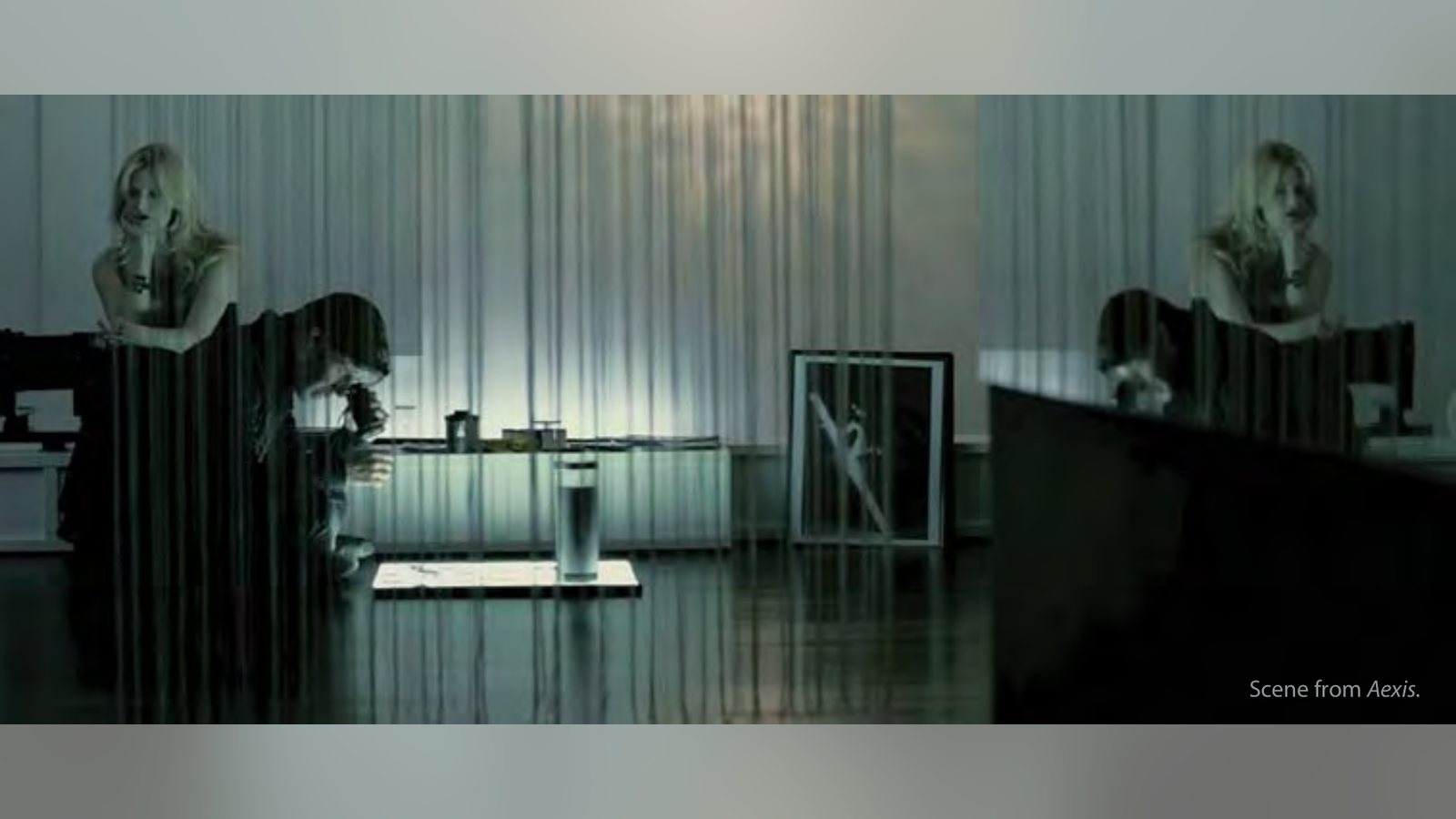
H.R. McDonald: Sharpness was a big part of the look of the film. Not optically but architecturally. It suggests the character is in some kind of fascist environment that is so controlled you question not only its reality but its humanity. I also tried to incorporate a lot of mirrors and reflections into the pictures to suggest the multiplicity of his character. As for lighting, I only used daylight balanced Kino Flo’s. Because the environment was so sharp, I wanted to force myself to stay away from hard light. The diffused approach really balances out the image nicely; it makes it seem less theatrical and more balanced. My favorite shot happens is a scene where an assassin sneaks into the main character’s bedroom at night, smothers him and kidnaps his wife. The whole scene is played out in one shot of the couple sleeping, and we only see the mysterious man in the reflection of the bed’s headboard. The shot suggests that because we don’t actually see the man (he’s only seen in the reflection), is this just happening in the main character’s head?
What cameras and lenses did you shoot with, and why?
H.R. McDonald: We shot on the Red MX in 4.5K at 2.40 (cropped). Originally we were going to shoot with anamorphic Lomo lenses but that fell through at the last minute and we ended up shooting on a set of Red Pro prime lenses; in retrospect these were better to shoot with anyway because they have cleaner optics than the Lomos. I usually like to shoot on old zoom lenses with the Red because they soften out the image, but I needed the primes because I was only working with Kino’s, and old zooms are better used at higher apertures. I used a 5D-MkII for an underwater shot and another shot with a Lensbaby; the 5D can be cut in with Red footage pretty easily on close ups.
Before you went to film school, were you already familiar with different cameras and production to post production workflows?
H.R. McDonald: Before I went to film school, I worked as a freelance editor and became a photog at a news station, which was a great way to train my eye.
By the way, how long did it take to shoot “Aexis”?
H.R. McDonald: We shot “Aexis” in 3 days. Two days in the house and one day in the basement at my school.
What advice or inspirational words can you share with start-up filmmakers working with limited time and limited crew?
H.R. McDonald: I guess the best piece of advice I could give to starting filmmakers is to recognize failure as a part of the learning process. It also doesn’t hurt to become passionate about something other than filmmaking.
What are you working on next?
H.R. McDonald: Right now I’m learning how to play the cello; it’s very relaxing.
Related filmmaking guides
- What does a cinematographer do?
- How to become a cinematographer
- Camera angles in film: a beginner’s guide
Keep learning filmmaking
Want more lessons like this? Join StudentFilmmakers free for live webinars with working pros, and stream on-demand filmmaking classes in cinematography, directing, screenwriting, sound and post.






