By Camille Haimet
Cinematographer Benoît Debie talks about choosing projects, experimenting with light and camera for directors like Gaspar Noé, and advice for young DPs.
Your films often deal with very controversial subject matter (rape, suicide bombers, hallucinogenic drugs, to name a few). What is it that attracts you to these projects?
Benoît Debie: Usually, when I choose to work with a specific director, it’s not only about how much I like the script, but also about how much complicity I feel we have together. And I always wind up working with very strong directors. When I work with Gaspar Noé, for example, as a DP it is very interesting because I can experiment with different things, and play with my art, with cameras or with light. For me, experimenting is a lot more interesting than working on a comedy or something like that. That’s why I decide to work on these kinds of projects.
Would you say that one of your goals in the making of a film is to make the audience uncomfortable (I’m thinking here of “Irreversible”)?
Benoît Debie: A little bit, yes. A lot of camera and light effects that we used for this movie were sure to make audiences very uncomfortable when they went to the theater. For example, at the beginning of “Irreversible”, the camera is spinning for the first 20 or 30 minutes and the sounds were quite intense. But I definitely think this helps with the psychology and drama of the movie.
But even more than just a slight discomfort, the films you work on often make people feel viscerally uncomfortable. What are more ways in which you achieve this?
Benoît Debie: It depends with each movie. I try to diversify and not always do the same stuff. I am usually clearer about what I am going to do after I speak with the director about his vision for the film. Sometimes I’ll work more with camera effects and sometimes more with light. For example, in “Enter the Void”, the effect was very stroby. I think this served as something slightly disturbing for the audience, maybe even a little bit aggressive.
Your films also seem to deal with psychologically disturbed individuals quite often. How do you create the corresponding effect in the movies?
Benoît Debie: I would say that one of my techniques is to help the actor‘s dramatic evolution with the light and camera. I consider that, in a movie, the camera and the light are a part of the character and it is my role to emphasize the character through these mediums.
What were the particular challenges of the visual effects in “Enter the Void”, which seemed highly stylistic compared to other movies you’ve worked on that were more grounded in reality?
Benoît Debie: That movie was really challenging for everybody, I think. It was more like a big experiment, even for Gaspar and I. We were thinking that we would shoot in the same manner as “Irreversible” in terms of camera and light. But when I got to Tokyo, everything was glowing and full of color, with new technology, especially light technology, everywhere. So we began to think of how we could use this to create a different effect. In Tokyo, they use a lot of LED so we had the idea to integrate this into the filming to play with the colors of the city and the look of Tokyo.
You work very closely with director Gaspar Noé. How much creative freedom versus exact instructions are you given in the work on his films?
Benoît Debie: Gaspar doesn’t speak very much on the set. With him, you have to propose ideas, and show him your vision of the sequence. If he likes the idea, then it’s fine; but if for any reason he doesn’t like it, you have to change and adjust. This is a little bit difficult as he doesn’t want to tell you exactly what he wants because he wants you to propose. So then you have to come up with new solutions, like a new way to frame the scene or something. I guess this is easier for me because we’ve done two movies together and it is more evident to know what he wants. “Enter the Void” was a very long process (we were shooting for 5 months), so now I know how he works.
How do you translate your personal, slightly experimental esthetic, to more commercial movies like Floria Sigismondi’s “The Runaways” or one of your newest projects, Harmony Korine’s Springbreakers?
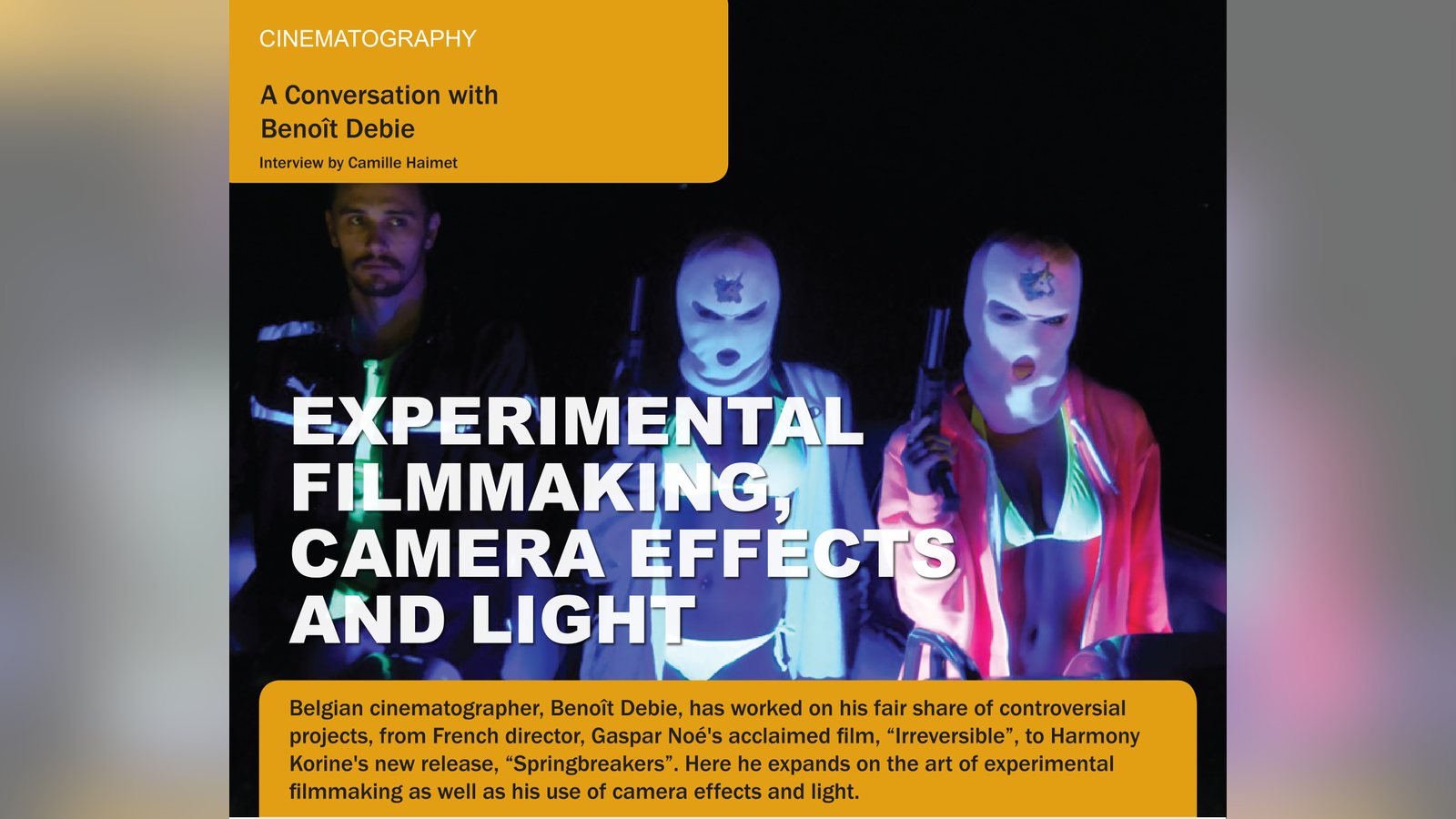
Benoît Debie: When I work with Gaspar, it’s more about experimenting with new techniques. But with something like The “Runaways” or “Springbreakers”, the goals are a little different. With “The Runaways”, the goal was to recreate the feel of the 1970’s. I had to analyze that time so that I could be more precise in terms of light and camera. I also wanted the movie to have a very natural feel, while still having the poppy and colorful appeal. Springbreakers was completely different because it was very important for Harmony to have strong visuals. Other than that, I was pretty free to do what I wanted, so I got interested in observing the colors around me. We were shooting in Florida, and during the night the city is very intense with noise and color all around. I tried to recreate this feeling in the movie.
Let’s talk about the famous fire extinguisher scene in “Irreversible”. What was it like creating this challenging scene? What was the work with the VFX department like?
Benoît Debie: We were shooting that sequence with six cameras simultaneously so that in post we could match the CGI effects with the blood and the movement. One part of the shooting was done with a real fire extinguisher and a dummy. Then we shot the exact same scene with a false fire extinguisher and the actor. I think it took us two months of work just for this sequence.
If you could share some of your insights into experimental cinematography, what would they be?
Benoît Debie: Everybody is different but this is what works for me: the best thing you can do is to observe the setting and what is around you. I spend a lot of time on set trying to see if everything is nice the way it is or if we will have to adjust something in terms of lighting or other. I also strongly recommend traveling around the world so as to observe different ambiances.
Keep learning filmmaking
Want more lessons like this? Join StudentFilmmakers free for live webinars with working pros, and stream on-demand filmmaking classes in cinematography, directing, screenwriting, sound and post.