By Jody Michelle Solis
Cinematographer Brian Melton talks about shooting the ASC award-winning short Red Autumn and how the story let him take creative risks with the image.
Between shooting an independent HD feature in Austin, Texas, Brian discusses with StudentFilmmakers Magazine how the story of Red Autumn allowed him to take risks and experiment; and he details the techniques he used to create mystery, suspense, and drama for the dark tale of a relationship between an aging ex-con and a young, innocent girl.
How long did it take to shoot, edit, and complete Red Autumn?
We shot for six days at the end of October ‘05, and I finished my portion (color correction) of the post process in late March or so… I had about six weeks for post. The film was done around April ‘06. What were some of your personal thoughts about the story of Red Autumn while working on the film?
The story development was a lengthy and tumultuous process. The original story and script was developed by a writer named Roger Scheck. It was titled something different then, and while the story structure was essentially the same, the tone of that script was much more violent and less suspenseful – perhaps less character driven as well. Both Mike [Mohammad Elsherif, the director] and I liked elements of that story but felt we needed to reel it into our tastes a bit more since we’d be responsible for making this story come to life. Mike did all of the re-writes. I think his changes helped the story have a more effective dramatic turn as well as characters that were more idiosyncratic.
Still, I worried about plot issues during shooting, and it really wasn’t until the editing phase that I realized the script we started with had truly been fleshed out into something that worked visually.
Mike and I had several discussions about seeding clues and foreshadowing Rick’s fate, and I think Mike and Zach Seivers [the editor] really found a good balance of clues and mystery.
After completing Red Autumn, did you feel the story was told and executed the way you hoped and planned for it?
For the most part, yes. However, the day we shot the last scene, we had some equipment problems and lost a generator which of course caused us to lose shooting time. We had to cut shots. Both Mike and I were nervous about getting the end of the film right… It turned out we did get what we needed and, in the end, I was very happy with the final results.
You said that the nature of the story allowed you to take risks and experiment. What kinds of risks did you take, and during the process of making the film, when did you take these risks?
I’m not sure how we got to this point, but Mike and I decided on a set of rules and restrictions that we felt could help support the look we were going for and work for the dark nature of the story. One of them was that we limited our lens choices to the wider end of the spectrum (not fish-eye or anything): a 9.8mm, 18mm, and 35mm, and shot almost entirely at T2.0/2.8. We worked a lot with obstructions and framing to create a sense of something hidden, truths untold, etc.
We wanted there to be tension and space in the film when things were quiet and the audience uncertain. Often, we’d place actors close to camera and maintain those close focus distances.
For several reasons, I decided to light rooms as opposed to actors. Of course, when we decided on blocking, I had a good idea of what areas needed to be lit, but one reason I decided on this was because I wanted time of day to play a part in determining hot spots and lighting angles. The film takes place over about a 36-hour period, so I thought it was good for the audience to literally see time passage. By doing this, we also ended up with more space for actors and for the set. I also liked the idea of having the actors lose their key every now and then.
These decisions were risky because as students we were breaking many of the rules and guidelines we’d been taught in class – established lighting and framing conventions. We’d kinda gone out on a limb of our own, drawing ideas from filmmakers we admire (Gus Van Sant, Kar Wai Wong) and letting the location we were shooting at help inform a lot of choices.
How did the story allow you to experiment?
Being sort of an off-beat story – one with an unusual intergenerational relationship – I felt that the lighting style and overall visual style needed to be “off” as well. It’s hard to describe exactly, but from the beginning both Mike and I realized this wasn’t a project for pristine, glamorous lighting. This was a project where there needed to be rough edges, character and tone etched as deeply into the acting and the shots as in the lighting, art direction, color choices, etc.
What cameras did you use, and how did the cameras benefit to the story and your storytelling devices? Or did the cameras at any point create any challenges, or call for specific alternative solutions?
We shot on the Arri SR-3. This is a really good camera – I’ve come to love it actually, and it facilitated pretty much everything we wanted to do. It’s small and compact and allowed us to work in tight spaces, which we had plenty of. Also, because it’s programmable to run film at high-speed, we were able to do a couple of slow motion shots that I think really sold the moments Mike used them for.
Could you talk about the lenses and filters you used, and why you used them? Any particular advantages or disadvantages you could share?
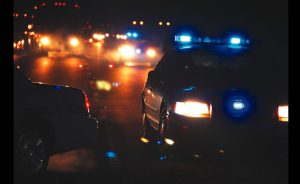
We used 35mm Cooke Primes: a 9.8mm, 18mm, 35mm and for three particular insert shots we used a 50mm Zeiss Prime Lens. Both Mike and I loved the 9.8mm, and we used that lens a lot in the opening sequence when Rick is returning home after he thinks he’s just killed someone.
I did use one filter – an Enhancing Filter – for day exteriors. This was to bring out the colors of the fall foliage, especially the reds. However, the filter brought skin tone values a bit too far into the red, so I corrected for that in post using Final Cut Pro Color Correction. In retrospect, I should’ve done more tests with this filter before deciding to use it.
What film stock did you use, and why?
Fuji Super F-250T 8652 for night scenes and F-250D 8662 for day scenes. I chose this because I had been a gaffer on a project where the DP shot on this stock, and I really liked the results – I thought it would work for Red Autumn because of how the color red looked in tests and the amount of grain it kept with the exposure I chose.
By the way, how did you become involved in this project? Were you put together with a crew, or did you choose crew members…?
At my school, we can choose who we work with for the most part. Mike and I are great friends and have worked together in the past so working on this project with Mike came naturally. The crew was made up of other NCSA students, and they typically choose to work on projects they find interesting or to gain experience working alongside older students. The crew on Red Autumn was fantastic and really hard-working.
What was your working relationship with Mike like?
Mike and I have worked on several projects together for school. Apart from being friends, we have an excellent working relationship. He’s a very visual director with a unique sense of camera movement and pacing. We spent a lot of time working out scene coverage and selecting shots both on paper and by going to the actual shooting location. On set, he’s pretty relaxed – he’s prepared, we trust each other, and we know for the most part what the other is going to like. We’re just starting to talk now about our next project which will probably happen this summer.
Taking into consideration Red Autumn’s main character, ex-con Rick, and this particular ex-con’s place of dwelling, one might wonder, why all the color in such a dark tale?
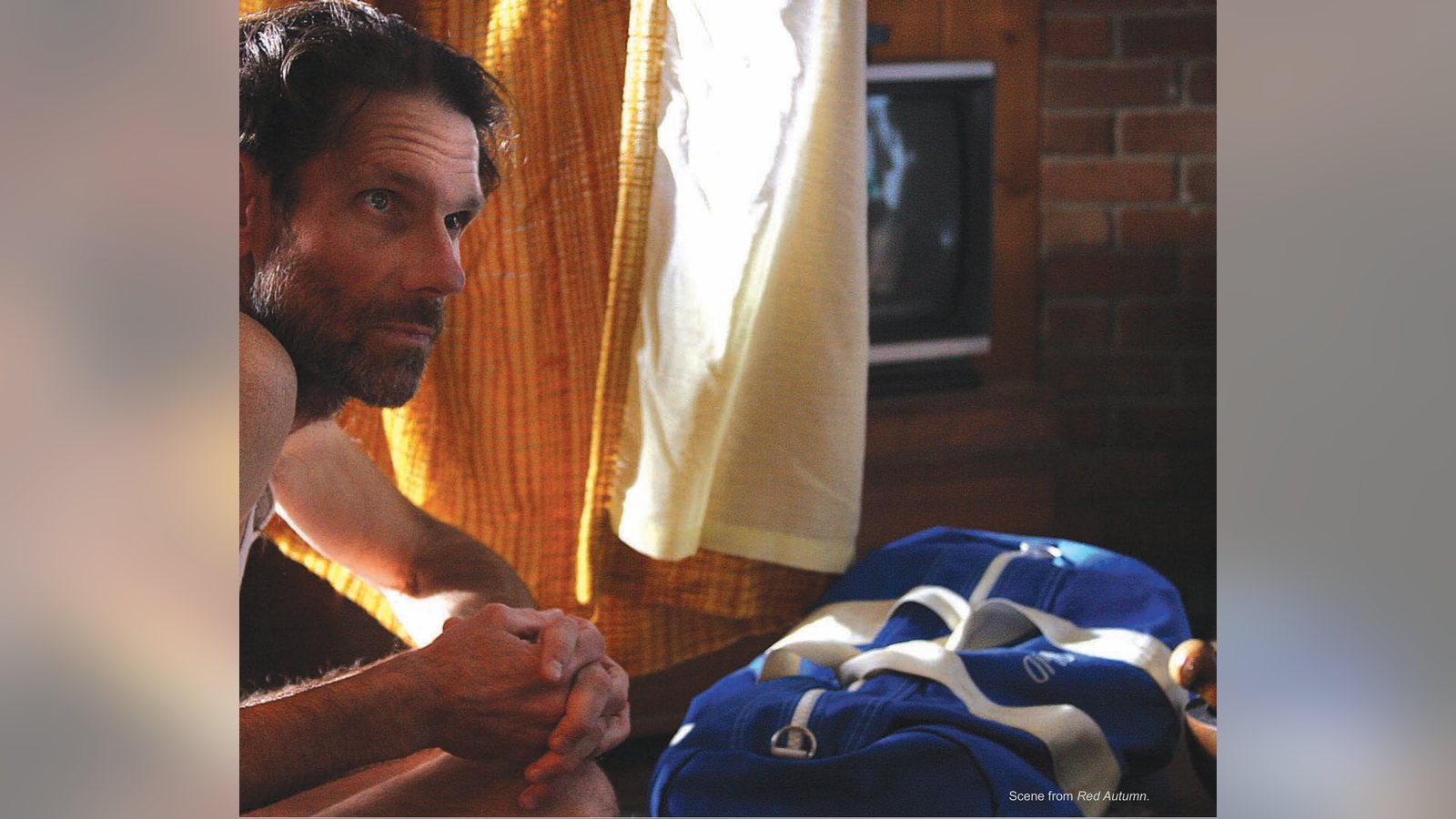
I wanted a relatively high color saturation and made use of primary colors because I thought it could convey both the young girl’s innocence and the idea that Rick was sort of a buffoon both as a criminal and in caring for a child. Each room had its own color and mood – Rick’s bedroom, where the film ends and where Rick meets his deadly fate, is blood red. Also, there’s a thin veil of fantasy here that Mike and I wanted to establish – to get into this story, you have to divorce yourself from reality a bit. The color choices were intended to help with that.
Could you talk more about your use of color and how you composed certain shots for the purpose of the story?
Both Mike and I had seen and enjoyed Gus Van Sant’s Last Days, and we thought it was appropriate to take some cues from that film because it also takes place in and around a large, rundown house with few central characters and builds tension gradually throughout. We liked how the filmmakers used the construction of the house in composing shots and how mystery and depth were created by elements located just outside of the frame or placed within the frame but somehow blocked or obscured.
We added to those ideas a few other basic concepts: frequent motivated camera movement – shots that dollied in, out or tracked with action, deliberate pans and tilts, as well subject movement toward or away from camera.
I thought it was very interesting how at one point, attention was drawn to Rick’s door lock and chain, and for a specific reason. This was done in a very creative but subtle way. Could you talk about this moment in the story?
That’s a pretty creepy scene – one where we very much intended to leave the audience hanging on a morsel of odd information. The idea was that Brenda, Chloe’s mother, had given Chloe instructions on what to do once inside the house. After all that Rick did to secure himself inside, Mike wanted to make sure the audience knew there was a way inside created by Chloe.
In relation to visually dropping clues, and creating suspense and drama in the story, what was one or two of your most favorite moments? How did you made it happen for certain scenes?
My favorite moment in the story is when Rick goes down into the basement to re-hide his money bag. Although he checks to make sure Chloe is still busy eating and watching TV, he fails to notice her enter the stairwell to the basement. Subsequently she overhears the meat of his conversation with Jasmine and sees where he’s moved the bag.
Since we often constructed shots that brought actors physically close to the camera, we had a lot of opportunities to hide important objects within the frame – this time, the hidden object was Chloe. I thought the acting in this scene was especially strong. When Rick hears Chloe’s voice, he knows she’s heard some of his conversation – whether or not she understood is another question – and it’s one of many seeds we tried to plant that gave Chloe the edge over Rick.
Were you faced with any lighting challenges, and if so, what were some of your solutions?
Many lighting challenges – most of which any cinematographer on a limited budget would encounter. We worked in pretty tight spaces so one of the solutions I developed also worked its way into the lighting style we chose: practically motivated light, usually from lamps or windows. Motivation from lamps at night allowed us to use small instruments (inkies, peppers, 2×4 kinos) and motivation from windows during the day allowed me to place instruments outside, saving valuable space in rooms.
What was your favorite scene to light?
My favorite scene to light was when Rick wakes up in the morning. We used some subtle fog effects and the great art direction made my job fun and easy.
Taking from your experience working on Red Autumn, is there a special piece of advice you could share with new cinematographers?
I learned a lot from this project – particularly that locations can facilitate or even dictate style choices. Finding a good location is often the most important step in creating an interesting image.
How did you feel when you learned that you won the American Society of Cinematographers (ASC) John Alonzo Heritage Award?
I felt extraordinarily humbled and immediately indebted to the awesome cinematography department at NCSA and all of students who worked on Red Autumn. I was certainly at a crossroads, graduating film school and making the awkward and difficult transition to working professionally. Receiving the award was amazing encouragement to continue pursuing a professional career as a cinematographer. Photo stills by Charlotte Acker.
Related filmmaking guides
Keep learning filmmaking
Want more lessons like this? Join StudentFilmmakers free for live webinars with working pros, and stream on-demand filmmaking classes in cinematography, directing, screenwriting, sound and post.