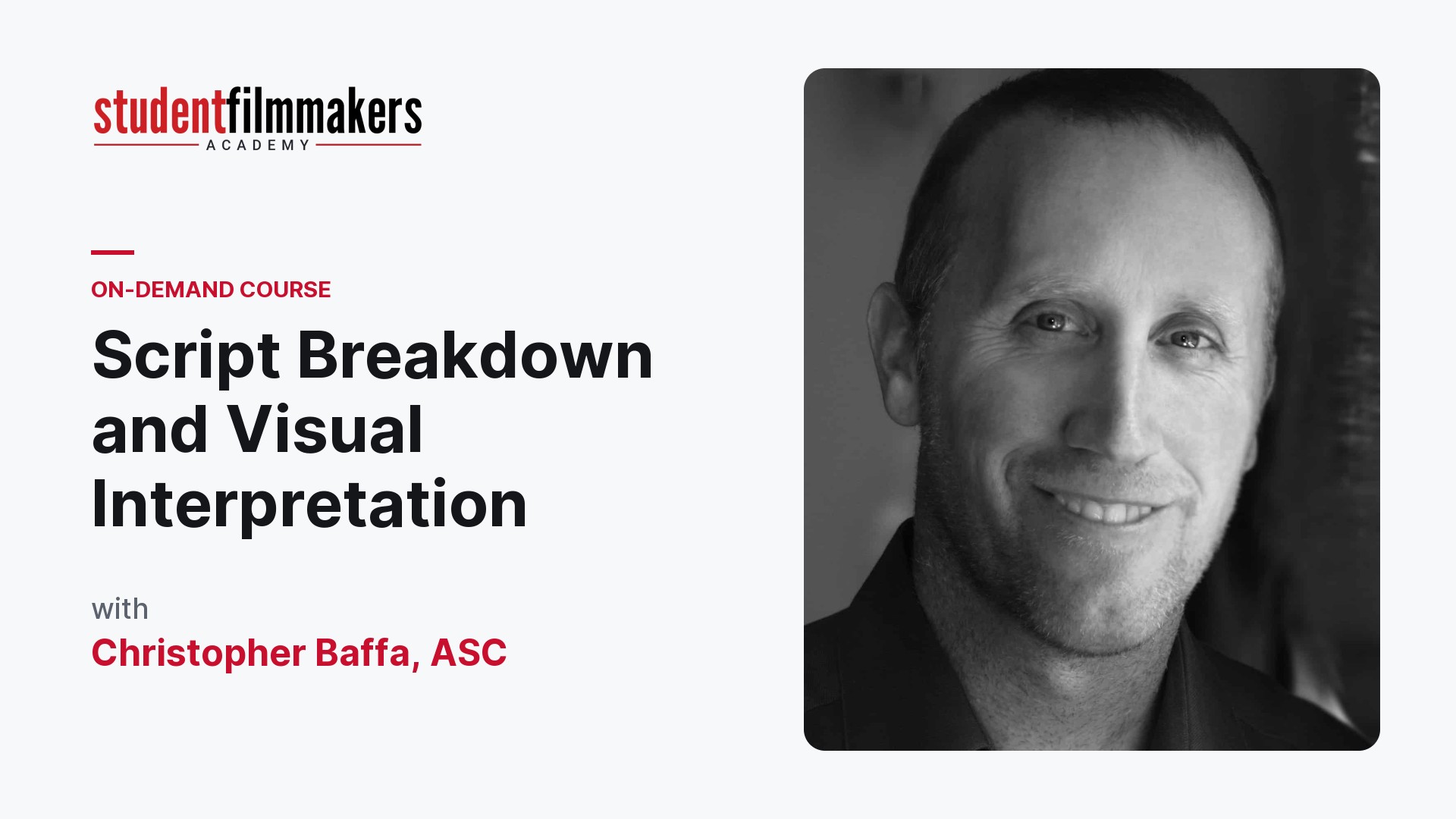
Christopher Baffa, ASC, who shot the pilots of Nip/Tuck, Glee and American Horror Story for Ryan Murphy, starts every job the same way: he reads the script until he knows how each character changes. Then he plans light, color, lenses and framing so the pictures change with them. He walked StudentFilmmakers members through that process step by step, using a made-up detective story, The Last Emperor and JFK.
What does a cinematographer look for in a script?
Baffa calls the script “really a blueprint. It’s the map of the journey.” He keeps to the three-act feature structure for teaching, since TV act breaks were built around commercials and add cold opens and tags.
On a first read he lets the story wash over him and only asks what kind of film it is: comedy, drama, romance. After that he hunts for two arcs. The story arc is the plot in order. The character arc is the inner change, and that is where his eye goes, because the emotions come from the people. His list of questions for the main character runs long:
- Do they transform, for better or worse, and does it stick?
- Do they return to who they were, or end up somewhere new?
- Is the face they show different from who they really are?
- Are they lying, perhaps to themselves? Manipulating, or being manipulated?
- What is their relationship to the world around them?
Once he has answers, he asks the question the whole class hangs on:
“In what manner, through the application of light, color, lenses, and composition, can these emotional elements be expressed, interpreted, reinforced, or perhaps even subverted photographically?”
How do you turn a story arc into a visual arc?
His examples were simple. Two people who are deeply linked might get tight overs, one face nearly pushing into the other’s frame. A character who isn’t connected gets a clean single. Long lenses and a soft background can bring a sense of the unknown. A wide lens close to the face, like Emmanuel Lubezki’s work in The Revenant, puts you right inside the emotion. A low angle makes someone powerful; a slightly high one makes them vulnerable.
Then he built a sample film he called The Detective: a murder, a detective hired, danger, his own fiancée under suspicion, the real killer caught, a wedding. Baffa started the couple in warm “home love” light with raised highlights and wider focal lengths, using a frame from his series Game of Silence regraded for the demo. A kitchen scene puts the fiancée alone in her own shot, planting the doubt. As the case grows dangerous the warmth drains away: cooler blues, fluorescent greens, near black and white, sickly yellows, neon reds. The ending returns to the warm start.
He stressed that the direction is up to you. You could just as easily start cold and warm up. What matters is that the visual arc tracks the story arc and the character arc.
How did Storaro color-code The Last Emperor?
Baffa calls the Bernardo Bertolucci film, shot by Vittorio Storaro, one of the finest script breakdowns ever put on screen. Storaro gave each stage of Puyi’s life its own color:
| Stage of Puyi’s life | What Baffa points out |
|---|---|
| War criminal, about to be arrested | Muted gray-green, and the walls are green too |
| Suicide attempt | The red of the blood carries us into warm memories of childhood |
| Young emperor at full power | Yellow |
| Learning | Green, from vivid trees behind him, not green light |
| Emperor in name only | Blues, with the light turning harder |
| Prison | Grays, desaturated |
| Old man back at the Forbidden City | Warmth again |
Two lessons came out of it. Color often lives in the art department, so if a wall is getting painted two colors, a DP can ask for one of them to be green. And the light can change in quality, not just in color.
What did JFK do with black and white?
His second model was Oliver Stone and Robert Richardson, ASC on JFK. Jim Garrison’s home and office stay muted and naturalistic, nearly black and white in the restaurant where he hears the news. Richardson’s “hot table” lighting turns every desk into an interrogation room, with the investigation literally reaching for the light. The Zapruder 8mm film is pushed in until the grain makes it dreamlike.
Black and white marks a version of events: a witness on the stairs, Donald Sutherland’s officer, Gary Oldman’s Oswald firing. Baffa noted that nearly all of the Oswald footage was black and white, so the editor could drop it anywhere and it still made sense. A clear rule protects you in the cut.
When should the director come in?
Soon. Baffa reads the script several times and starts marking where each phase begins around the third or fourth read, but he brings the director in early because both of them are doing the same work. The director may want the color to drain away, the JFK way, where he had pictured it getting louder. He guards against early ideas:
“I usually try not to let myself get too deep because the more I fall in love with an idea or I really see something and become married to it, the harder it is to shake out of that.”
He marks up scripts in the Scriptation app now, with each character’s dialogue in its own pen color, the way he once used highlighters. He reads screen directions even when he sets them aside, because they show what the writer saw. When something is unclear he calls the writer. He writes short stories himself and never wants a writer to watch the film and see their idea erased.
Should the look be built on set or in the grade?
He does as much as he can on set, then adjusts with the gaffer or the DIT if a color is fighting the scene. Post gives you room to tweak, not to reverse:
“If you shot something in a lot of red light, you’re a little bit stuck. You can drain a little bit of it, but you’re never going to get rid of the red. You can’t make it blue.”
Editing is the other risk. A great editor may open on scene 54 and jump around in time, which can break a look planned in script order. Color is easier to rebalance later than lenses or film treatment, which is one reason he likes it. If the cutting will speed up as the danger grows, he may ease off the image changes so the two don’t compete. He also calls composers early. If one describes a score with heavy African percussion, that can steer his color choices.
How do you keep every department on the same page?
Baffa writes a look document for the department heads as early as he can, knowing it may change. He once watched another cinematographer object on set when an actor arrived in a yellow shirt, because the color plan said otherwise. Nobody had told wardrobe. The DP ended up apologizing, and Baffa took the lesson.
The opposite happened on Dominion, which he shot in South Africa. A young concept artist painted key scenes, and Baffa’s crew matched them, down to a small yellow highlight. When the artist saw his painting taped by the monitor next to the real set, he cried. As Baffa put it: “Let’s not have it look kind of like that. Let’s have it look like that.”
How far should the look move?
He sets limits so no scene feels like it belongs to another film, unless the story is about the world turning upside down. However many stops the journey makes, “you want it to ultimately feel like one life, one story, one journey, one arc.”
A breakdown, in Baffa’s order
- Read once for the story and the genre. No notes.
- Find the story arc and every character arc. Ask what changes and why.
- Choose your tools: light, color, lenses, framing, angle.
- Bring in the director before you fall for an idea.
- On the third or fourth read, mark where each phase starts and ends.
- Share a look document with design, wardrobe, the editor and the composer.
For more on the prep side of the job, see why breaking down a script is essential for a DP, how concept drawings can sharpen a story and how to use color in filmmaking.
In the full class, Baffa also answers questions on TV act structure, look bibles, and what American and European films do differently.