By John Hart
Drawing can be learned. Storyboard artist John Hart explains how concept drawings illuminate and intensify a script’s narrative before you shoot.
No, drawing is not easy, but it can be learned. Albeit, easy for some, difficult for others. I started drawing in the third grade, even drawing three-dimensional objects. My talent must have come from some ancestor, as no one else in the family has that particular drawing skill. Being aware of this lack of innate drawing skills in most students has prompted me to be happily involved in a 20-year career of teaching new artists.
The Pixar Proposal
The leading animation studios, Pixar/Disney and Dreamworks have recently decided to return to the traditional hand drawn style of conceiving and realizing storyboards as an important tool in pre-production for their animated films.
John Lasseter, founder and president of Pixar, is seen recently in his studio with hand drawn storyboards and concept sketches covering the large wall behind him.
Even Peter Jackson, innovative founder of his own New Zealand digital animation studio, which he used to effectively in his Lord of the Rings trilogy, insists that his artists begin with hand drawn concepts and thumbnail sketches to create new characters and production designs.
His CGI talent would then take over visualizing later, but as I keep saying, ‘the brain to the hand,’ is the surest and quickest way to one’s drawing board.
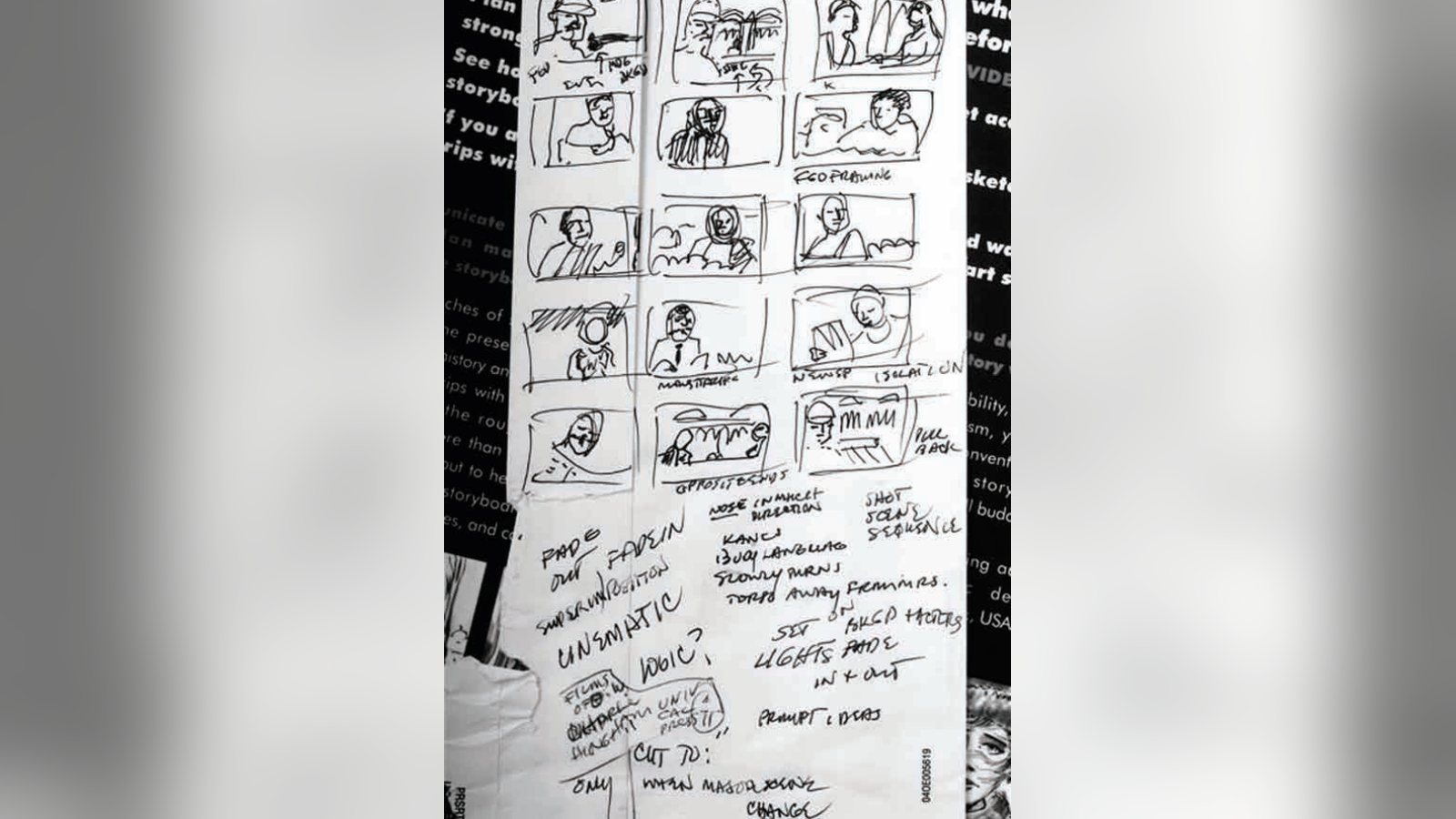
Tip #1: Simple ‘thumbnail sketches’ can be done anywhere. “It’s the concept that counts.” (In Illustration 1, simple thumbnail sketches are done on an envelope.) So Who Needs Software?
Why invest in expensive software when one has the where-with-all to draw on your own, sketching ideas right from one’s own special imagination, an imagination when coupled with its ‘speed of light’ transmission from your brain’s grey matter through the handheld pencil directly onto the storyboard?
Learn from the ‘Biggies’:
Utilize this Vital Pre-Production Tool: Storyboards
All the great artists worked that way – Da Vinci, Michaelangelo, Raphael, right up the present with genius directors like Eisenstein, Hitchcock, Hawks, Spielberg, and Scorcese. All have made concept sketches of the images they want to realize, whether on canvas or on film. You can start doing the same type of ‘concept’ or ‘thumbnail sketches’ by buying a sketchbook and starting, even if it’s only a scribble.
Tip #2: Keep a sketch book, and sketch ideas in your sketchbook. Start with simple forms – action is the way to go. (See Illustration 2.)
The Exterior World of Three Dimensions: Recreating it on Paper, Film, and Video
Once the rudiments of design, proportion, perspective, light and shade are mastered, along with drawing the human figure in motion (even starting with stick figures), executing fully dimensional ‘actors in motion,’ can help enormously to visualize the script at hand.
Tip #3: You can start with stick figures, and then, add on more ‘body.’ Then, add light and shade. Note action arrows – very handy for storyboards. (Illustration 3 shows starting with stick figures and ‘fleshing them out.’)
Paying Attention to Pre-Viz
‘Pre-viz’ is the new catch word for the preparations that go into the pre-production process. It is the ideal field of study or expertise for the pre-production team. Being in a pre-production meeting where all concerned are involved in and aware of the pre-viz process makes for a more relaxed atmosphere and a mutual interchange of ideas that also speeds things along, and does what the storyboard does so well – saves time and money.
Tip #4: Practice figure movement. Start with stick figures. Principle of thirds. (Illustration 4 shows ‘stick figure’ drawn towards ‘full figure.’ Principle of thirds for true proportion.)
Tip #5: Be aware of thirds for proportions. Sketch your own hand! Practice everyday, and you’ll get better at drawing every day. (Illustration 5: Sketching the face and hand; the principle of thirds in the human face.) The following are photo illustrations are frames taken from my video documentary, South Street Seaport.
Illustration 6:
Principle of Thirds.
Note the cameraman in foreground, crowd in middleground, and pier in background. The crowd takes up the bottom two-thirds of the frame. The pier and sky take up the top third of the frame.
Illustration 7: Photo for storyboard. Note the cameraman in foreground, the dancers occupying the middleground, and the sign and building in the background space.
Illustration 8: Be aware of one-point perspective. Note that the railing in the left of frame to the right of the figure (placed in the left third of the frame) recedes to a vanishing point on the distant shore just above the railing.
I believe that the new filmmaker will need to follow these professional compositional devices that apply to any frame of film, these historic artistic principles for correct placement of figures. Objects or structures drawn in the storyboard frame need to be adhered to, or that Hollywood professional polish will simply not be there. Great design is about developing a sense of proportion, which will impart an image created by an artist.
In Illustration 9, not only do we have the frame’s division into ‘receding’ planes – foreground, middleground, and background (the red figure, the sail boat, and the buildings in the background) – but the red figure occupies the left third of the designed frame.
The hull of the ship splits the frame into the bottom third (the water) and top two-thirds (the sails and background).
Tip #6: Basic light and shade sketching on graph paper brings out the 3D quality in any object. Notice the light source in Illustration 10. Concept: Light causes shadows.
The storyboard then consists of making a series of sketches where every basic scene and every camera set up within the scene is illustrated. It is a visual record of the film’s appearance before shooting begins.
The storyboard artist is an integral part of the visualization process, often coming up with concept drawings that illuminate and augment the script narrative.
So, do carry a sketchbook at all times and quickly draw very basic sketches of the people, places, and objects that you encounter in everyday life. When you render these sketches, keep in mind proportion – of the body, of the object. Even if the sketches are not perfect, it is practice that helps you develop you own drawing style.
If you are just starting a filmmaking career, you have to be familiar with utilizing this vital pre-production tool – storyboards.
By planning effectively, communicating clearly and accurately, while submitting strong visually exciting storyboards, your director will be eternally grateful.
Remember, you don’t have to be a Rembrandt in order to tell a story with pictures. Whatever your artistic ability, from stick figure sketches to polished realism, you can use basic drawing techniques and conventions to plan and communicate your film’s story with effective storyboards – a vital skill for all budding filmmakers.
Good luck!
Related filmmaking guides
Keep learning filmmaking
Want more lessons like this? Join StudentFilmmakers free for live webinars with working pros, and stream on-demand filmmaking classes in cinematography, directing, screenwriting, sound and post.