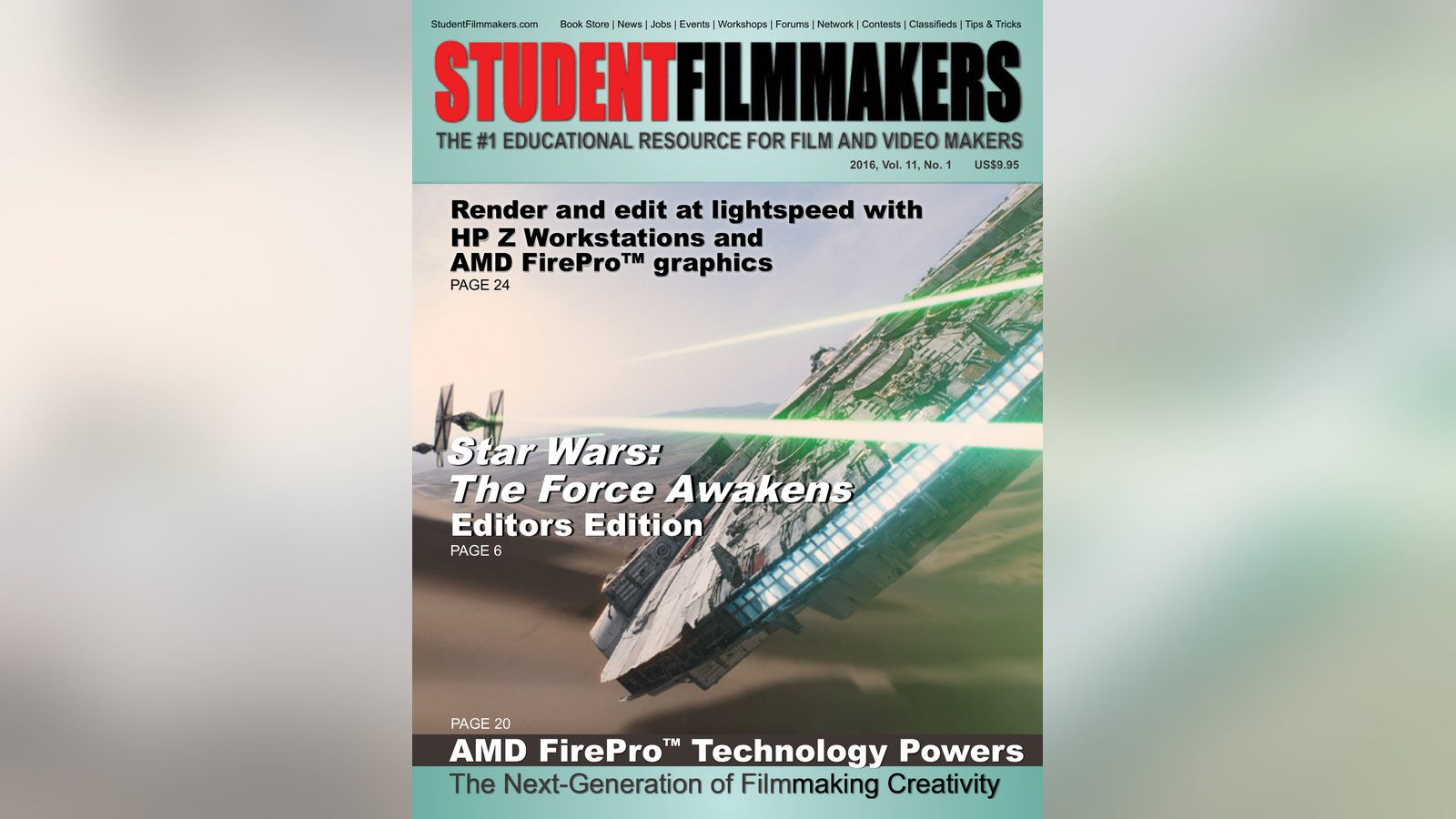
The National Centre for Computer Animation at Bournemouth University explains its art-meets-science philosophy, how students learn tools and its alumni.
The fundamental philosophy of The National Centre for Computer Animation at Bournemouth University is that the field of computer animation represents the marriage between art and science and that practitioners in this innovative and exciting field need a good understanding of both the creative and the technical processes involved. Since its establishment in 1989, the school has pioneered both undergraduate and postgraduate courses in computer visualisation and animation, conducted research of international significance and pioneered the production of computer animated simulation rides in the UK. Students and staff have had their work screened internationally and have gained numerous prizes. StudentFilmmakers Magazine talks with Sofronis Efstathiou, Postgraduate Framework Leader at Bournemouth University and BFX Competition & Festival Director.
StudentFilmmakers Magazine:
Tell us a little bit about yourself and your background.
Sofronis Efstathiou: My background was in product design, which quickly moved towards Computer Animation around 1995. As a teenager I loved playing computer games and making or watching films. In 2000 I studied for my Masters at the National Centre for Computer Animation here in Bournemouth University, which put me on the right track to working in the industry. I worked in Sydney for a VFX & Animation studio called Animal Logic, and on returning back to the UK worked with Microsoft’s Lionhead games studio whilst teaching at the NCCA on the Masters courses. I’m now a Principal Lecturer at Bournemouth University, continuing to teach at the NCCA whilst also running an International VFX, Animation and Computer Games festival called BFX.
SFM: What is your teaching philosophy? What is important?
Sofronis Efstathiou: Our approach has always been to blend the technical side of the subject with the arts. We have a strong philosophy that underpins our delivery and course designs – the marriage of art and science and sciences in the service of the arts. This means that our students are uniquely placed to be artists with very strong technical skills. I tend to teach the technical side of the subject, so in the classroom I want to give the students a good understanding of what is happening in the background of the 3D or 2D application we are using, how everything is interconnected and how to be a strong technical artist or technical director within a production pipeline. We bring a lot of our industry experience or contacts into the classroom, which really helps keep the teaching relevant and progressive. We are never too proud to ask a question or look for help. It keeps us on our toes.
SFM: What would you say sets your school apart from other schools?
Sofronis Efstathiou: The NCCA has been here for over 26 years now, our graduates are littered all over the creative industries – many own their own studios, a lot of them are supervisors or senior artists within the companies – we can rely on many of them to advise us on our course, current practices within the industry and ask them to give talks and set briefs to the students. Currently students have been given briefs from studios that have created films, TV and games projects such as Gravity, Inception, Interstellar, Guardians of the Galaxy, Elite: Dangerous, Tree Fu Tom, Avengers, The Jungle Book, Kung Fu Panda, The Chemical Brother, Batman and Suicide Squad to name a few. It’s these industry contacts and their willingness to work with us and our students that keep us apart from other schools. As mentioned earlier, we create a unique graduate – an artist who is taught math and how to program or script. All of this is underpinned with units that reinforce art history, cinematography and the moving image.
SFM: Could you share with us some of the success stories of students and alumni?
Sofronis Efstathiou: Sure – our students have pretty much worked on every Oscar or BAFTA nominated film from the past 10 years that has required animation of VFX! Graduates such as Andy Lockley have won Oscars for Inception and Interstellar, and this year Mark Ardington has been nominated for his work on Ex-Machina. Paul Kavanagh recently won a VES for his work on Star Wars: The Force Awakens. Our graduates are seen all over the world working on some of the best projects that films or games has to offer, whether that’s Star Wars, The Lego Movie or the new Marvel film.
SFM: What are your thoughts on technology and how technology impacts education and students?
Sofronis Efstathiou: Technology shouldn’t be a hindrance, students are expected to learn the tools as quickly as possible and then start to make things! Some students struggle with the tools initially – working in 3D can be big conceptual leap for many. Therefore, we want the overall experience to be engaging and stable. When technology gets in the way, students will start to make compromises that are not always in the best interest of their project. Staff is also trying to deliver processes and features that are at the cutting edge of the industry – therefore they need stable platforms that are powerful enough to run the latest software.
SFM: What workstations do your students use and what applications are they using?
Sofronis Efstathiou: We currently use HP Z440 workstations. It’s a great price point for us, offering the right types of features and power over a three year cycle. We need something that is reliable and expandable – and doesn’t mind being hit by a different project every day. At Bournemouth University we use industry standard software across the courses – for Animation and VFX our main applications are Maya, Houdini, zBrush, Mari, Nuke, Katana, Adobe Creative Suite, Motionbuilder, Unreal Game Engine, Realflow, V-Ray, Renderman and Maxwell (as well as host of plugins!).
We also run both Windows and Linux OS’s across the Undergraduate and Postgraduate.
SFM: Can you tell us more about your computer technology selection process?
Sofronis Efstathiou: Sure – we have a 3 year cycle for workstations on the courses, so we need to pick a hardware solution which is going to be stable and reliable over that period. The breadth of work our students undertake is huge – from animation, simulation, rendering to tool building. On top of the student work our researchers are using the same workstations to conduct their research. As mentioned earlier, we needed to balance great performance with affordability. Therefore we choose the HP Z440 with an AMD FirePro™ graphics card. The hardware was certified to work with our software package, whilst we were offered excellent customer service with a point of contact as we started to build our computer image with the relevant software and drivers.
SFM: How many workstations did you install for the students?
Sofronis Efstathiou: This year it was around 80 workstations for the NCCA, however we have over 300 workstations for staff and students in the building. I believe another faculty has the same machines – but I’m not sure how many of them were bought this year.
SFM: How does HP and AMD technology improve workflow for student projects and learning?
Sofronis Efstathiou: Well, they provide the stability and performance we mentioned earlier. It’s important the students don’t feel like they are fighting with their tools. We want to create a positive environment where the computer becomes an extension of their arm and their toolset. Each year student projects become more ambitious and complex, that’s the nature of our industry. Whether working in 2D, 3D or real-time – we need a platform that allows our students to work at the very forefront of what is being produced today. We need loads of memory (minimium 32GB), fast SSD drives, excellent CPU’s and a certified GPU capable of displaying large datasets on screen.
SFM: Why did your school Sofronis Efstathiou: We have started to use the FirePro™ GPU’s because of the types of works our students are undertaking – the complexity of our projects are becoming exponential – students are working with complex detailed geometry and simulations than ever before; whilst tackling films and games assignments across multiple applications. The production pipelines require solid integration across software, hardware and cohorts, 2D and 3D – we needed something that could provide a reliable and seamless experience; with technical support when required.
with new filmmakers and
SFM: If you could share your insights or a piece of advice animators around the world, what would it be?
Sofronis Efstathiou: Hmmm – it all depends on what they are trying to achieve. The starting point with our students is to ask them to research and plan appropriately, make sure they nail as much of the shoot or narrative down as early as possible. Addressing shortfalls because you failed to plan is expensive to fix later. And normally, especially if a student project – you may never be able to go back and fix it. Time won’t allow it. Oh – and keep it simple. I can’t tell you how many times I say that in a year.
Keep learning filmmaking
Want more lessons like this? Join StudentFilmmakers free for live webinars with working pros, and stream on-demand filmmaking classes in cinematography, directing, screenwriting, sound and post.