By Bryant Falk
When recording location sound, four tracks give you room to capture what you need. Bryant Falk explains how to plan mics and tracks for clean film audio.
When recording audio on location, never underestimate the power of four tracks to capture what you need. Eight tracks, although flexible, tend to be cost prohibitive and require quite a bit more hardware.
Four tracks are historically known as the original track count for multi-track recording. With Les Paul and Ampex being known as the creators of the modern four track recorder, this quickly became the de-facto standard for producing albums. This count number also allows much flexibility for sound on location as well. Of course, the advantage today is that four tracks can be captured on a recorder the size of a small game console. Roland recently released their new affordable Edirol R-4 Pro. This is a four track hard disk recorder complete with 4 XLR phantom mic inputs. A popular four track recorder like the TEAC 2340 from the 70’s was as large as a microwave oven!
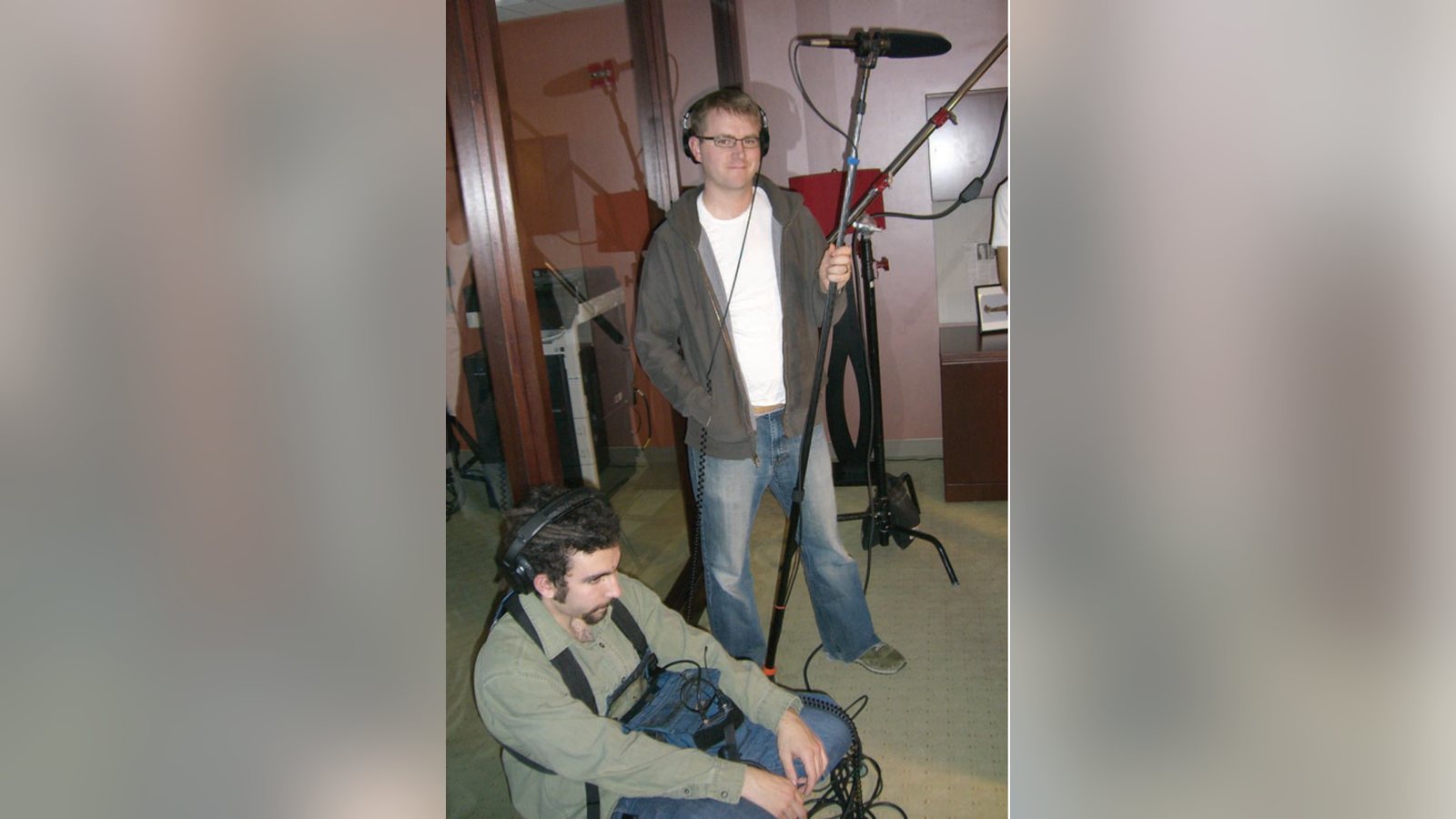
Think of the many scenes you’ve watched in movies or on television. Most of the time, they involve no more than two people. One talks, then the other. Two lav mics and a boom would be perfect to capture the audio of that scene, (three tracks). Or maybe it’s two couples, and that’s either four lav mics, or two lavs, and two boom mics, (lav’s for the principle dialogue). Many combinations can be achieved with four tracks that allow for much more flexibility in the editing suite.
Now submixing is also another option not to be ignored on location. For example, in our “two couples” scene, we could submix our four lav mics to two tracks, and then, use two boom mics for each couple. This makes good use of our four independent audio tracks.
Never Underestimate the Power of 4-Tracks to Capture What You Need
While working on a new spy comedy short called, Spytime, I often found occasions where a four track recorder would have been the perfect item to capture audio. Scenes involving my lead, the arch-villain, and damsel in distress could have been easily recorded on independent tracks keeping as much flexibility as possible.
An issue often overlooked when working on audio is “comb filtering.” This is a phenomenon where two mics recording the same audio but at different distances from the source can actually cancel out the source audio creating a think sounding track. Keeping each mic on its own track allows you to easily slide one of the mic tracks (in post) so the filtering is accounted for. This is an oversimplification, but needless to say, having separate tracks allows you the ability to easily remedy this problem.
So the next time you’re working on a project, think about how four tracks can capture your project. It’s just the right number to achieve much while keeping a compact and cost effective audio rig.
Bryant Falk has been a producer and engineer for over 12 years working with such clients as The Ricki Lake Show, Coca-Cola, Sports Illustrated, Valley National Bank, and MTV’s The Shop. His company Abacus Audio (www.abacusaudio.com) handles many aspects of the audio production field from creative and production to mixing and final output.
Related filmmaking guides
- The power of sound in film
- Understanding microphone frequency response
- ADR: automated dialogue replacement explained
Keep learning filmmaking
Want more lessons like this? Join StudentFilmmakers free for live webinars with working pros, and stream on-demand filmmaking classes in cinematography, directing, screenwriting, sound and post.